
Level:
Correct: 0
Incorrect: 0
Marks: 0/0
Exam Practice
Course:
Topics:
Avg
score:
–
Topics
done:
0/25

Preparing soluble salts

Practise 15 exam-style questions on Preparing soluble salts for Edexcel GCSE Combined Science (Foundation Chemistry Paper 1). Write your answer as you would in the exam and get it marked in seconds against the mark scheme, point by point, with the Study Helper on hand if you get stuck.

  • 15 questions
  • 1–6 marks each
  • Instant marking
  • No sign-up needed
15 questions, marked as you go

Sample questions with model answers

Here are 4 of the questions in this topic, each with a model answer, an explanation of why it earns the marks and the mark scheme an examiner would use.

Question 1

1 mark

In the core practical to make copper sulfate crystals, the filtered copper sulfate solution is heated in an evaporating basin.

What is the purpose of this step?

Choose your answer.

  • A to evaporate some of the water so that crystals form when the solution cools
  • B to make more of the copper oxide react with the acid
  • C to remove the excess sulfuric acid
  • D to change the blue solution into a white powder

Model answer

A to evaporate some of the water so that crystals form when the solution cools

Explanation

After filtering, the solution contains only copper sulfate and water. Evaporating some of the water in an evaporating basin concentrates the solution, so blue crystals form as it cools; these are then dried, for example on a watch glass. Heating until all the water has gone is a common error.

Mark scheme
  1. 1 mark

    A / to evaporate some of the water so that crystals form when the solution cools

    The only correct answer is A: heating removes some of the water, making the solution more concentrated so that crystals of hydrated copper sulfate form as it cools. B is not correct because the copper oxide has already reacted and the excess has been filtered off; C is not correct because there is no excess acid: copper oxide was added in excess so that all the acid reacted; D is not correct because a white powder (anhydrous copper sulfate) forms only if the crystals are heated too strongly, which the method avoids. Accept the letter or the option. If more than one option is given, do not award the mark.
Question 2

2 marks

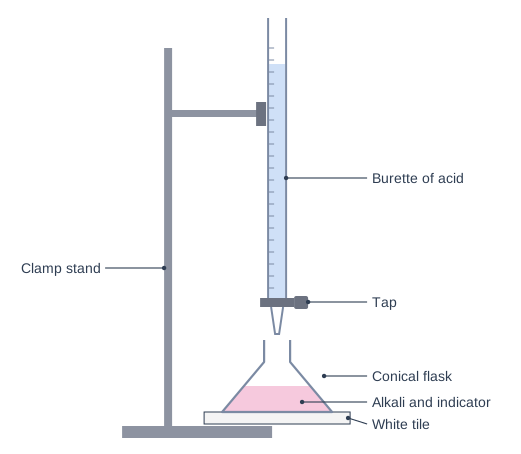
The diagram shows the apparatus Femi uses in a titration to find the volume of dilute sulfuric acid needed to neutralise 25.0 cm³ of sodium hydroxide solution.

Give one reason why Femi places the conical flask on a white tile. Give one reason why he uses a pipette, rather than a measuring cylinder, to measure the sodium hydroxide solution into the flask.

Diagram of a titration set-up. "Burette of acid" labels the long, thin graduated glass tube held in the clamp; "Tap" labels the tap at the bottom of the long graduated tube; "Conical flask" labels the cone-shaped flask underneath; "Alkali and indicator" labels the solution inside the flask; "White tile" labels the white square the flask stands on; "Clamp stand" labels the vertical stand on the left.

Model answer

The white tile makes the colour change of the indicator easier to see. A pipette measures exactly 25.0 cm³ much more accurately than a measuring cylinder.

Explanation

In a titration the volume of alkali must be known accurately, so a pipette (with a pipette filler) is used, and the acid is added from a burette. The white tile is a simple way of making the end point easier to spot. Answers about protecting the bench miss the purpose.

Mark scheme
  1. 1 mark

    (white tile:) so the colour change of the indicator is easier to see

    accept so the end point can be seen clearly / to see when the colour changes. Ignore 'to protect the bench' or 'so the flask does not slip'.

  2. 1 mark

    (pipette:) a pipette measures the volume (25.0 cm³) more accurately

    accept more precisely / gives an exact volume / a measuring cylinder is less accurate (ORA). Ignore 'it is easier to use'.

Question 3

2 marks

Ibrahim puts potassium hydroxide solution and a few drops of methyl orange in a conical flask. He adds dilute nitric acid from a burette, a little at a time, and swirls the flask after each addition.

Explain why he swirls the flask.

Model answer

Swirling mixes the acid that has just been added with all of the alkali in the flask. The acid then reacts throughout the solution, so the indicator changes colour only when all of the alkali has been neutralised, and he sees the true end point.

Explanation

Acid dropping into an unmixed solution can change the indicator colour in one place before the rest of the alkali has reacted, or the end point can be missed. Swirling the flask (rather than stirring with a rod, which could remove liquid) keeps the mixture even. 'To make it faster' does not explain why mixing matters for the end point.

Mark scheme
  1. 1 mark

    to mix the acid with the (alkali / solution in the flask)

    accept to mix the solutions / reactants. Ignore 'to dissolve it'.

  2. 1 mark

    so the acid reacts with the alkali throughout the flask before more is added / so the colour change shows the true end point (and is not seen too early or too late)

    accept so the indicator colour is the same throughout the solution / so he can tell exactly when the alkali has all reacted. accept so the reaction is complete before he reads the colour. Ignore 'to speed up the reaction' on its own.

Question 4

4 marks

Kai wrote this method for making copper sulfate crystals from copper oxide.

Step 1 Heat 50 cm³ of dilute sulfuric acid in a beaker directly over a Bunsen burner until it boils.
Step 2 Add one spatula of copper oxide powder and stir.
Step 3 Filter the mixture into an evaporating basin.
Step 4 Heat the solution to evaporate some of the water, then leave it to cool so that crystals form.

Identify two problems with Kai's method. For each problem, describe how the method should be improved.

Model answer

Problem 1: in step 1 Kai heats the acid directly until it boils, so the hot acid could spit out of the beaker. Improvement: warm the acid gently by standing the beaker in a water bath, so it does not boil.
Problem 2: in step 2 one spatula of copper oxide may not be enough to react with all of the acid. Improvement: add copper oxide a little at a time, stirring, until some black solid is left unreacted, so that all the acid has reacted.

Explanation

Compare each step with the core practical: the acid is warmed in a water bath, copper oxide is added until it is in excess, the excess is filtered off, the solution is partly evaporated and left to crystallise, and the crystals are dried on a watch glass. Each improvement should fix the problem identified, not just say 'be more careful'.

Mark scheme
  1. 1 mark

    (problem) step 1: heating the acid directly until it boils is dangerous / the hot acid may spit or boil over

    Max 2 if no improvements are described. Two problems, each with its improvement: max 4. An improvement can score without the problem being stated if it is clearly linked to the correct step. accept the acid is overheated / the acid would boil away.

  2. 1 mark

    (improvement) warm the acid gently (below boiling) by standing the beaker in a water bath

    accept use a water bath (at about 50-60 °C). Do not accept 'heat it less' on its own.

  3. 1 mark

    (problem) step 2: one spatula of copper oxide may not be enough / may not be in excess, so some acid may not react

    accept the crystals may be contaminated with acid.

  4. 1 mark

    (improvement) add copper oxide a little at a time, stirring, until some is left unreacted / until no more reacts

    accept add excess copper oxide / until black solid remains.

  5. 1 mark

    (problem) the method has no step to separate and dry the crystals / the crystals are left wet with solution

    This is an alternative third problem.

  6. 1 mark

    (improvement) separate the crystals from the remaining solution and leave them to dry on a watch glass / pat them dry with filter paper

    accept dry in a warm place. Do not accept heating the crystals strongly.

Ready to try the rest? Every answer you write is marked against the mark scheme, so you can see exactly where the marks are.

Study Helper Hints first, answers after you try

Stuck on this one? Ask for a hint and I’ll point you in the right direction, without giving the answer away. Once you’ve checked your answer, I’ll show you how the marks are awarded.