
Level:
Correct: 0
Incorrect: 0
Marks: 0/0
Exam Practice
Course:
Topics:
Avg
score:
–
Topics
done:
0/25

Relative formula mass and empirical formulae

Practise 16 exam-style questions on Relative formula mass and empirical formulae for Edexcel GCSE Combined Science (Foundation Chemistry Paper 1). Write your answer as you would in the exam and get it marked in seconds against the mark scheme, point by point, with the Study Helper on hand if you get stuck.

  • 16 questions
  • 1–6 marks each
  • Instant marking
  • No sign-up needed
16 questions, marked as you go

Sample questions with model answers

Here are 4 of the questions in this topic, each with a model answer, an explanation of why it earns the marks and the mark scheme an examiner would use.

Question 1

1 mark

Which statement describes the empirical formula of a compound?

Choose your answer.

  • A the actual number of atoms of each element in one molecule
  • B the simplest whole number ratio of atoms of each element in the compound
  • C the ratio of the masses of the elements in the compound
  • D the total number of atoms in one molecule of the compound

Model answer

B

Explanation

The empirical formula gives the simplest whole number ratio of the atoms of each element. For example, ethane has the molecular formula C₂H₆ but the empirical formula CH₃. The formula you calculate from the masses of elements that react is always an empirical formula.

Mark scheme
  1. 1 mark

    B / the simplest whole number ratio of atoms of each element in the compound

    The only correct answer is B. A is not correct because the actual number of atoms of each element in one molecule is the molecular formula; C is not correct because the empirical formula is a ratio of the numbers of atoms, not of their masses (atoms of different elements have different masses); D is not correct because the total number of atoms does not show which elements are present or their ratio. Accept the letter or the option. If more than one option is given, do not award the mark.
Question 2

2 marks

Ammonium nitrate, NH₄NO₃, is used as a fertiliser because it contains a high percentage of nitrogen.

Calculate the percentage by mass of nitrogen in ammonium nitrate.

(relative atomic masses: H = 1, N = 14, O = 16)

Model answer

Relative formula mass of NH₄NO₃ = 14 + (4 × 1) + 14 + (3 × 16) = 80
Mass of nitrogen in the formula = 2 × 14 = 28
Percentage of nitrogen = 28 ÷ 80 × 100 = 35%

Explanation

First work out the relative formula mass, then divide the total mass of nitrogen in the formula by it and multiply by 100. The formula contains two nitrogen atoms (one in NH₄ and one in NO₃), so use 2 × 14 = 28, not 14. Forgetting to multiply by 100 gives 0.35, which is a fraction, not a percentage.

Mark scheme
  1. 1 mark

    (relative formula mass of NH₄NO₃ =) 14 + (4 × 1) + 14 + (3 × 16) = 80 / (2 × 14) ÷ 80 (× 100) / 28 ÷ 80 (× 100); or a correct final answer of 35 % with no working

    An answer of 35 % with no working scores 2 marks. An answer of 0.35 (not multiplied by 100) scores 1 mark. 14 ÷ 80 × 100 = 17.5 % (only one nitrogen atom counted) scores 1 mark only if the relative formula mass 80 is shown; 17.5 % with no working scores 0. 80 ÷ 28 × 100 = 286 (fraction upside down) scores 1 mark only if the relative formula mass 80 is shown. Allow ECF for MP2 from an incorrect relative formula mass if the working is shown (28 ÷ their value × 100, correctly evaluated).

  2. 1 mark

    35 (%)

    Allow 35.0. Ignore units.

Question 3

2 marks

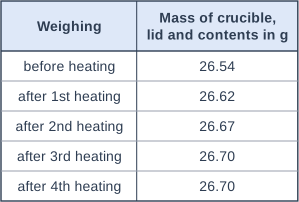
A student heated magnesium ribbon in a crucible to make magnesium oxide. After each heating, she let the crucible cool and then weighed it.

The table shows her results.

Explain why the student did not need to heat the crucible again after the 4th heating.

Table with columns "Weighing", "Mass of crucible, lid and contents in g". Weighing: before heating; Mass of crucible, lid and contents in g: 26.54 | Weighing: after 1st heating; Mass of crucible, lid and contents in g: 26.62 | Weighing: after 2nd heating; Mass of crucible, lid and contents in g: 26.67 | Weighing: after 3rd heating; Mass of crucible, lid and contents in g: 26.70 | Weighing: after 4th heating; Mass of crucible, lid and contents in g: 26.70.

Model answer

The mass after the 4th heating (26.70 g) was the same as after the 3rd heating, so the mass had become constant. This shows that all of the magnesium had reacted with oxygen, so heating it again would not change the mass.

Explanation

The mass increases with each heating because more magnesium combines with oxygen from the air. When two weighings in a row give the same mass, no more oxygen is combining, so all the magnesium has reacted. This is called heating to constant mass.

Mark scheme
  1. 1 mark

    the mass did not change between the 3rd and 4th heatings / the mass stayed at 26.70 g / the mass had become constant

    An explanation linking two points. Allow 'the mass stopped increasing' / 'the last two masses are the same' / 'the mass stayed the same'. Do not accept 'the mass stopped decreasing' (the mass increased each time).

  2. 1 mark

    (so) all of the magnesium had reacted / no more oxygen could combine with the magnesium / the reaction was complete

    Allow 'all the magnesium had turned into magnesium oxide'. Do not accept 'all the oxygen had been used up' or 'no more magnesium oxide could escape'.

Question 4

4 marks

Magnetite is a black ore of iron. A scientist heated 2.32 g of pure iron oxide from magnetite in a stream of carbon monoxide gas until all of the oxygen had been removed. The mass of iron left was 1.68 g.

Calculate the empirical formula of this iron oxide.

(relative atomic masses: O = 16, Fe = 56)

You must show your working.

Model answer

Mass of oxygen = 2.32 − 1.68 = 0.64 g
Fe: 1.68 ÷ 56 = 0.03
O: 0.64 ÷ 16 = 0.04
Ratio Fe : O = 0.03 : 0.04 = 3 : 4
Empirical formula = Fe₃O₄

Explanation

First find the mass of oxygen that was removed: the mass of the iron oxide minus the mass of iron left (show every step: the formula on its own scores no marks). Then divide each mass by its relative atomic mass and find the simplest whole number ratio. 0.03 : 0.04 is 3 : 4; if you divide by the smaller number you get 1 : 1.33, which must be multiplied by 3, never rounded to 1 : 1. Do not write Fe₂O₃ from memory: the formula must come from the data.

Mark scheme
  1. 1 mark

    (mass of oxygen =) 2.32 − 1.68 = 0.64 (g)

    The question says 'You must show your working', so marks are only awarded for working that uses the masses from the question: an answer of Fe₃O₄ with no working (answer only) scores 0 marks. Allow ECF throughout. Using 2.32 g as the mass of oxygen does not score MP1; MP2 can then be scored for Fe 1.68 ÷ 56 = 0.03 with O 2.32 ÷ 16 = 0.145 (ECF), but MP3 and MP4 only for a correct whole number ratio and formula from these values.

  2. 1 mark

    Fe 1.68 ÷ 56 = 0.03(0) and O 0.64 ÷ 16 = 0.04(0)

    Ignore any label given to these values. Inverted division (56 ÷ 1.68 and 16 ÷ 0.64) does not score MP2. Allow ECF from an incorrect mass of oxygen.

  3. 1 mark

    ratio Fe : O = 3 : 4

    Allow 0.03 : 0.04 = 3 : 4 directly, or 1 : 1.33 multiplied by 3. A ratio of 1 : 1.33 that is not changed into whole numbers does not score MP3. Rounding 1.33 to 1 (giving FeO), or writing Fe₂O₃ from memory, does not score MP3 or MP4.

  4. 1 mark

    Fe₃O₄

    Award this mark only if working from the masses is shown: Fe₃O₄ on its own scores 0. Accept Fe3O4 / O₄Fe₃. Allow ECF from the student's whole number ratio. Do not accept Fe₆O₈ (it can be simplified, so it is not the empirical formula).

Ready to try the rest? Every answer you write is marked against the mark scheme, so you can see exactly where the marks are.

Study Helper Hints first, answers after you try

Stuck on this one? Ask for a hint and I’ll point you in the right direction, without giving the answer away. Once you’ve checked your answer, I’ll show you how the marks are awarded.