
Level:
Correct: 0
Incorrect: 0
Marks: 0/0
Exam Practice
Course:
Topics:
Avg
score:
–
Topics
done:
0/25

Extracting metals from their ores

Practise 15 exam-style questions on Extracting metals from their ores for Edexcel GCSE Combined Science (Foundation Chemistry Paper 1). Write your answer as you would in the exam and get it marked in seconds against the mark scheme, point by point, with the Study Helper on hand if you get stuck.

  • 15 questions
  • 1–6 marks each
  • Instant marking
  • No sign-up needed
15 questions, marked as you go

Sample questions with model answers

Here are 4 of the questions in this topic, each with a model answer, an explanation of why it earns the marks and the mark scheme an examiner would use.

Question 1

1 mark

Platinum is a metal used in jewellery and in catalytic converters. Platinum is found in the Earth's crust as the uncombined element.

What does this suggest about the reactivity of platinum?

Model answer

Platinum is very unreactive, so it would be near the bottom of the reactivity series, like gold.

Explanation

Unreactive metals, such as gold, are found in the Earth's crust as the uncombined elements, because they do not react with oxygen or other substances to form compounds. Platinum is found uncombined, so it must also be very unreactive. More reactive metals are only found in compounds, in ores.

Mark scheme
  1. 1 mark

    platinum is (very) unreactive / has a low reactivity / is near the bottom of the reactivity series

    accept it is less reactive than most metals / it is similar in reactivity to gold (or silver); accept it does not react (easily) with oxygen / water / other substances. Do not accept 'platinum is reactive' / 'very reactive'. Ignore references to cost, rarity or appearance.
Question 2

2 marks

Some years ago, a rock containing a low percentage of a copper compound was not called a copper ore. After the price of copper rose, the same rock was called a copper ore.

Explain why.

Model answer

An ore is a rock that contains enough of a metal or metal compound to make it worth extracting the metal. When copper was cheap, the copper from the rock would have been worth less than the cost of extracting it. After the price rose, the copper became worth more than the cost of extraction, so extracting it made a profit and the rock became an ore.

Explanation

Whether a rock is called an ore depends on economics as well as chemistry: it must be profitable to extract the metal. The amount of copper in the rock did not change; what changed was the value of the copper compared with the cost of mining and extracting it. A common error is to say the rock 'contains more copper'.

Mark scheme
  1. 1 mark

    an ore is a rock that contains enough metal (compound) to make extraction economic / profitable / worthwhile

    accept an ore is a rock from which a metal can be extracted at a profit. Ignore 'an ore contains copper / a metal compound' on its own (the rock always contained the copper compound).

  2. 1 mark

    at the higher price, the copper extracted is worth more than the cost of extracting it / extracting the copper now makes a profit

    accept it became worth extracting the copper (from the rock) because copper sells for more money. Do not accept 'the rock now contains more copper'.

Question 3

3 marks

According to a mining company's records, the ore from its zinc mine contained 12% zinc by mass in 1970. The ore mined there today contains 4.0% zinc by mass.

Calculate how many times more ore must be mined today than in 1970 to obtain the same mass of zinc.

Suggest one reason why it now costs more to produce each tonne of zinc from this mine.

Model answer

12 ÷ 4.0 = 3, so three times as much ore must be mined today to obtain the same mass of zinc.
It costs more because three times as much rock has to be dug up, crushed and processed for each tonne of zinc, which uses more energy and fuel and produces more waste rock.

Explanation

If the percentage of zinc in the ore is a third of what it was, three times as much ore is needed for the same mass of zinc: divide the old percentage by the new one. Dividing the other way (4.0 ÷ 12) or subtracting the percentages are common errors. Mining and processing more rock for each tonne of metal is one reason why the cost of extraction rises as the best ores are used up.

Mark scheme
  1. 1 mark

    12 ÷ 4.0 / mass of ore for 1 tonne of zinc: 1 ÷ 0.12 = 8.3 tonnes (1970) and 1 ÷ 0.040 = 25 tonnes (today); or a correct final answer of 3 (times) with no working

    An answer of 3 (times) with no working scores marking points 1 and 2. 4.0 ÷ 12 = 0.33 and 12 − 4.0 = 8 (wrong methods) score 0. Accept any correct method that compares the masses of ore needed for the same mass of zinc, e.g. 100 ÷ 12 = 8.33 and 100 ÷ 4 = 25, then 25 ÷ 8.33.

  2. 1 mark

    evaluation: 3 (times)

    accept three times as much ore; accept 3.0 or 3.01 (from rounded intermediate values).

  3. 1 mark

    more ore has to be mined / crushed / processed (and more waste rock removed) for each tonne of zinc, which uses more energy / fuel / machinery / workers

    accept it takes more energy to extract the same mass of zinc; accept more waste rock to dispose of. Do not accept 'zinc is more reactive now' or 'there is less zinc in the world' on their own. Ignore 'zinc is rarer' with no link to the ore.

Question 4

4 marks

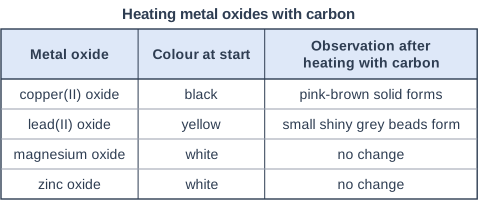
A teacher heats four metal oxides, each mixed with carbon powder, in separate test tubes. She uses a Bunsen burner and works in a fume cupboard.

The table shows the results.

Explain what the results show about the reactivity of copper, lead and magnesium compared with carbon.

Zinc is below carbon in the reactivity series. Suggest why there was no change with zinc oxide.

Heating metal oxides with carbon. Table with columns "Metal oxide", "Colour at start", "Observation after heating with carbon". Metal oxide: copper(II) oxide; Colour at start: black; Observation after heating with carbon: pink-brown solid forms | Metal oxide: lead(II) oxide; Colour at start: yellow; Observation after heating with carbon: small shiny grey beads form | Metal oxide: magnesium oxide; Colour at start: white; Observation after heating with carbon: no change | Metal oxide: zinc oxide; Colour at start: white; Observation after heating with carbon: no change.

Model answer

Carbon removed the oxygen from copper(II) oxide and lead(II) oxide, forming copper and lead, so copper and lead are less reactive than carbon. Carbon could not remove the oxygen from magnesium oxide, so magnesium is more reactive than carbon.
Zinc oxide probably needs a higher temperature than a Bunsen burner can give, so the reduction did not take place in the test tube.

Explanation

Carbon can reduce the oxide of a metal that is below carbon in the reactivity series, but not the oxide of a metal above carbon. The pink-brown solid is copper and the shiny grey beads are lead. Zinc is below carbon, so carbon can reduce zinc oxide, but only at a much higher temperature than a Bunsen burner gives: 'no change' in one experiment does not prove that a metal is more reactive than carbon.

Mark scheme
  1. 1 mark

    carbon removed oxygen from / reduced copper(II) oxide and lead(II) oxide (forming copper and lead)

    accept copper and lead were formed / extracted. Ignore 'copper oxide and lead oxide reacted' on its own.

  2. 1 mark

    so copper and lead are less reactive than carbon / are below carbon (in the reactivity series)

    accept ORA: carbon is more reactive than copper and lead. Both metals are needed.

  3. 1 mark

    carbon did not remove oxygen from / reduce magnesium oxide, so magnesium is more reactive than carbon / above carbon

    accept no change with magnesium oxide so magnesium is more reactive than carbon. Do not accept 'magnesium is unreactive'.

  4. 1 mark

    (zinc oxide) the Bunsen burner was not hot enough / a higher temperature is needed (to reduce zinc oxide)

    accept the mixture was not heated strongly enough / for long enough; accept the reaction is too slow at this temperature. Do not accept 'zinc is more reactive than carbon' (the question says zinc is below carbon).

Ready to try the rest? Every answer you write is marked against the mark scheme, so you can see exactly where the marks are.

Study Helper Hints first, answers after you try

Stuck on this one? Ask for a hint and I’ll point you in the right direction, without giving the answer away. Once you’ve checked your answer, I’ll show you how the marks are awarded.