
Level:
Correct: 0
Incorrect: 0
Marks: 0/0
Exam Practice
Course:
Topics:
Avg
score:
–
Topics
done:
0/25

Pure substances and separating mixtures

Practise 16 exam-style questions on Pure substances and separating mixtures for Edexcel GCSE Combined Science (Foundation Chemistry Paper 1). Write your answer as you would in the exam and get it marked in seconds against the mark scheme, point by point, with the Study Helper on hand if you get stuck.

  • 16 questions
  • 1–6 marks each
  • Instant marking
  • No sign-up needed
16 questions, marked as you go

Sample questions with model answers

Here are 4 of the questions in this topic, each with a model answer, an explanation of why it earns the marks and the mark scheme an examiner would use.

Question 1

1 mark

Simple distillation can be used to obtain pure water from salt solution.

Which statement explains why simple distillation can separate the water from the salt?

Choose your answer.

  • A salt does not dissolve in water
  • B water has a much lower boiling point than salt
  • C salt particles are too big to pass through the condenser
  • D water and salt have the same boiling point

Model answer

B - water has a much lower boiling point than salt.

Explanation

Simple distillation separates a liquid from a solution because the liquid has a much lower boiling point than the dissolved solid. The water boils off, its vapour is cooled in the condenser and the pure water is collected, while the salt is left in the flask.

Mark scheme
  1. 1 mark

    B / water has a much lower boiling point than salt

    The only correct answer is B: when the solution is heated, the water boils and turns into a vapour, which is condensed and collected, but salt has a much higher boiling point, so it stays in the flask. A is not correct because salt does dissolve in water (that is why it forms a salt solution); C is not correct because the condenser is not a filter: the salt stays behind because it does not boil; D is not correct because two substances with the same boiling point could not be separated by distillation. Accept the letter or the option. If more than one option is given, do not award the mark.
Question 2

2 marks

A company uses lauric acid to make soap. Pure lauric acid melts at 44 °C.

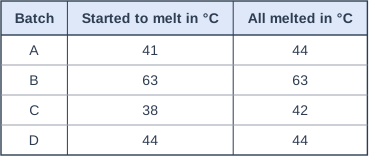
A technician tests four batches, A, B, C and D, of a white solid that should be lauric acid. The table shows her results.

Give the letter of the batch that is pure lauric acid.

Explain why batch B is not lauric acid, even though it has a sharp melting point.

Table with columns "Batch", "Started to melt in °C", "All melted in °C". Batch: A; Started to melt in °C: 41; All melted in °C: 44 | Batch: B; Started to melt in °C: 63; All melted in °C: 63 | Batch: C; Started to melt in °C: 38; All melted in °C: 42 | Batch: D; Started to melt in °C: 44; All melted in °C: 44.

Model answer

D.

Batch B melts at one temperature, 63 °C, so it is a pure substance. But pure lauric acid melts at 44 °C, so B must be a different substance.

Explanation

Batch D melts sharply at 44 °C, the melting point of pure lauric acid. Batches A and C melt over a range of temperatures, so they contain impurities. Batch B has a sharp melting point, so it is pure, but its melting point does not match lauric acid, so it is another substance. A common mistake is to say that B is impure.

Mark scheme
  1. 1 mark

    D

    Do not award the mark if more than one letter is given.

  2. 1 mark

    B melts at one temperature, so it is a pure substance, but its melting point (63 °C) is not 44 °C, so it is a different substance

    Both ideas are needed: B is pure / a single substance AND its melting point does not match that of lauric acid. Accept 'B is a different pure substance because it melts at 63 °C, not 44 °C'. Do not accept 'B is impure' or 'B is a mixture'.

Question 3

2 marks

Here are five mixtures.

A chalk powder and water
B the coloured dyes in the coating of a sweet
C methanol and water, two liquids that mix completely
D the coloured substances in an extract of spinach leaves
E crude oil

Which two mixtures can be separated by paper chromatography?

Give two letters.

Model answer

B and D

Explanation

Paper chromatography separates a mixture of soluble substances, such as the dyes in a sweet coating or the coloured substances in leaves, because the substances move over the paper at different rates. Chalk is insoluble, so chalk and water are separated by filtration. Methanol and water, and the liquids in crude oil, are liquids with different boiling points, so they are separated by fractional distillation.

Mark scheme
  1. 1 mark

    B

    Max 1 if more than two answers are given. The two letters can be given in either order.

  2. 1 mark

    D

Question 4

4 marks

A company cleans metal machine parts with propanone. The used propanone contains small pieces of metal and some grease.

- The pieces of metal are insoluble in propanone.
- The grease has dissolved in the propanone.
- Propanone boils at 56 °C. The grease boils at over 300 °C.

The company wants to collect the pieces of metal for recycling and obtain pure propanone to use again.

Describe how this can be done. Name each technique you use and explain why it works.

Model answer

First filter the used propanone. The pieces of metal are insoluble, so they cannot pass through the filter paper and are left on it as the residue, ready to be recycled. The propanone, with the grease dissolved in it, passes through.

Then use simple distillation on this liquid. Propanone boils at 56 °C, much lower than the grease, so the propanone boils off, is cooled in the condenser and is collected as pure propanone. The grease stays behind in the flask.

Explanation

Choose each technique from the properties of the substances. Filtration separates an insoluble solid from a liquid, and simple distillation separates a liquid from substances dissolved in it that have much higher boiling points. Many answers name the techniques but do not explain why each one works.

Mark scheme
  1. 1 mark

    filter the used propanone / filtration

    Ignore safety points (for example, using an electric heater because propanone is flammable).

  2. 1 mark

    the pieces of metal are insoluble / too big to pass through the filter paper, so they stay on the filter paper (as the residue) and the liquid passes through

    Accept 'the metal is left on the filter paper because it has not dissolved'.

  3. 1 mark

    (simple) distillation of the liquid that passes through the filter paper / of the filtrate

    Accept distillation. Allow fractional distillation (it would also separate the propanone). Do not accept evaporation or crystallisation (the propanone would not be collected).

  4. 1 mark

    propanone boils / evaporates (first, at 56 °C) and is condensed and collected, but the grease does not boil / stays in the flask (because its boiling point is much higher)

    The propanone turning into a vapour must be linked to its condensing / being collected or to the grease being left behind.

Ready to try the rest? Every answer you write is marked against the mark scheme, so you can see exactly where the marks are.

Study Helper Hints first, answers after you try

Stuck on this one? Ask for a hint and I’ll point you in the right direction, without giving the answer away. Once you’ve checked your answer, I’ll show you how the marks are awarded.