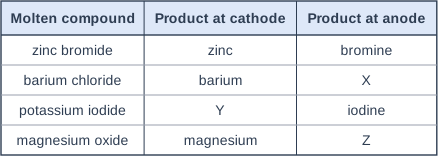
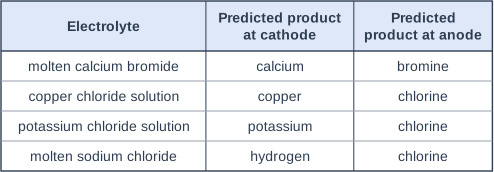
Question 1
1 markInert electrodes are used to electrolyse a compound.
Which compound produces a metal at the cathode both when it is molten and when it is dissolved in water?
Choose your answer.
- A potassium iodide
- B copper chloride
- C sodium chloride
- D magnesium bromide
Model answer
B - copper chloride.
Explanation
A molten compound always gives its metal at the cathode. In a solution, hydrogen ions from the water are also attracted to the cathode, and the metal forms only if it is less reactive than hydrogen. Copper is below hydrogen in reactivity, but potassium, sodium and magnesium are above it, so their solutions give hydrogen.
Mark scheme
-
1 mark
B / copper chloride
The only correct answer is B: copper is less reactive than hydrogen, so copper forms at the cathode from copper chloride solution, and copper also forms from molten copper chloride. A, C and D are not correct because potassium, sodium and magnesium are more reactive than hydrogen: when the compounds are molten the metal forms at the cathode, but in solution hydrogen forms at the cathode instead. Accept the letter or the option. If more than one option is given, do not award the mark.