
Level:
Correct: 0
Incorrect: 0
Marks: 0/0
Exam Practice
Course:
Topics:
Avg
score:
–
Topics
done:
0/25

Conservation of mass, reacting masses and concentration

Practise 15 exam-style questions on Conservation of mass, reacting masses and concentration for Edexcel GCSE Combined Science (Foundation Chemistry Paper 1). Write your answer as you would in the exam and get it marked in seconds against the mark scheme, point by point, with the Study Helper on hand if you get stuck.

  • 15 questions
  • 1–6 marks each
  • Instant marking
  • No sign-up needed
15 questions, marked as you go

Sample questions with model answers

Here are 4 of the questions in this topic, each with a model answer, an explanation of why it earns the marks and the mark scheme an examiner would use.

Question 1

1 mark

When calcium is heated in air, it reacts with oxygen to form calcium oxide.

2Ca + O₂ → 2CaO

In this reaction, 80 g of calcium forms 112 g of calcium oxide.

What mass of calcium oxide forms from 8.0 g of calcium?

Choose your answer.

  • A 3.2 g
  • B 5.7 g
  • C 11.2 g
  • D 22.4 g

Model answer

C

8.0 g ÷ 80 g = 0.1, so the mass of calcium oxide = 0.1 × 112 g = 11.2 g

Explanation

The masses react in a fixed ratio, so scale the given masses by the same factor: 8.0 g is one tenth of 80 g, so one tenth of 112 g of calcium oxide forms. Check that the answer makes sense: calcium oxide must be heavier than the calcium because oxygen has joined on.

Mark scheme
  1. 1 mark

    C / 11.2 g

    The only correct answer is C: 8.0 g is one tenth of 80 g, so the mass of calcium oxide is one tenth of 112 g = 11.2 g (8.0 × 112 ÷ 80). A is not correct because 3.2 g is the mass of oxygen that combines (11.2 − 8.0), not the mass of calcium oxide; B is not correct because 5.7 g comes from using the masses the wrong way up (8.0 × 80 ÷ 112), which would make the product lighter than the calcium; D is not correct because the 2 in front of CaO has already been used in the masses 80 g and 112 g, so it must not be doubled again. Accept the letter or the option. If more than one option is given, do not award the mark.
Question 2

2 marks

A student investigates the mass of carbon dioxide given off when zinc carbonate reacts with dilute sulfuric acid.

She stands a conical flask of excess dilute sulfuric acid on a balance, adds a weighed sample of zinc carbonate and puts some cotton wool in the neck of the flask. When the fizzing stops, she records the decrease in the balance reading. She repeats the experiment with different masses of zinc carbonate.

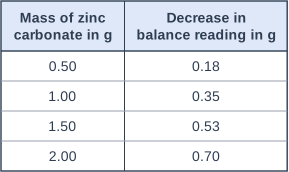
The table shows her results.

Describe the relationship shown by the results, and explain why using more zinc carbonate gives a bigger decrease in the balance reading.

Table with columns "Mass of zinc carbonate in g", "Decrease in balance reading in g". Mass of zinc carbonate in g: 0.50; Decrease in balance reading in g: 0.18 | Mass of zinc carbonate in g: 1.00; Decrease in balance reading in g: 0.35 | Mass of zinc carbonate in g: 1.50; Decrease in balance reading in g: 0.53 | Mass of zinc carbonate in g: 2.00; Decrease in balance reading in g: 0.70.

Model answer

The decrease in the balance reading is directly proportional to the mass of zinc carbonate: doubling the mass from 1.00 g to 2.00 g doubles the decrease from 0.35 g to 0.70 g. More zinc carbonate reacts to make more carbon dioxide gas. The gas escapes from the open flask through the cotton wool, so more mass leaves the flask and the balance reading falls further.

Explanation

In a non-enclosed system a gas that is made can escape, so the balance reading falls by the mass of gas given off. Mass is still conserved: no atoms are destroyed, they have just left the flask. Use a pair of results to describe the pattern, for example double the mass of zinc carbonate gives double the decrease.

Mark scheme
  1. 1 mark

    the decrease in the balance reading is (directly) proportional to the mass of zinc carbonate / doubling the mass of zinc carbonate doubles the decrease (e.g. 1.00 g gives 0.35 g and 2.00 g gives 0.70 g)

    Accept 'as the mass of zinc carbonate increases, the decrease in the balance reading increases' / 'a positive correlation'. Ignore references to time or rate.

  2. 1 mark

    more zinc carbonate makes more carbon dioxide (gas), which escapes from the (open) flask, so more mass is lost from the flask

    The answer must link more carbon dioxide (gas) to its escaping / leaving the flask. Accept 'the carbon dioxide leaves the flask through the cotton wool, so it is not weighed'. Do not accept 'atoms are destroyed' / 'mass is not conserved'. Ignore 'more reaction' on its own.

Question 3

2 marks

Bilal dissolved 3.0 g of potassium chloride in water and made the solution up to 250 cm³.

He worked out the concentration like this:
concentration = 3.0 ÷ 250 = 0.012 g dm⁻³

Calculate the correct concentration in g dm⁻³ and explain the mistake Bilal made.

Model answer

Correct concentration = 3.0 ÷ 0.25 = 12 g dm⁻³

Bilal divided by the volume in cm³ (250) instead of changing it into dm³ first (250 cm³ = 0.25 dm³), so his answer is a thousand times too small.

Explanation

Concentration in g dm⁻³ means grams in each cubic decimetre, so the volume must be in dm³. Divide 250 cm³ by 1000 to get 0.25 dm³. Not converting cm³ to dm³ is one of the most common mistakes in concentration calculations.

Mark scheme
  1. 1 mark

    (3.0 ÷ 0.25 =) 12 (g dm⁻³)

    An answer of 12 g dm⁻³ with no working scores marking point 1. Do not accept 0.012 or 12 000. Ignore units.

  2. 1 mark

    he did not change the volume from cm³ into dm³ / he divided by the volume in cm³ instead of dm³

    Allow 'he should have divided the volume by a thousand first' / 'his answer is the mass in one cm³, not one dm³'. Ignore 'he used the wrong units' alone. Do not accept 'he should have multiplied by the volume'.

Question 4

4 marks

Potassium sulfate can be made by neutralising sulfuric acid with potassium hydroxide.

H₂SO₄ + 2KOH → K₂SO₄ + 2H₂O

(relative atomic masses: H = 1, O = 16, S = 32, K = 39)

A solution contains 4.9 g of sulfuric acid.

Calculate the mass of potassium hydroxide needed to neutralise all of the sulfuric acid.

Model answer

Relative formula mass of H₂SO₄ = (2 × 1) + 32 + (4 × 16) = 98
Mass of 2KOH = 2 × (39 + 16 + 1) = 112
So 98 g of sulfuric acid reacts with 112 g of potassium hydroxide.
Mass of potassium hydroxide = 4.9 × 112 ÷ 98 = 5.6 g

Explanation

The balanced equation shows that one H₂SO₄ reacts with two KOH, so 98 g of sulfuric acid needs 2 × 56 = 112 g of potassium hydroxide. 4.9 g is one twentieth of 98 g, so one twentieth of 112 g is needed. Forgetting the 2 in front of KOH halves the answer to 2.8 g.

Mark scheme
  1. 1 mark

    (relative formula mass of H₂SO₄ =) (2 × 1) + 32 + (4 × 16) = 98; or a correct final answer of 5.6 g with no working

    An answer of 5.6 g with no working scores 4 marks. 4.9 × 56 ÷ 98 = 2.8 g (the 2 in front of KOH ignored) with working scores 2 marks (MP1 and MP3). 4.9 × 98 ÷ 112 = 4.3 g (ratio the wrong way up) scores MP1 and MP2 only. Allow ECF from incorrect relative formula masses for MP3 and MP4.

  2. 1 mark

    (mass of 2KOH =) 2 × (39 + 16 + 1) = 112 / 98 g of sulfuric acid reacts with 112 g of potassium hydroxide; or a correct final answer of 5.6 g with no working

    Allow KOH = 56 and 2 × 56 = 112 seen in the working.

  3. 1 mark

    4.9 × 112 ÷ 98 / 4.9 ÷ 98 = 0.05 and 0.05 × 112; or a correct final answer of 5.6 g with no working

    Allow ECF from MP1 and MP2.

  4. 1 mark

    5.6 (g)

    Allow 5.60 (g). Ignore units.

Ready to try the rest? Every answer you write is marked against the mark scheme, so you can see exactly where the marks are.

Study Helper Hints first, answers after you try

Stuck on this one? Ask for a hint and I’ll point you in the right direction, without giving the answer away. Once you’ve checked your answer, I’ll show you how the marks are awarded.