
Level:
Correct: 0
Incorrect: 0
Marks: 0/0
Exam Practice
Course:
Topics:
Avg
score:
–
Topics
done:
0/27

Venn diagrams, independent and mutually exclusive events

Practise 18 exam-style questions on Venn diagrams, independent and mutually exclusive events for Edexcel A-Level Maths (Paper 3). Write your answer as you would in the exam and get it marked in seconds against the mark scheme, point by point, with the Study Helper on hand if you get stuck.

  • 18 questions
  • 3–11 marks each
  • Instant marking
  • No sign-up needed
18 questions, marked as you go

Sample questions with model answers

Here are 4 of the questions in this topic, each with a model answer, an explanation of why it earns the marks and the mark scheme an examiner would use.

Question 1

3 marks

At a sixth-form college a student is chosen at random. The event D is that this student drives to college, and the event J is that this student has a part-time job.

\(P(D) = 0.35\), \(P(J) = 0.4\) and \(P(D \mid J) = 0.35\)

Are D and J independent? Give a reason for your answer.

Find the probability that a randomly chosen student has a part-time job but does not drive to college.

Model answer

\(P(D \mid J) = 0.35 = P(D)\), so D and J are independent.
\(P(J \cap D') = P(J) \times P(D') = 0.4 \times (1 - 0.35)\)
\(= 0.26\)

Explanation

Independence means that knowing one event has happened does not change the probability of the other, so \(P(D \mid J) = P(D)\) shows that D and J are independent. Then J and D' are also independent, so the required probability is \(0.4 \times 0.65 = 0.26\) (or \(0.4 - 0.4 \times 0.35\)). A common error is to work out \(0.4 - 0.35\), which treats a conditional probability as the probability of an intersection.

Mark scheme
  1. 1 mark

    B1 D and J are independent because \(P(D \mid J) = P(D)\) (both 0.35). A correct final answer of 0.26 with no working scores the M1 and A1 below

    An answer of 0.26 with no working scores 2 marks; this B1 needs the reason. "Independent" with no reason, or a reason from the context only (e.g. "having a job does not affect driving"), scores B0. Allow \(P(D \cap J) = 0.35 \times 0.4 = 0.14 = P(D)P(J)\) as the reason.

  2. 1 mark

    M1 \(P(J \cap D') = P(J) \times P(D') = 0.4 \times 0.65\), or \(P(J) - P(J \cap D) = 0.4 - 0.4 \times 0.35\)

    Allow \(P(J) \times (1 - P(D \mid J))\). \(0.4 - 0.35\) scores M0.

  3. 1 mark

    A1 0.26

    Allow \(\dfrac{13}{50}\) or 26%.
Question 2

4 marks

For two events A and B,
\(P(A \cap B') = p\), \(P(A \cap B) = q\), \(P(A' \cap B) = r\) and \(P(A' \cap B') = s\)
where \(p + q + r + s = 1\)

Prove that A and B are independent if and only if \(qs = pr\)

[For independent events A and B, \(P(A \cap B) = P(A)P(B)\)]

Model answer

\(P(A) = p + q\), \(P(B) = q + r\) and \(P(A \cap B) = q\)
A and B are independent \(\Leftrightarrow q = (p + q)(q + r)\)
Since \(p + q + r + s = 1\), \(q = q(p + q + r + s)\)
So A and B are independent \(\Leftrightarrow q(p + q + r + s) = (p + q)(q + r)\)
\(\Leftrightarrow pq + q^2 + qr + qs = pq + pr + q^2 + qr\)
\(\Leftrightarrow qs = pr\)
Every step is reversible, so A and B are independent if and only if \(qs = pr\).

Explanation

Write \(P(A)\), \(P(B)\) and \(P(A \cap B)\) in terms of the regions, so that independence becomes \(q = (p + q)(q + r)\). Multiplying q by \(p + q + r + s\), which equals 1, makes both sides quadratic, and three terms then cancel to leave \(qs = pr\). Because every step is an equivalence the argument proves both directions; a proof that only shows "independent implies \(qs = pr\)" without saying that the steps reverse does not prove "if and only if", and checking numerical examples is not a proof.

Mark scheme
  1. 1 mark

    M1 Writes \(P(A) = p + q\) and \(P(B) = q + r\) and the independence condition \(q = (p + q)(q + r)\). An answer with no working scores 0 marks

    An answer with no working scores 0 marks: this is a proof. Numerical examples score 0 marks. Allow the regions shown on a labelled Venn diagram.

  2. 1 mark

    M1 Uses \(p + q + r + s = 1\) to make the two sides comparable, e.g. writes q as \(q(p + q + r + s)\), or substitutes \(s = 1 - p - q - r\) into \(qs = pr\), and expands

    Alternative route: \(qs = pr \Leftrightarrow q(1 - p - q - r) = pr \Leftrightarrow q = pq + q^2 + qr + pr = (p + q)(q + r)\).

  3. 1 mark

    A1 Correct algebra to reach the other condition: \(pq + q^2 + qr + qs = pq + pr + q^2 + qr\), so \(qs = pr\) (or the reverse route to \(q = (p + q)(q + r)\))

    Depends on both M marks (this one and the first). Every term must be correct.

  4. 1 mark

    A1* Concludes that both directions are proved: every step is reversible (an equivalence), so A and B are independent if and only if \(qs = pr\) (cso)

    cso: no errors in the argument and a concluding statement that covers "if and only if". A proof of one direction only, with no statement that the steps reverse and no separate proof of the converse, scores A0 for this mark.

Question 3

5 marks

Rhiannon cycles to college. Her journey time, T minutes, is modelled as equally likely to take any value between 22 and 30. In the model, the probability that T lies between two values is the area between those values under a horizontal line of height h, drawn for \(22 \leqslant t \leqslant 30\) (the graph is zero outside this interval).

Find the value of h.

Find the probability that a randomly chosen journey takes less than 23 minutes or more than 28 minutes.

Find the value of t for which the probability that a randomly chosen journey takes more than t minutes is 0.2

Model answer

Total area = 1: \((30 - 22) \times h = 1\), so \(h = \dfrac{1}{8}\)
\(T < 23\) and \(T > 28\) are mutually exclusive, so their areas add:
\(P(T < 23 \text{ or } T > 28) = (23 - 22) \times \dfrac{1}{8} + (30 - 28) \times \dfrac{1}{8} = \dfrac{1}{8} + \dfrac{2}{8} = \dfrac{3}{8}\)
\(P(T > t) = (30 - t) \times \dfrac{1}{8} = 0.2\)
\(30 - t = 1.6\), so \(t = 28.4\)

Explanation

In this model probability is area, and the area for all possible journey times, from 22 to 30 minutes, must be 1, so the height is \(\dfrac{1}{8}\). The two intervals do not overlap, so the events are mutually exclusive and their areas are added: \(\dfrac{1}{8} + \dfrac{2}{8}\). Working backwards, the strip to the right of t must have area 0.2, so its width is 1.6; a common error is to measure from 0 instead of from 22.

Mark scheme
  1. 1 mark

    B1 \(h = \dfrac{1}{8}\) (total area \(8h = 1\)). Correct answers of \(\dfrac{1}{8}\), \(\dfrac{3}{8}\) and 28.4 with no working score all 5 marks

    An answer of \(h = \dfrac{1}{8}\), \(\dfrac{3}{8}\) and \(t = 28.4\) with no working scores 5 marks. Allow decimals: 0.125 and 0.375.

  2. 1 mark

    M1 Adds the two areas, because the events \(T < 23\) and \(T > 28\) are mutually exclusive: \((23 - 22) \times h + (30 - 28) \times h\)

    ft their h. Using \(23 \times h\) for \(T < 23\) (measuring from 0 instead of 22), or multiplying the two probabilities, scores M0.

  3. 1 mark

    A1 \(\dfrac{3}{8}\) (0.375)

  4. 1 mark

    M1 \((30 - t) \times h = 0.2\) with their h

    Or \((t - 22) \times h = 0.8\). \(t \times h = 0.2\) scores M0.

  5. 1 mark

    A1 \(t = 28.4\)

    Accept \(\dfrac{142}{5}\).

Question 4

7 marks

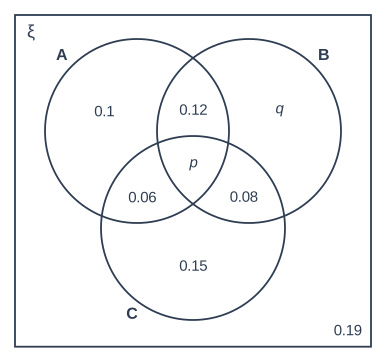
The Venn diagram represents the events A, B and C. The number in each region is the probability of that region, and p and q are unknown probabilities.

The events A and B are independent.

Find p and q.

Are A and C independent? Show how you decide.

Find \(P((A \cup B)')\).

[For independent events A and B, \(P(A \cap B) = P(A)P(B)\)]

A Venn diagram: a rectangle labelled ξ (the universal set) containing three overlapping circles labelled A, B and C, each overlapping the other two. The numbers written in each region are: A ∩ B′ ∩ C′ (in A only): 0.1; A′ ∩ B ∩ C′ (in B only): q; A′ ∩ B′ ∩ C (in C only): 0.15; A ∩ B ∩ C′ (in A and B but not C): 0.12; A ∩ B′ ∩ C (in A and C but not B): 0.06; A′ ∩ B ∩ C (in B and C but not A): 0.08; A ∩ B ∩ C (in all three): p; A′ ∩ B′ ∩ C′ (outside all three circles): 0.19.

Model answer

Total probability: \(0.1 + 0.15 + 0.12 + 0.06 + 0.08 + 0.19 + p + q = 1\), so \(p + q = 0.3\)
\(P(B) = q + 0.12 + 0.08 + p = 0.5\)
\(P(A) = 0.1 + 0.12 + 0.06 + p = 0.28 + p\) and \(P(A \cap B) = 0.12 + p\)
Independence: \(0.12 + p = 0.5(0.28 + p)\)
\(0.12 + p = 0.14 + 0.5p\), so \(0.5p = 0.02\) and \(p = 0.04\)
\(q = 0.3 - 0.04 = 0.26\)
\(P(A) = 0.32\), \(P(C) = 0.15 + 0.06 + 0.08 + 0.04 = 0.33\) and \(P(A \cap C) = 0.06 + 0.04 = 0.1\)
\(P(A) \times P(C) = 0.1056 ≠ 0.1\), so A and C are not independent.
\(P((A \cup B)') = 0.15 + 0.19 = 0.34\)

Explanation

The eight regions add to 1, which fixes \(p + q\) and therefore \(P(B) = 0.5\); independence of A and B then gives a linear equation in p. Testing A and C needs \(P(A)\), \(P(C)\) and \(P(A \cap C)\), each of which includes the centre region p. A common error is to leave p out of \(P(A \cap B)\) or \(P(A \cap C)\).

Mark scheme
  1. 1 mark

    M1 Uses the sum of the probabilities = 1 to get \(p + q = 0.3\), so \(P(B) = 0.12 + 0.08 + p + q = 0.5\); or correct final answers of \(p = 0.04\), \(q = 0.26\) and 0.34 with no working

    An answer of \(p = 0.04\), \(q = 0.26\) and 0.34 with no working scores 5 marks; the conclusion about A and C needs supporting probabilities. Allow fractions, decimals or percentages.

  2. 1 mark

    M1 Uses independence with \(P(A) = 0.28 + p\) and \(P(A \cap B) = 0.12 + p\): \(0.12 + p = 0.5(0.28 + p)\) (their \(P(B)\))

    Must be an equation in p only. Taking \(P(A \cap B) = 0.12\) (leaving out p) scores M0.

  3. 1 mark

    A1 \(p = 0.04\)

  4. 1 mark

    A1 \(q = 0.26\)

    Depends on both M marks.

  5. 1 mark

    M1 Finds \(P(A) = 0.32\), \(P(C) = 0.33\) and \(P(A \cap C) = 0.1\) (ft their p) and uses a correct test, e.g. compares \(P(A) \times P(C)\) with \(P(A \cap C)\)

    Or compares \(P(A \mid C) = \dfrac{0.1}{0.33}\) with \(P(A)\). A conclusion with no probabilities scores M0 A0.

  6. 1 mark

    A1 \(P(A) \times P(C) = 0.32 \times 0.33 = 0.1056 ≠ 0.1 = P(A \cap C)\), so A and C are not independent

    All probabilities correct and a correct conclusion.

  7. 1 mark

    B1 \(P((A \cup B)') = 0.15 + 0.19 = 0.34\)

    0.19 alone (outside all three circles) scores B0.

Ready to try the rest? Every answer you write is marked against the mark scheme, so you can see exactly where the marks are.

Study Helper Hints first, answers after you try

Stuck on this one? Ask for a hint and I’ll point you in the right direction, without giving the answer away. Once you’ve checked your answer, I’ll show you how the marks are awarded.