
Level:
Correct: 0
Incorrect: 0
Marks: 0/0
Exam Practice
Course:
Topics:
Avg
score:
–
Topics
done:
0/27

Conditional probability and probability models

Practise 18 exam-style questions on Conditional probability and probability models for Edexcel A-Level Maths (Paper 3). Write your answer as you would in the exam and get it marked in seconds against the mark scheme, point by point, with the Study Helper on hand if you get stuck.

  • 18 questions
  • 3–9 marks each
  • Instant marking
  • No sign-up needed
18 questions, marked as you go

Sample questions with model answers

Here are 4 of the questions in this topic, each with a model answer, an explanation of why it earns the marks and the mark scheme an examiner would use.

Question 1

3 marks

On one day, 100 students at a college were asked which of the library (L), the canteen (C) and the gym (G) they had used. The Venn diagram shows the results.

A student is chosen at random from these 100 students.

Given that the student used at least two of the three facilities, find the probability that the student used all three.

Find \(P(L \mid C')\).
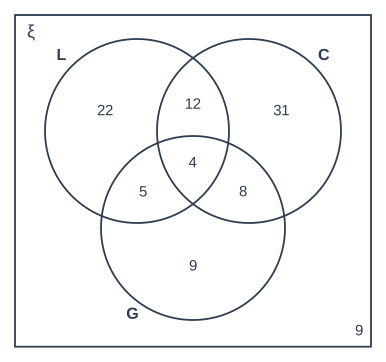
A Venn diagram: a rectangle labelled ξ (the universal set) containing three overlapping circles labelled L, C and G, each overlapping the other two. The numbers written in each region are: L ∩ C′ ∩ G′ (in L only): 22; L′ ∩ C ∩ G′ (in C only): 31; L′ ∩ C′ ∩ G (in G only): 9; L ∩ C ∩ G′ (in L and C but not G): 12; L ∩ C′ ∩ G (in L and G but not C): 5; L′ ∩ C ∩ G (in C and G but not L): 8; L ∩ C ∩ G (in all three): 4; L′ ∩ C′ ∩ G′ (outside all three circles): 9.

Model answer

Used at least two: \(12 + 5 + 8 + 4 = 29\)
\(P(\text{all three} \mid \text{at least two}) = \dfrac{4}{29} = 0.138\)
Not the canteen: \(22 + 5 + 9 + 9 = 45\), of whom \(22 + 5 = 27\) used the library
\(P(L \mid C') = \dfrac{27}{45} = 0.6\)

Explanation

For a conditional probability from a Venn diagram of numbers, count only the people who meet the condition and use that count as the denominator. "At least two" means the three regions in exactly two circles plus the centre, 29 students, and \(C'\) is everything outside the C circle, 45 students including the 9 outside all three. A common error is to divide by 100 throughout.

Mark scheme
  1. 1 mark

    M1 Denominator 29, the number who used at least two facilities (\(12 + 5 + 8 + 4\)): \(\dfrac{4}{\text{their } 29}\); or correct final answers of \(\dfrac{4}{29}\) and 0.6 with no working

    An answer of 4/29 (awrt 0.138) and 0.6 with no working scores 3 marks. A denominator of 100 scores M0.

  2. 1 mark

    A1 \(\dfrac{4}{29}\) or awrt 0.138, i.e. [0.1375, 0.1385)

  3. 1 mark

    B1 \(P(L \mid C') = \dfrac{22 + 5}{45} = \dfrac{27}{45} = 0.6\)

    45 is the number who did not use the canteen (\(22 + 5 + 9 + 9\)). Accept \(\dfrac{3}{5}\).

Question 2

5 marks

A student uses the large data set to count, for Leuchars in 2015, the number of days in each month on which the Daily Total Rainfall was recorded as 0. The table shows the results.

A day is chosen at random from the 184 days. The event D is that the Daily Total Rainfall on that day was recorded as 0.

Find \(P(D \mid \text{the day is in September})\).

Find \(P(\text{the day is in September} \mid D)\). Give your answer to 3 significant figures.

State, with a reason, whether or not D is independent of the event that the day is in September.

The student suggests that the days recorded as "tr" should also be counted as days with no rain. Explain, from what you know about the large data set, why this is not correct.

Table with columns "Month", "May", "June", "July", "August", "September", "October". Month: Number of days; May: 31; June: 30; July: 31; August: 31; September: 30; October: 31 | Month: Days recorded as 0; May: 4; June: 6; July: 2; August: 7; September: 9; October: 9.

Model answer

September has 30 days, of which 9 had rainfall recorded as 0:
\(P(D \mid \text{September}) = \dfrac{9}{30} = 0.3\)
Days recorded as 0: \(4 + 6 + 2 + 7 + 9 + 9 = 37\)
\(P(\text{September} \mid D) = \dfrac{9}{37} = 0.243\) (3 s.f.)
\(P(D) = \dfrac{37}{184} = 0.201\), which is not equal to \(P(D \mid \text{September}) = 0.3\), so D is not independent of the day being in September.
"tr" means a trace of rain, less than 0.05 mm, so it did rain on those days; they should not be counted as days with no rain.

Explanation

The two conditional probabilities have different denominators: 30 September days for the first and the 37 days recorded as 0 for the second, so they are not the same. Independence would need \(P(D \mid \text{September})\) to equal \(P(D) = \dfrac{37}{184}\), and it does not. In the large data set "tr" records a trace of rain (less than 0.05 mm), so a tr day is not a day with no rain.

Mark scheme
  1. 1 mark

    B1 \(\dfrac{9}{30} = 0.3\). Correct answers of 0.3 and awrt 0.243 with no working score the B1 and the M1 A1 for them

    An answer of 0.3 and awrt 0.243 (or 9/37) with no working scores 3 marks; the comment and the explanation are marked separately.

  2. 1 mark

    M1 \(\dfrac{9}{\text{total number of days recorded as 0}} = \dfrac{9}{37}\), with 37 found from \(4 + 6 + 2 + 7 + 9 + 9\)

    A denominator of 184 or 30 scores M0.

  3. 1 mark

    A1 \(\dfrac{9}{37}\) or awrt 0.243, i.e. [0.2425, 0.2435)

  4. 1 mark

    B1 Not independent, because \(P(D \mid \text{September}) = 0.3\) is not equal to \(P(D) = \dfrac{37}{184}\) (= 0.201)

    Accept \(P(D)\) as \(\dfrac{37}{184}\), 0.2 or awrt 0.201, i.e. [0.2005, 0.2015). Must compare \(P(D \mid \text{September})\) with \(P(D)\) (or \(P(\text{September} \mid D)\) with \(P(\text{September}) = \dfrac{30}{184}\)). Comparing 0.3 with 0.243 scores B0.

  5. 1 mark

    B1 "tr" means a trace of rain, an amount less than 0.05 mm, so some rain did fall on those days

    Accept any wording equivalent to "a small amount of rain (less than 0.05 mm) fell", i.e. not "no rain". "tr means the data is missing" or "tr is an outlier" scores B0.

Question 3

6 marks

At a sixth-form college, a proportion p of the students study Mathematics. Of the students who study Mathematics, 45% also study Physics. Of the students who do not study Mathematics, 30% study Physics.

A student who studies Physics is chosen at random. The probability that this student studies Mathematics is 0.6

Find the value of p.

Find the probability that a randomly chosen student who does not study Physics studies Mathematics.

Model answer

\(P(\text{M} \cap \text{Ph}) = 0.45p\) and \(P(\text{Ph}) = 0.45p + 0.3(1 - p) = 0.3 + 0.15p\)
\(\dfrac{0.45p}{0.3 + 0.15p} = 0.6\)
\(0.45p = 0.18 + 0.09p\), so \(0.36p = 0.18\) and \(p = 0.5\)
\(P(\text{Ph}) = 0.375\), so \(P(\text{not Ph}) = 0.625\)
\(P(\text{M} \cap \text{not Ph}) = 0.5 \times 0.55 = 0.275\)
\(P(\text{M} \mid \text{not Ph}) = \dfrac{0.275}{0.625} = 0.44\)

Explanation

A tree with first branches p and \(1 - p\) gives \(P(\text{Physics}) = 0.45p + 0.3(1 - p)\), and the reversed conditional probability \(P(\text{Maths} \mid \text{Physics}) = \dfrac{0.45p}{P(\text{Physics})}\) gives a linear equation in p. The last part uses the same idea with "not Physics", whose probability is \(1 - 0.375\). A common error is to set \(0.45p = 0.6\), forgetting to divide by \(P(\text{Physics})\).

Mark scheme
  1. 1 mark

    M1 \(P(\text{Physics}) = 0.45p + 0.3(1 - p)\). Correct answers of 0.5 and 0.44 with no working score 2 marks

    An answer of \(p = 0.5\) and 0.44 with no working scores 2 marks (the two A marks). Allow fractions, decimals or percentages.

  2. 1 mark

    M1 \(\dfrac{0.45p}{0.45p + 0.3(1 - p)} = 0.6\)

    The numerator must be \(P(\text{Mathematics} \cap \text{Physics}) = 0.45p\).

  3. 1 mark

    A1 \(p = 0.5\)

  4. 1 mark

    M1 \(P(\text{not Physics}) = 1 - (0.45p + 0.3(1 - p))\) (= 0.625) and \(P(\text{Mathematics} \cap \text{not Physics}) = 0.55p\) (= 0.275), with their p

  5. 1 mark

    M1 (dM1) \(\dfrac{0.55p}{P(\text{not Physics})}\) with their values

    Depends on the previous M mark.

  6. 1 mark

    A1 0.44

    Accept \(\dfrac{11}{25}\).

Question 4

8 marks

Lewis is practising darts. On each throw he aims at the treble 20.

The probability that his first throw hits the treble 20 is 0.3
After a throw that hits, the probability that his next throw hits is 0.4
After a throw that misses, the probability that his next throw hits is 0.25

Lewis throws three darts.

Find the probability that exactly two of his three darts hit the treble 20.

Given that exactly two of the three darts hit the treble 20, find the probability that his first dart missed.

Find the probability that his third dart hits the treble 20.

Lewis's coach models each of Lewis's throws as hitting the treble 20 with probability 0.3, independently of his other throws. Using the information above, explain why the coach's model may not be suitable.

Give your answers to 3 significant figures.

Model answer

Exactly two hits:
HHM: \(0.3 \times 0.4 \times 0.6 = 0.072\)
HMH: \(0.3 \times 0.6 \times 0.25 = 0.045\)
MHH: \(0.7 \times 0.25 \times 0.4 = 0.07\)
\(P(\text{exactly two}) = 0.072 + 0.045 + 0.07 = 0.187\)
\(P(\text{first missed} \mid \text{exactly two}) = \dfrac{0.07}{0.187} = 0.374\) (3 s.f.)
\(P(\text{second hits}) = 0.3 \times 0.4 + 0.7 \times 0.25 = 0.295\)
\(P(\text{third hits}) = 0.295 \times 0.4 + 0.705 \times 0.25 = 0.29425 = 0.294\) (3 s.f.)
The coach's model assumes independent throws, but the probability of a hit is 0.4 after a hit and 0.25 after a miss, so each throw depends on the one before; the model is not suitable.

Explanation

Each probability on the tree depends on the previous throw, so every path is a product of the right conditional probabilities, and the three paths with exactly two hits are added. The conditional probability divides the path MHH by that total, and the third dart is found by first finding P(second hits). The given probabilities 0.4 and 0.25 differ, which shows that the throws are not independent, so the coach's independent model is not suitable.

Mark scheme
  1. 1 mark

    M1 Identifies the three sequences HHM, HMH and MHH and multiplies along each: \(0.3 \times 0.4 \times 0.6\), \(0.3 \times 0.6 \times 0.25\) and \(0.7 \times 0.25 \times 0.4\) (at least two correct). Correct answers of 0.187, awrt 0.374 and awrt 0.294 with no working score 5 marks

    An answer of 0.187, awrt 0.374 and awrt 0.294 with no working scores 5 marks: 2 marks for 0.187, 2 marks for 0.374 and 1 mark (the final A1) for 0.294; the explanation is marked separately. Allow fractions, decimals or percentages.

  2. 1 mark

    A1 0.187

    Exact: \(0.072 + 0.045 + 0.07\).

  3. 1 mark

    M1 \(\dfrac{P(\text{MHH})}{\text{their } 0.187} = \dfrac{0.07}{0.187}\)

    0.07 and 0.187 are exact values.

  4. 1 mark

    A1 awrt 0.374, i.e. [0.3735, 0.3745)

    Accept \(\dfrac{70}{187}\).

  5. 1 mark

    M1 P(second dart hits) \(= 0.3 \times 0.4 + 0.7 \times 0.25\) (= 0.295)

    0.295 is exact.

  6. 1 mark

    M1 P(third dart hits) \(=\) their \(0.295 \times 0.4 + (1 -\) their \(0.295) \times 0.25\), or the sum of the four paths that end in a hit

    The four paths are HHH, HMH, MHH and MMH (0.048, 0.045, 0.07 and 0.13125, exact values).

  7. 1 mark

    A1 awrt 0.294, i.e. [0.2935, 0.2945)

    Exact value 0.29425.

  8. 1 mark

    B1 The throws are not independent: P(hit after a hit) = 0.4 is not equal to P(hit after a miss) = 0.25, so the result of a throw affects the next one

    Must refer to the different probabilities (0.4 and 0.25) or to the probability of a hit changing from throw to throw (0.3, 0.295, ...). "Lewis improves with practice" with no reference to the probabilities scores B0.

Ready to try the rest? Every answer you write is marked against the mark scheme, so you can see exactly where the marks are.

Study Helper Hints first, answers after you try

Stuck on this one? Ask for a hint and I’ll point you in the right direction, without giving the answer away. Once you’ve checked your answer, I’ll show you how the marks are awarded.