Question 1
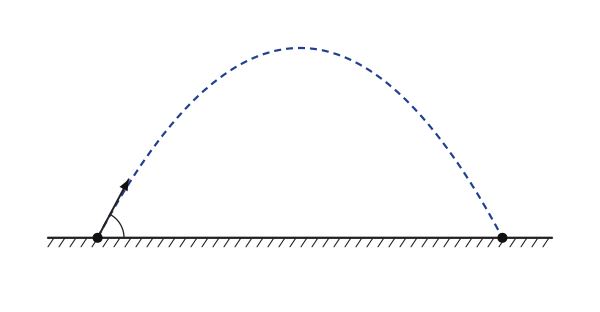
5 marksA hockey player lifts the ball from the point \(A\) on a horizontal pitch. The ball leaves the ground at \(A\) with speed \(17\ \text{m s}^{-1}\), directed upwards at an angle \(\alpha\) to the horizontal, where \(\tan\alpha = \dfrac{15}{8}\). It moves freely under gravity and first lands at the point \(B\) on the pitch. Figure 1 shows the path of the ball. The ball is modelled as a particle.
Find the time that the ball takes to travel from \(A\) to \(B\), and the distance \(AB\).
Use \(g = 9.8\ \text{m s}^{-2}\) and give your answers to 2 or 3 significant figures.
Model answer
\(\sin\alpha = \dfrac{15}{17}\), \(\cos\alpha = \dfrac{8}{17}\), so the initial velocity has components 8 (horizontal) and 15 (vertical).
Vertical, \(A\) to \(B\): \(0 = 15t - 4.9t^2\), \(t ≠ 0\)
\(t = \dfrac{15}{4.9} = 3.06\) s (3 s.f.)
Horizontal: \(AB = 8 \times 3.0612... = 24.5\) m (3 s.f.)
Explanation
Use the 8-15-17 triangle to resolve the velocity into horizontal and vertical components of 8 and 15. The time of flight comes from zero vertical displacement, and the horizontal distance is the constant horizontal speed times this time. Common errors are not resolving the 17 and giving more than 3 significant figures.
Mark scheme
-
1 mark
M1 Uses vertical motion from \(A\) to \(B\) with zero vertical displacement and the resolved component \(17\sin\alpha = 15\): \(0 = 15t - 4.9t^2\); or correct final answers of 3.1 s (3.06 s) and 24 m (24.5 m) with no working
Correct answers of 3.1 s (or 3.06 s) and 24 m (or 24.5 m) with no working score 2 marks (the A1 for each answer). Condone sin/cos confusion and sign errors for this M mark, but the speed must be resolved: using the full speed as a component is M0. \(\sin\alpha = \dfrac{15}{17}\), \(\cos\alpha = \dfrac{8}{17}\). Accept equivalent forms.
-
1 mark
A1 Correct equation: \(0 = 15t - 4.9t^2\) oe
Accept equivalent forms.
-
1 mark
A1 \(t = \dfrac{30}{9.8} = 3.1\) s or 3.06 s
Depends on the M mark. awrt 3.06, i.e. in [3.055, 3.065), or 3.1. Answers from g = 9.8 should be given to 2 or 3 s.f.; a more accurate final answer loses this A mark (over-accuracy is penalised once per question). Use of g = 9.81 is penalised once per question.
-
1 mark
M1 Uses horizontal motion: \(AB = (17\cos\alpha) \times \text{their } t = 8 \times \text{their } t\)
The horizontal component must be resolved.
-
1 mark
A1 \(AB = 24\) m or 24.5 m
awrt 24.5, i.e. in [24.45, 24.55), or 24. Answers from g = 9.8 should be given to 2 or 3 s.f.; a more accurate final answer loses this A mark (over-accuracy is penalised once per question). Use of g = 9.81 is penalised once per question.