
Level:
Correct: 0
Incorrect: 0
Marks: 0/0
Exam Practice
Course:
Topics:
Avg
score:
–
Topics
done:
0/27

Friction and inclined planes

Practise 18 exam-style questions on Friction and inclined planes for Edexcel A-Level Maths (Paper 3). Write your answer as you would in the exam and get it marked in seconds against the mark scheme, point by point, with the Study Helper on hand if you get stuck.

  • 18 questions
  • 3–11 marks each
  • Instant marking
  • No sign-up needed
18 questions, marked as you go

Sample questions with model answers

Here are 4 of the questions in this topic, each with a model answer, an explanation of why it earns the marks and the mark scheme an examiner would use.

Question 1

4 marks

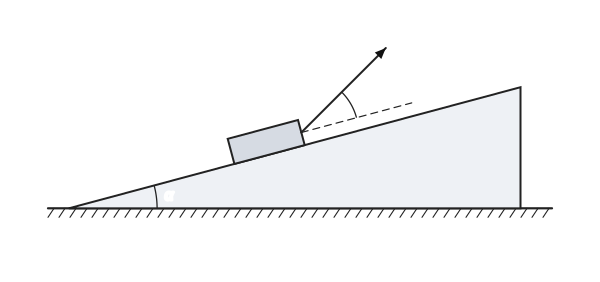
A book of mass 0.6 kg rests in equilibrium on the lid of a desk. The lid is a rough plane inclined at \(15^\circ\) to the horizontal. The book is not necessarily on the point of slipping.

The book is modelled as a particle.

Find the magnitude of the normal reaction of the lid on the book.

Find also the magnitude and direction of the total force exerted on the book by the lid.

Use \(g = 9.8\ \text{m s}^{-2}\) and give your answers to 2 or 3 significant figures.

Model answer

Perpendicular to the lid: \(R = 0.6g\cos 15^\circ = 5.68\) N (3 s.f.)
The book is in equilibrium under two forces: its weight and the total force from the lid (normal reaction and friction combined).
So the total force from the lid balances the weight: magnitude \(0.6g = 5.88\) N, acting vertically upwards.
(Check: \(F = 0.6g\sin 15^\circ = 1.52\) N and \(\sqrt{5.68^2 + 1.52^2} = 5.88\) N.)

Explanation

The normal reaction is only the component of the lid's force perpendicular to the lid, found by resolving the weight: \(0.6g\cos 15^\circ\). The total force from the lid is the resultant of the normal reaction and friction, and since it is the only force other than the weight it must be equal and opposite to the weight. A common error is to treat the normal reaction as the whole force from the surface.

Mark scheme
  1. 1 mark

    M1 Resolves perpendicular to the lid: \(R = 0.6g\cos 15^\circ\); or correct final answers of \(R = 5.7\) N (or 5.68 N) and a total force of 5.88 N acting vertically upwards with no working

    Answers of 5.7 (or 5.68) N, and 5.88 (or 5.9) N acting vertically upwards, with no working score 4 marks. Correct number of terms with the weight resolved: using \(\sin 15^\circ\) (R = 1.52) is M1 A0 (sin/cos confusion is condoned for the method mark). An omitted mass is a method error (M0); an omitted g is an accuracy error. Accept any equivalent form.

  2. 1 mark

    A1 \(R = 5.7\) or 5.68 (N)

    Answers from g = 9.8 should be given to 2 or 3 s.f.: 5.6796 loses this mark (over-accuracy is penalised once per question). Use of g = 9.81 is penalised once per question. Accept awrt 5.68, i.e. [5.675, 5.685), or 5.7.

  3. 1 mark

    B1 The total force exerted on the book by the lid has magnitude \(0.6g = 5.88\) N (or 5.9 N)

    The only forces on the book are its weight and the force from the lid (the normal reaction and friction together), so the force from the lid balances the weight. Also accept it found as \(\sqrt{R^2 + F^2}\) with \(F = 0.6g\sin 15^\circ = 1.52\) N. Accept 0.6g N. B0 for 5.68 N (the normal reaction only).

  4. 1 mark

    B1 The total force exerted on the book by the lid acts vertically upwards

    Accept 'upwards', 'vertically up' or 'opposite to the weight'. 'Perpendicular to the lid' is B0 (that is the direction of the normal reaction only).
Question 2

5 marks

A crate of mass m kg is pulled up a rough ramp onto a loading platform by a light rope. The ramp is inclined at an angle α to the horizontal, where \(\tan\alpha = \dfrac{7}{24}\). The rope lies along a line of greatest slope of the ramp, the tension in the rope is \(\dfrac{2}{5}mg\) newtons and the crate moves up the ramp at constant speed.

The crate is modelled as a particle.

Show that the coefficient of friction between the crate and the ramp is \(\dfrac{1}{8}\).

Model answer

\(\tan\alpha = \dfrac{7}{24}\), so \(\sin\alpha = \dfrac{7}{25}\) and \(\cos\alpha = \dfrac{24}{25}\)
Perpendicular to the ramp: \(R = mg\cos\alpha = \dfrac{24}{25}mg\)
The crate is moving, so \(F = \mu R\), acting down the ramp.
Parallel to the ramp (constant speed): \(\dfrac{2}{5}mg = mg\sin\alpha + \mu R\)
\(\dfrac{2}{5}mg = \dfrac{7}{25}mg + \dfrac{24}{25}\mu mg\)
\(10 = 7 + 24\mu\)
\(\mu = \dfrac{3}{24} = \dfrac{1}{8}\)

Explanation

Constant speed means no resultant force, and moving means friction is \(\mu R\) acting down the ramp, against the motion. Use the 7, 24, 25 triangle for exact values of \(\sin\alpha\) and \(\cos\alpha\), then m and g cancel. Using a decimal angle loses the final mark because the given answer must come from exact working.

Mark scheme
  1. 1 mark

    M1 Resolves perpendicular to the ramp: \(R = mg\cos\alpha\). An answer with no working scores 0 marks.

    An answer with no working scores 0 marks: this is a 'show that' and the given answer must be derived. Condone sin/cos confusion for this mark.

  2. 1 mark

    A1 \(R = \dfrac{24}{25}mg\)

    Exact value needed: \(\cos\alpha = \dfrac{24}{25}\) from \(\tan\alpha = \dfrac{7}{24}\). A decimal angle (16.26°) is A0 here and loses the A1* (exact working is required).

  3. 1 mark

    M1 Resolves parallel to the ramp (no resultant force, as the speed is constant), using \(F = \mu R\): \(\dfrac{2}{5}mg = mg\sin\alpha + \mu R\)

    Correct number of terms and the weight resolved; condone sign errors and sin/cos confusion. An equation with an ma term (a ≠ 0) is M0. An omitted mass in the weight component is a method error (M0); an omitted g is an accuracy error.

  4. 1 mark

    A1 \(\dfrac{2}{5}mg = \dfrac{7}{25}mg + \mu \times \dfrac{24}{25}mg\) oe

    Correct equation with exact trig ratios.

  5. 1 mark

    A1* \(10 = 7 + 24\mu\), so \(\mu = \dfrac{3}{24} = \dfrac{1}{8}\) (cso)

    Depends on the M mark in point 3 (not on the A mark just before). It is cso, so it also needs the correct equation above it. Given answer correctly obtained with at least one line of working after the equation and no wrong working seen. Restating \(\mu = \dfrac{1}{8}\) without a correct derivation scores A0. Verification (substituting \(\mu = \dfrac{1}{8}\) and showing the forces balance) is acceptable only if it ends with a conclusion and every step is correct.

Question 3

7 marks

A small box of roof tiles, of mass 3 kg, is placed on a rough roof. The roof is a plane inclined at an angle α to the horizontal, where \(\tan\alpha = \dfrac{8}{15}\). The coefficient of friction between the box and the roof is 0.25.

The box is held at rest by a light rope, which lies along a line of greatest slope of the roof and pulls up the roof with tension T newtons.

The box is modelled as a particle.

Find the range of values of T for which the box remains at rest.

Use \(g = 9.8\ \text{m s}^{-2}\) and give your answer to 2 or 3 significant figures.

Model answer

\(\tan\alpha = \dfrac{8}{15}\), so \(\sin\alpha = \dfrac{8}{17}\), \(\cos\alpha = \dfrac{15}{17}\)
Perpendicular: \(R = 3g\cos\alpha = \dfrac{45g}{17} = 25.94\) N, so \(\mu R = 0.25R = 6.485\) N
Weight component down the roof: \(3g\sin\alpha = \dfrac{24g}{17} = 13.835\) N
Least T (about to slide down, friction up the slope): \(T + 6.485 = 13.835\), \(T = 7.35\)
Greatest T (about to slide up, friction down the slope): \(T = 13.835 + 6.485 = 20.32\)
So \(7.35 \leqslant T \leqslant 20.3\) (3 s.f.)

Explanation

There are two limiting cases: with the least tension the box is about to slide down and friction acts up the roof, and with the greatest tension it is about to slide up and friction acts down the roof. In each case \(F = \mu R\) with the same R, so the two equations give the ends of the range. A common error is to keep friction in the same direction in both cases.

Mark scheme
  1. 1 mark

    M1 Resolves perpendicular to the roof: \(R = 3g\cos\alpha\); or a correct final answer of \(7.35 \leqslant T \leqslant 20.3\) (or \(7.4 \leqslant T \leqslant 20\)) with no working

    An answer of \(7.35 \leqslant T \leqslant 20.3\) with no working scores 3 marks (the last three A1 marks); the two equations must be seen for the method marks. Condone sin/cos confusion for this mark. Accept any equivalent form.

  2. 1 mark

    A1 \(R = 3g \times \dfrac{15}{17} = \dfrac{45g}{17}\) (= 25.9 N)

    \(\sin\alpha = \dfrac{8}{17}\), \(\cos\alpha = \dfrac{15}{17}\); decimal values from \(\alpha = 28.07^\circ\) are fine. Accept awrt 25.9, i.e. [25.85, 25.95), or the exact form.

  3. 1 mark

    M1 Box on the point of sliding down (friction up the slope): \(T + 0.25R = 3g\sin\alpha\)

    Correct number of terms, weight resolved, \(F = \mu R\) used; condone sign errors and sin/cos confusion. Accept any equivalent form. An omitted mass is a method error (M0); an omitted g is an accuracy error.

  4. 1 mark

    M1 Box on the point of sliding up (friction down the slope): \(T = 3g\sin\alpha + 0.25R\)

    As above. The two equations must have friction in opposite directions. Accept any equivalent form.

  5. 1 mark

    A1 Least value \(T = 7.35\) (or 7.4)

    Not dependent on the point immediately before; depends on the first two M marks. Exact working gives \(\dfrac{3g(8 - 3.75)}{17} = 0.75g = 7.35\).

  6. 1 mark

    A1 Greatest value \(T = 20.3\) (or 20)

    Depends on the first and third M marks. Answers from g = 9.8 should be given to 2 or 3 s.f.: 20.32 loses this mark (over-accuracy penalised once per question). Use of g = 9.81 is penalised once per question. Accept awrt 20.3, i.e. [20.25, 20.35), or 20.

  7. 1 mark

    A1 \(7.35 \leqslant T \leqslant 20.3\)

    Depends on both earlier A1 values being correct. Both inequalities must allow equality (at each end the box is in limiting equilibrium, still at rest): strict inequalities score A0 for this mark only. Accept \(T \in [7.35, 20.3]\) or words such as 'T is between 7.35 and 20.3 inclusive'.

Question 4

9 marks

A sledge with its load has mass m kg. It is pulled up a straight path on a snowy slope at constant speed by a light rope. The path is a rough plane inclined at an angle α to the horizontal, and the coefficient of friction between the sledge and the snow is μ. As shown in Figure 1, the rope lies in the vertical plane containing the line of greatest slope along which the sledge moves, and makes an angle β with this line, above it, where \(0 < \beta < 90^\circ\). The tension in the rope is T newtons.

The sledge is modelled as a particle.

Show that
\[T = \dfrac{mg(\sin\alpha + \mu\cos\alpha)}{\cos\beta + \mu\sin\beta}\]
Given that m = 20, \(\alpha = 10^\circ\) and \(\mu = 0.15\), and that the rope will break if the tension in it exceeds 70 N, find the greatest value of β for which the sledge can be pulled up the path at constant speed without the rope breaking.

Use \(g = 9.8\ \text{m s}^{-2}\) and give your answer in degrees to 3 significant figures.

A sledge on a slope rising to the right at angle alpha. A rope from the sledge points up the slope at angle beta above the line of the slope, with an arrow labelled T N.

Model answer

Perpendicular to the slope: \(R + T\sin\beta = mg\cos\alpha\), so \(R = mg\cos\alpha - T\sin\beta\)
Moving, so \(F = \mu R\), acting down the slope.
Parallel to the slope (constant speed): \(T\cos\beta = mg\sin\alpha + \mu R\)
\(T\cos\beta = mg\sin\alpha + \mu mg\cos\alpha - \mu T\sin\beta\)
\(T(\cos\beta + \mu\sin\beta) = mg(\sin\alpha + \mu\cos\alpha)\)
\(T = \dfrac{mg(\sin\alpha + \mu\cos\alpha)}{\cos\beta + \mu\sin\beta}\)
With m = 20, α = 10° and μ = 0.15: \(20 \times 9.8(\sin 10^\circ + 0.15\cos 10^\circ) = 62.99\)
The rope does not break while \(T \leqslant 70\): \(\dfrac{62.99}{\cos\beta + 0.15\sin\beta} \leqslant 70\), so \(\cos\beta + 0.15\sin\beta \geqslant 0.8998\)
\(\cos\beta + 0.15\sin\beta = \sqrt{1.0225}\cos(\beta - \lambda)\), where \(\tan\lambda = 0.15\), \(\lambda = 8.53^\circ\)
\(\cos(\beta - 8.53^\circ) \geqslant \dfrac{0.8998}{1.0112} = 0.8899\)
\(\cos(\beta - 8.53^\circ) = 0.8899\) gives \(\beta - 8.53^\circ = \pm 27.14^\circ\), so \(\beta = 35.67^\circ\) or \(\beta = -18.6^\circ\) (not in the range).
For \(0 < \beta \leqslant 35.67^\circ\), \(|\beta - 8.53^\circ| \leqslant 27.14^\circ\), so the inequality holds and \(T \leqslant 70\) N; for larger β it fails.
The greatest value of β is \(35.7^\circ\) (3 s.f.).

Explanation

Pulling at an angle above the slope reduces the normal reaction, and so the friction, but also reduces the part of the tension that acts along the slope; the printed result shows the balance between the two. With the numbers, the rope's limit gives \(\cos\beta + 0.15\sin\beta \geqslant 0.900\), which the \(R\cos(\beta - \lambda)\) form solves: T is least at \(\beta = \tan^{-1}0.15\) and increases for larger β, so \(35.7^\circ\) is the greatest safe angle. A common error in the first part is to leave the rope's component out of the normal reaction.

Mark scheme
  1. 1 mark

    M1 Resolves perpendicular to the slope: \(R + T\sin\beta = mg\cos\alpha\) (correct number of terms, both forces resolved). An answer with no working scores 0 marks for the show that; a correct value of \(\beta = 35.7^\circ\) with no working scores 1 mark.

    An answer with no working scores 0 marks for the 'show that' (the given result must be derived). For the second part, SC: \(\beta = 35.7^\circ\) with no working scores 1 mark (the A1 for β; accept awrt 35.7, i.e. [35.65, 35.75)). Condone sin/cos confusion and sign errors for this M mark. An omitted mass is a method error (M0); an omitted g is an accuracy error.

  2. 1 mark

    A1 \(R = mg\cos\alpha - T\sin\beta\)

    A common error is \(R = mg\cos\alpha\) (rope component left out): M0.

  3. 1 mark

    M1 Resolves parallel to the slope with no resultant force (constant speed) and \(F = \mu R\): \(T\cos\beta = mg\sin\alpha + \mu R\)

    Correct number of terms, forces resolved, friction down the slope; condone sign errors and sin/cos confusion.

  4. 1 mark

    A1 \(T\cos\beta = mg\sin\alpha + \mu(mg\cos\alpha - T\sin\beta)\)

    Correct equation with R substituted.

  5. 1 mark

    A1* \(T(\cos\beta + \mu\sin\beta) = mg(\sin\alpha + \mu\cos\alpha)\), giving the printed result (cso)

    Depends on the M mark in point 3 (not on the A mark just before). It is cso, so it also needs the correct equation above it. Given answer: at least one line of working collecting the T terms must be seen, with no wrong working. Restating the result scores A0.

  6. 1 mark

    M1 Substitutes T = 70 and the given values into the printed result to form an equation (or inequality) in β: \(70(\cos\beta + 0.15\sin\beta) = 20g(\sin 10^\circ + 0.15\cos 10^\circ)\), i.e. \(\cos\beta + 0.15\sin\beta = 0.900\)

    The right-hand side is 62.99 (awrt 63.0, i.e. [62.95, 63.05)); accept awrt 0.900, i.e. [0.8995, 0.9005), for the ratio. The inequality \(T \leqslant 70\) is equally good.

  7. 1 mark

    M1 (dM1) Uses a valid method to solve it: \(\cos\beta + 0.15\sin\beta = \sqrt{1.0225}\cos(\beta - \lambda)\) with \(\tan\lambda = 0.15\) (\(\lambda = 8.53^\circ\)), giving \(\cos(\beta - 8.53^\circ) = 0.890\); or another complete method

    Depends on the M mark just before. Accept \(\sqrt{1 + 0.15^2}\) or 1.011 for the amplitude. Squaring to a quadratic in \(\cos\beta\) (or \(\sin\beta\)) and solving is also fine, as is a numerical solution of their equation with the equation shown.

  8. 1 mark

    A1 \(\beta = 35.7^\circ\)

    Accept awrt 35.7, i.e. [35.65, 35.75). The question asks for 3 significant figures, so \(36^\circ\) alone is A0. Use of g = 9.81 (giving \(35.6^\circ\)) is penalised once per question. Radians (0.623) are A0.

  9. 1 mark

    B1 Explains why \(35.7^\circ\) is the greatest value: the other solution, \(\beta = 8.53^\circ - 27.1^\circ = -18.6^\circ\), is not in the range, and for \(0 < \beta < 35.7^\circ\), \(\cos\beta + 0.15\sin\beta > 0.900\), so T < 70 N

    Any correct reason that angles above \(35.7^\circ\) give T > 70 N while smaller angles give T < 70 N, e.g. that T is least at \(\beta = 8.5^\circ\) and increases as β increases beyond this, or a check of T on each side of \(35.7^\circ\). B0 for a bare statement with no reason.

Ready to try the rest? Every answer you write is marked against the mark scheme, so you can see exactly where the marks are.

Study Helper Hints first, answers after you try

Stuck on this one? Ask for a hint and I’ll point you in the right direction, without giving the answer away. Once you’ve checked your answer, I’ll show you how the marks are awarded.