Question 1
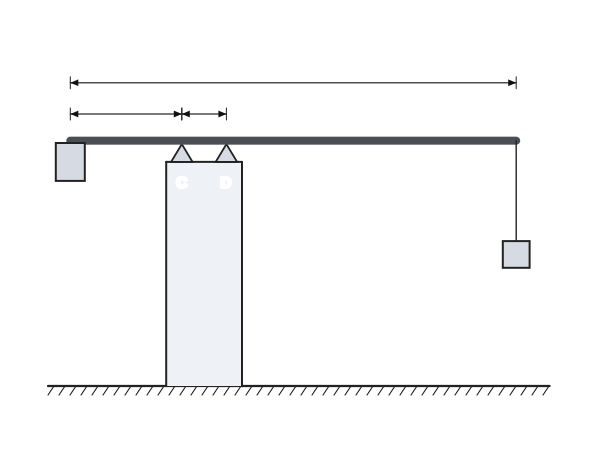
4 marksA non-uniform metre rule AB has length 100 cm. When the rule is placed on a knife-edge at the point 42 cm from A, it rests horizontally in equilibrium.
A small object of mass 50 g is then hung from the rule at the point 10 cm from A. The knife-edge is moved so that the rule again rests horizontally in equilibrium, and the knife-edge is now 34 cm from A.
The object is modelled as a particle.
Find the mass of the rule.
Model answer
The rule balances on its own at 42 cm, so its centre of mass G is 42 cm from A.
With the object, moments about the knife-edge (34 cm from A):
\(Mg \times (42 - 34) = 0.05g \times (34 - 10)\)
\(8M = 1.2\)
\(M = 0.15\) kg, so the mass of the rule is 150 g.
Explanation
When the rule balances on its own, its weight must act through the knife-edge, which locates the centre of mass at 42 cm. With the object added, the moments of the rule's weight and the object's weight about the new knife-edge balance, and the distances are measured from the knife-edge, not from A. A common error is to use distances from A in the moments equation.
Mark scheme
-
1 mark
B1 The centre of mass of the rule is 42 cm from A (the weight acts through the knife-edge when the rule balances on its own); or a correct final answer of 150 g (0.15 kg) with no working
An answer of 150 g (or 0.15 kg) with no working scores 4 marks.
-
1 mark
M1 Takes moments about the knife-edge in its new position (34 cm from A): \(Mg \times (42 - 34) = 0.05g \times (34 - 10)\)
Two terms, each a weight times a distance from the knife-edge; masses in grams with the object as 50 is fine. g may be omitted throughout (it cancels). An omitted distance is a method error: M0.
-
1 mark
A1 \(8M = 0.05 \times 24\) oe
-
1 mark
A1 Mass of the rule 150 g (or 0.15 kg)
Depends on the M mark in point 2 (not on the A mark just before). Units needed here, since the answer could be in grams or kilograms: 150 with no unit is A1 only if the working is clearly in grams.