
Level:
Correct: 0
Incorrect: 0
Marks: 0/0
Exam Practice
Course:
Topics:
Avg
score:
–
Topics
done:
0/27

Connected particles and pulleys

Practise 18 exam-style questions on Connected particles and pulleys for Edexcel A-Level Maths (Paper 3). Write your answer as you would in the exam and get it marked in seconds against the mark scheme, point by point, with the Study Helper on hand if you get stuck.

  • 18 questions
  • 3–11 marks each
  • Instant marking
  • No sign-up needed
18 questions, marked as you go

Sample questions with model answers

Here are 4 of the questions in this topic, each with a model answer, an explanation of why it earns the marks and the mark scheme an examiner would use.

Question 1

6 marks

Two ice skaters, Aled and Bryony, are at rest on a horizontal ice rink, 14 m apart, each holding one end of a light rope. Aled has mass 60 kg and Bryony has mass 45 kg. Aled pulls the rope in, hand over hand, so that the rope stays horizontal and straight and the tension in it is a constant 45 N. The skaters are modelled as particles moving along the straight line joining them, and the ice is modelled as smooth.

Find the time that passes before the skaters meet, and the distance that Aled moves in this time.

[Constant acceleration: \(v = u + at\), \(s = ut + \dfrac{1}{2}at^2\), \(s = vt - \dfrac{1}{2}at^2\), \(v^2 = u^2 + 2as\), \(s = \dfrac{1}{2}(u + v)t\)]

Model answer

The rope is light, so the tension is 45 N at both ends: it pulls each skater towards the other.
Aled: \(45 = 60a_A\), so \(a_A = 0.75\ \text{m s}^{-2}\)
Bryony: \(45 = 45a_B\), so \(a_B = 1\ \text{m s}^{-2}\)
Both start from rest and move towards each other, so they meet when their distances add up to 14 m:
\(\dfrac{1}{2}(0.75)t^2 + \dfrac{1}{2}(1)t^2 = 14\)
\(0.875t^2 = 14\), \(t^2 = 16\), \(t = 4\) s
Aled moves \(\dfrac{1}{2} \times 0.75 \times 4^2 = 6\) m (and Bryony moves 8 m).

Explanation

By Newton's third law the rope pulls Aled towards Bryony as he pulls on it, and because the rope is light the same 45 N tension pulls Bryony towards Aled, so each skater accelerates with 45 N divided by their own mass. They meet when the distances they move from rest add up to 14 m. Common errors are treating the skaters as one body with a single acceleration, and thinking that only Bryony moves because only Aled is pulling.

Mark scheme
  1. 1 mark

    M1 Newton's second law for one skater, with the tension of 45 N as the only horizontal force on that skater: \(45 = 60a_A\) or \(45 = 45a_B\); or correct answers of 4 s and 6 m with no working

    Correct answers of 4 s and 6 m with no working score 2 marks (the final A marks). M0 if the skater's mass is omitted, or if the skaters are treated as one body with a single acceleration (\(45 = 105a\)).

  2. 1 mark

    A1 Aled: \(a_A = 0.75\ \text{m s}^{-2}\) (towards Bryony)

  3. 1 mark

    A1 Bryony: \(a_B = 1\ \text{m s}^{-2}\) (towards Aled), with the same tension of 45 N acting on her

    Depends on the M mark. The rope is light, so the tension is the same at both ends (and by Newton's third law the rope pulls Aled as hard as he pulls it). A tension other than 45 N on Bryony, or \(a_B = 0\), is A0.

  4. 1 mark

    M1 Uses \(s = ut + \dfrac{1}{2}at^2\) from rest for each skater and sets the sum of their distances equal to 14: \(\dfrac{1}{2}(0.75)t^2 + \dfrac{1}{2}(1)t^2 = 14\)

    With their accelerations. M0 for equating the two distances, or for one skater's distance alone equal to 14.

  5. 1 mark

    A1 \(t = 4\) s

  6. 1 mark

    A1 Aled moves \(\dfrac{1}{2} \times 0.75 \times 4^2 = 6\) m

    Depends on the second M mark. ft \(\dfrac{1}{2} \times\) their \(a_A \times\) their \(t^2\). 8 m (Bryony's distance) as the answer is A0. No \(g\) is used, so the answers are exact.
Question 2

7 marks

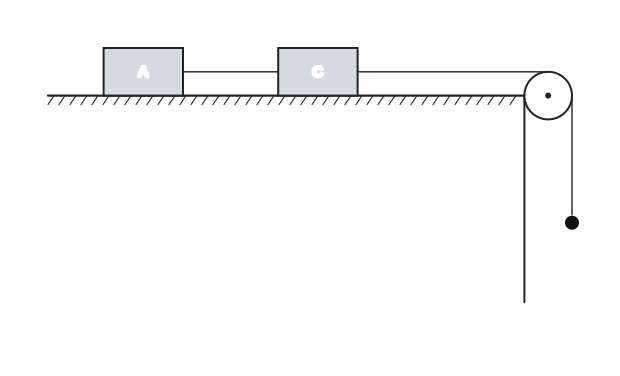
Two blocks \(A\) and \(C\), of masses 3 kg and 2 kg, lie on a smooth horizontal table and are joined by a light inextensible string. A second light inextensible string joins \(C\) to a particle \(B\) of mass 1.5 kg. This string passes over a small smooth pulley fixed at the edge of the table, and \(B\) hangs freely, as shown in Figure 1. Both strings between the blocks and the pulley are horizontal, and the blocks are modelled as particles.

The system is released from rest with both strings taut.

Find the acceleration of \(B\), the tension in the string joining \(A\) and \(C\), and the tension in the string joining \(C\) and \(B\).

Use \(g = 9.8\ \text{m s}^{-2}\) and give your answers to 2 or 3 significant figures.

Figure 1: two blocks, A on the left and C to its right, on a horizontal table, joined by a horizontal string. A second horizontal string runs from C to a small pulley at the right-hand edge of the table, passes over it and hangs vertically down to a particle B.

Model answer

Whole system (all particles have the same magnitude of acceleration): \(1.5g = (3 + 2 + 1.5)a\)
\(a = \dfrac{14.7}{6.5} = 2.262\), so \(a = 2.26\ \text{m s}^{-2}\) (3 s.f.)
\(A\): \(T_1 = 3a = 6.785\), so the tension in \(AC\) is 6.78 N (3 s.f.)
\(A\) and \(C\) together: \(T_2 = 5a = 11.31\), so the tension in \(CB\) is 11.3 N (3 s.f.)
(Check with \(B\): \(1.5g - T_2 = 14.7 - 11.31 = 3.39 = 1.5a\).)

Explanation

Because the strings are inextensible, all three particles have the same magnitude of acceleration, and the weight of \(B\) is the only external force driving the system, so \(1.5g = 6.5a\). Each tension then comes from the part of the system that it alone accelerates: \(T_1\) accelerates \(A\), and \(T_2\) accelerates \(A\) and \(C\) together. A common error is to use the same tension in both strings.

Mark scheme
  1. 1 mark

    M1 Equation of motion for the whole system (or for \(B\) with the tension): \(1.5g = 6.5a\); or correct answers of \(2.26\ \text{m s}^{-2}\), 6.78 N and 11.3 N with no working

    Correct answers of \(a = 2.26\ \text{m s}^{-2}\), 6.78 N (string \(AC\)) and 11.3 N (string \(CB\)) with no working score 3 marks (the A marks for the values). Equations need the correct masses; an omitted \(g\) is an accuracy error. Accept any equivalent form.

  2. 1 mark

    A1 Correct equation

    Or the three separate equations \(T_1 = 3a\), \(T_2 - T_1 = 2a\), \(1.5g - T_2 = 1.5a\).

  3. 1 mark

    A1 \(a = 2.26\ \text{m s}^{-2}\) (accept 2.3 or \(\dfrac{3g}{13}\))

    Depends on the first M mark. Answers from g = 9.8 to 2 or 3 s.f. Use of g = 9.81 is penalised once in this question.

  4. 1 mark

    M1 Equation of motion for \(A\): \(T_1 = 3a\)

  5. 1 mark

    A1 Tension in \(AC\) \(= 6.78\) N or 6.8 N

    6.785 is over-accurate (penalise over-accuracy once in the question). Accept awrt 6.78, i.e. [6.775, 6.785), or 6.8.

  6. 1 mark

    M1 Equation of motion for \(B\) (\(1.5g - T_2 = 1.5a\)), or for \(A\) and \(C\) together (\(T_2 = 5a\))

    Accept any equivalent form.

  7. 1 mark

    A1 Tension in \(CB\) \(= 11.3\) N or 11 N

    Each tension must be linked to the correct string. Accept awrt 11.3, i.e. [11.25, 11.35), or 11.

Question 3

8 marks

A car of mass 1250 kg tows a caravan of mass 850 kg using a light rigid towbar, which is parallel to the direction of motion. The engine of the car produces a constant driving force of 2430 N. The resistances to motion are modelled as constant forces of magnitude 420 N on the car and 330 N on the caravan. The car and the caravan are modelled as particles.

At first, the car and the caravan move along a straight horizontal road. Find the acceleration of the car and the caravan, and the tension in the towbar.

The car and the caravan then move up a straight hill, which is inclined at an angle \(\alpha\) to the horizontal, where \(\sin\alpha = \dfrac{1}{20}\). The towbar stays parallel to the road, and the driving force and the resistances are unchanged. Find the acceleration of the car and the caravan on the hill, and show that the tension in the towbar is the same as on the horizontal road.

Use \(g = 9.8\ \text{m s}^{-2}\) and give your answers to 2 or 3 significant figures.

Model answer

Horizontal road, car and caravan together: \(2430 - 420 - 330 = 2100a\)
\(1680 = 2100a\), so \(a = 0.8\ \text{m s}^{-2}\)
Caravan: \(T - 330 = 850 \times 0.8 = 680\), so \(T = 1010\) N
Hill: the component of the total weight down the slope is \(2100g\sin\alpha = 2100 \times 9.8 \times \dfrac{1}{20} = 1029\) N
Car and caravan together: \(2430 - 420 - 330 - 1029 = 2100a\)
\(651 = 2100a\), so \(a = 0.31\ \text{m s}^{-2}\)
Caravan: \(T - 330 - 850g\sin\alpha = 850a\)
\(T = 330 + 416.5 + 850 \times 0.31 = 330 + 416.5 + 263.5 = 1010\) N
So the tension in the towbar on the hill is 1010 N, the same as on the horizontal road.

Explanation

Treating the car and caravan as one body removes the towbar force, so the driving force and the resistances give the acceleration, and the caravan's own equation then gives the tension. On the hill each vehicle also has a component of its weight down the slope in proportion to its mass, which lowers the acceleration of both by \(g\sin\alpha = 0.49\ \text{m s}^{-2}\), so the towbar's pull on the caravan is unchanged. Common errors are leaving out the weight component on the hill and resolving the weight with \(\cos\alpha\).

Mark scheme
  1. 1 mark

    M1 Newton's second law for the car and caravan together on the horizontal road: \(2430 - 420 - 330 = 2100a\); or correct final answers of \(0.8\ \text{m s}^{-2}\) and 1010 N on the horizontal road and \(0.31\ \text{m s}^{-2}\) on the hill with no working

    Correct answers of an acceleration of \(0.8\ \text{m s}^{-2}\) and a tension of 1010 N on the horizontal road, and an acceleration of \(0.31\ \text{m s}^{-2}\) on the hill, with no working score 3 marks (the A marks for these three values); the final A1* needs the caravan's equation on the hill. All of these values are exact with g = 9.8. Alternative: separate equations for the car (\(2430 - 420 - T = 1250a\)) and the caravan (\(T - 330 = 850a\)) solved together earn the first two M marks and their A marks. Each equation needs the correct number of terms and must be dimensionally correct; sign errors are condoned for the M marks. M0 if a mass is omitted.

  2. 1 mark

    A1 \(a = 0.8\ \text{m s}^{-2}\)

    Exact (no \(g\) is used on the horizontal road). Accept 0.80.

  3. 1 mark

    M1 Newton's second law for the caravan on the horizontal road: \(T - 330 = 850a\) (or for the car: \(2430 - 420 - T = 1250a\)), with their \(a\)

    M0 if the towbar force is left out or the wrong mass is used.

  4. 1 mark

    A1 \(T = 1010\) N

    Exact.

  5. 1 mark

    M1 Newton's second law for the car and caravan together on the hill, with the weight resolved along the slope: \(2430 - 420 - 330 - 2100g\sin\alpha = 2100a\)

    The weight component is \(2100 \times 9.8 \times \dfrac{1}{20} = 1029\) N. Every term must be present and the weight resolved; sin/cos confusion and sign errors are condoned for the M mark. An omitted \(g\) is an accuracy error; an omitted mass in the weight term is M0.

  6. 1 mark

    A1 \(a = 0.31\ \text{m s}^{-2}\)

    Exact with g = 9.8; accept 0.310. Use of g = 9.81 (giving 0.3095) is penalised once in this question. Answers from g = 9.8 should be given to 2 or 3 s.f.

  7. 1 mark

    M1 Newton's second law for the caravan on the hill, with its weight resolved: \(T - 330 - 850g\sin\alpha = 850a\) (or for the car: \(2430 - 420 - 1250g\sin\alpha - T = 1250a\)), with their \(a\)

    The caravan's weight component is \(850 \times 9.8 \times \dfrac{1}{20} = 416.5\) N (the car's is 612.5 N). Leaving out the weight component is M0.

  8. 1 mark

    A1* \(T = 330 + 416.5 + 263.5 = 1010\) N, which is the same as the tension on the horizontal road

    cso: 1010 N (exact) from a correct equation on the hill and a statement that it is the same as (equal to) the tension on the horizontal road. Restating 1010 N without an equation for the hill scores M0 A0. An answer with no working scores 0 marks for this part.

Question 4

9 marks

Two particles \(A\) and \(B\), of masses 0.9 kg and 0.6 kg, are attached to the ends of a light inextensible string, which passes over a small smooth fixed pulley. The particles hang with the hanging parts of the string vertical and taut. Particle \(B\) is then projected vertically downwards with speed \(2\ \text{m s}^{-1}\), so that \(A\) starts to move upwards with the same speed. In the subsequent motion neither particle reaches the pulley or the ground.

Find the distance that \(B\) moves downwards before it first comes to instantaneous rest.

Find the time from the moment of projection until \(B\) first returns to its starting position.

Use \(g = 9.8\ \text{m s}^{-2}\) and give your answers to 2 or 3 significant figures.

[Constant acceleration: \(v = u + at\), \(s = ut + \dfrac{1}{2}at^2\), \(s = vt - \dfrac{1}{2}at^2\), \(v^2 = u^2 + 2as\), \(s = \dfrac{1}{2}(u + v)t\)]

Model answer

Take downwards positive for \(B\) and upwards positive for \(A\).
\(B\): \(0.6g - T = 0.6a\)
\(A\): \(T - 0.9g = 0.9a\)
Adding: \(-0.3g = 1.5a\), so \(a = -0.2g = -1.96\ \text{m s}^{-2}\)
\(B\) slows down: \(v^2 = u^2 + 2as\), \(0 = 2^2 - 2 \times 1.96 \times s\), \(s = \dfrac{4}{3.92} = 1.020\)
Distance \(= 1.02\) m (3 s.f.)
The acceleration stays \(-1.96\ \text{m s}^{-2}\) after \(B\) stops and it moves back up. Return to the start: \(s = ut + \dfrac{1}{2}at^2\), \(0 = 2t - 0.98t^2\), \(t = \dfrac{2}{0.98} = 2.041\)
Time \(= 2.04\) s (3 s.f.)

Explanation

Particle \(A\) is the heavier, so the resultant of the weights, \(0.3g\), acts against \(B\)'s initial downward motion, and equations of motion for both particles (with the same tension) give a constant deceleration of \(0.2g\). The forces do not change when \(B\) stops and moves back up, so one suvat equation with \(s = 0\) covers the whole trip. A common error is to assume \(B\) keeps speeding up because it is moving downwards.

Mark scheme
  1. 1 mark

    M1 Equation of motion for \(B\), taking downwards as positive for \(B\): \(0.6g - T = 0.6a\); or correct answers of 1.02 m and 2.04 s with no working

    Correct answers of 1.02 m (or 1.0 m) and 2.04 s (or 2.0 s) with no working score 2 marks (the A marks for the two answers). Allow the whole-system equation \(0.6g - 0.9g = 1.5a\) in place of either equation. Masses must be correct; an omitted \(g\) is an accuracy error. Accept any equivalent form.

  2. 1 mark

    A1 Correct equation

  3. 1 mark

    M1 Equation of motion for \(A\), with the same direction convention (upwards for \(A\)): \(T - 0.9g = 0.9a\)

    Accept any equivalent form.

  4. 1 mark

    A1 Correct equation

  5. 1 mark

    A1 \(a = -1.96\ \text{m s}^{-2}\): \(B\) decelerates at \(1.96\ \text{m s}^{-2}\) (\(0.2g\))

    Depends on both M marks. Taking \(B\) to accelerate downwards (\(a = +1.96\) with \(B\) moving faster) is A0: \(A\) is heavier, so the system slows down. Accept a magnitude of 2.0 (2 s.f.) or \(0.2g\).

  6. 1 mark

    M1 Uses \(v^2 = u^2 + 2as\) with \(u = 2\), \(v = 0\) and their deceleration

    Any complete suvat method.

  7. 1 mark

    A1 Distance \(= 1.02\) m or 1.0 m

    Answers from g = 9.8 to 2 or 3 s.f.: 1.020 is over-accurate (penalise once in the question). Use of g = 9.81 is penalised once in this question.

  8. 1 mark

    M1 Complete method for the time to return, e.g. \(s = ut + \dfrac{1}{2}at^2\) with \(s = 0\), \(u = 2\), \(a = -1.96\), or twice the time to come to rest

    The acceleration is the same throughout, because the forces do not change; using a different acceleration for the return is M0. Accept any equivalent form.

  9. 1 mark

    A1 Time \(= 2.04\) s or 2.0 s

    Accept awrt 2.04, i.e. [2.035, 2.045), or 2.0.

Ready to try the rest? Every answer you write is marked against the mark scheme, so you can see exactly where the marks are.

Study Helper Hints first, answers after you try

Stuck on this one? Ask for a hint and I’ll point you in the right direction, without giving the answer away. Once you’ve checked your answer, I’ll show you how the marks are awarded.