Level:
Correct: 0
Incorrect: 0
Marks: 0/0
Exam Practice
Course:
Topics:
Avg
score:
–
Topics
done:
0/27

Graphs in kinematics

Practise 18 exam-style questions on Graphs in kinematics for Edexcel A-Level Maths (Paper 3). Write your answer as you would in the exam and get it marked in seconds against the mark scheme, point by point, with the Study Helper on hand if you get stuck.

  • 18 questions
  • 2–9 marks each
  • Instant marking
  • No sign-up needed
18 questions, marked as you go

Sample questions with model answers

Here are 4 of the questions in this topic, each with a model answer, an explanation of why it earns the marks and the mark scheme an examiner would use.

Question 1

4 marks

A lift rises vertically from rest at the ground floor of a building and stops at the top floor, 39 m higher, 16 seconds later. The lift is modelled as accelerating uniformly for the first 4 seconds, then moving at a constant speed of \(V\ \text{m s}^{-1}\), and then decelerating uniformly for the last 2 seconds.

Using the model, find the value of \(V\), and find the time taken for the lift to rise the first 20 m. Give any answer that is not exact to 3 significant figures.

Model answer

Time at constant speed \(= 16 - 4 - 2 = 10\) s
Area under the speed-time graph: \(\tfrac{1}{2}(16 + 10)V = 39\)
\(13V = 39\), so \(V = 3\)
In the first 4 s the lift rises \(\tfrac{1}{2} \times 4 \times 3 = 6\) m.
It rises the next \(20 - 6 = 14\) m at \(3\ \text{m s}^{-1}\), taking \(\dfrac{14}{3}\) s.
Time to rise 20 m \(= 4 + \dfrac{14}{3} = \dfrac{26}{3} = 8.67\) s (3 s.f.)

Explanation

The speed-time graph is a trapezium whose parallel sides are the total time (16 s) and the time at constant speed (10 s), and its area is the 39 m risen. The first 20 m is reached during the constant-speed stage, after the 6 m covered while accelerating. A common error is to divide 20 by \(V\), ignoring the slower start.

Mark scheme
  1. 1 mark

    M1 Uses the area under the speed-time graph (a trapezium with parallel sides 16 and \(16 - 4 - 2 = 10\)): \(\tfrac{1}{2}(16 + 10)V = 39\), or an equivalent sum of three areas; or correct final answers of \(V = 3\) and 8.67 s with no working

    Answers of \(V = 3\) and 8.67 s (or \(\dfrac{26}{3}\) s) with no working score 4 marks. A missing \(\tfrac{1}{2}\) is M0.

  2. 1 mark

    A1 \(V = 3\)

    cao

  3. 1 mark

    M1 Distance in the first 4 s, \(\tfrac{1}{2} \times 4 \times\) their \(V\), then the time at constant speed for the rest of the 20 m, \(\dfrac{20 - \text{their } 6}{\text{their } V}\), added to 4

    Must use their \(V\). M0 for \(\dfrac{20}{V}\) alone, which ignores the slower accelerating stage.

  4. 1 mark

    A1 \(\dfrac{26}{3}\) s, awrt 8.67, i.e. [8.665, 8.675)

    Accept \(8\tfrac{2}{3}\).
Question 2

5 marks

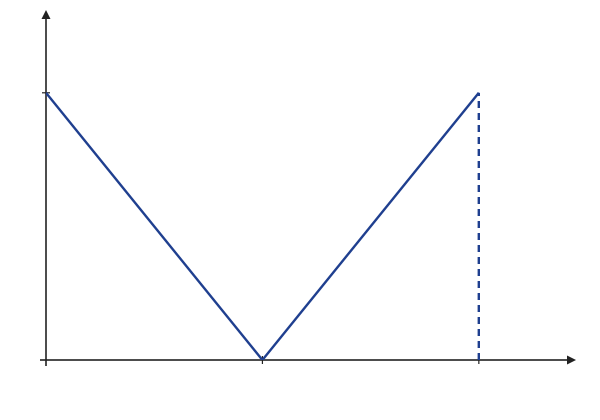
A small block is projected up a line of greatest slope of a smooth ramp and then slides back down along the same line. Figure 1 shows the speed-time graph of the block for the first 8 seconds of its motion. Its speed decreases uniformly from \(6\ \text{m s}^{-1}\) to zero in the first 4 seconds, and then increases uniformly back to \(6\ \text{m s}^{-1}\) in the next 4 seconds.

Find the total distance that the block travels in the 8 seconds, and its displacement from its starting point at the end of the 8 seconds.

Taking the direction up the ramp as positive, describe fully the velocity-time graph of the block for \(0 \leqslant t \leqslant 8\).

A sketch of a speed-time graph, with speed (m s⁻¹) on the vertical axis and t (s) on the horizontal axis. A V-shaped graph: a straight line from speed 6 at t = 0 down to the t-axis at t = 4, then a straight line back up to speed 6 at t = 8.

Model answer

Distance = area under the speed-time graph \(= \tfrac{1}{2} \times 4 \times 6 + \tfrac{1}{2} \times 4 \times 6 = 12 + 12 = 24\) m
The block goes 12 m up the ramp and 12 m back down, so its displacement from its starting point is 0.
Velocity-time graph: velocity is positive (up the ramp) for the first 4 s and negative afterwards, and it changes at a constant rate of \(-1.5\ \text{m s}^{-2}\) throughout. So the graph is a single straight line from \((0, 6)\) through \((4, 0)\) to \((8, -6)\).

Explanation

A speed-time graph gives distance, so both triangles add to 24 m, but the block travels the second 12 m in the opposite direction, so its displacement is zero. On a velocity-time graph the downhill motion has negative velocity, and the acceleration is the same throughout, so the graph is one straight line of gradient \(-1.5\) from 6 to \(-6\). A common error is to draw the velocity-time graph as a V shape, which would mean the acceleration changed direction at \(t = 4\).

Mark scheme
  1. 1 mark

    M1 Total distance = sum of the two triangle areas: \(\tfrac{1}{2} \times 4 \times 6 + \tfrac{1}{2} \times 4 \times 6\); or a correct final answer of 24 m with no working

    An answer of 24 m with no working scores 2 marks; the displacement and the description are marked on their own points.

  2. 1 mark

    A1 24 m

    cao

  3. 1 mark

    B1 Displacement 0 (it is back at its starting point), because the 12 m up the ramp and the 12 m down the ramp are in opposite directions

    Must give 0 with a reason (opposite directions, or returns to the start). B0 for 24 m.

  4. 1 mark

    B1 The velocity-time graph is a single straight line (constant gradient \(-1.5\))

    Accept "a straight line with negative gradient". B0 for a V shape or for two separate lines meeting at the axis with different gradients.

  5. 1 mark

    B1 It goes from \(v = 6\) at \(t = 0\) to \(v = -6\) at \(t = 8\), crossing the \(t\)-axis at \(t = 4\)

    Both end values with their signs needed (the crossing at \(t = 4\) then follows). Accept the points \((0, 6)\), \((4, 0)\) and \((8, -6)\).

Question 3

7 marks

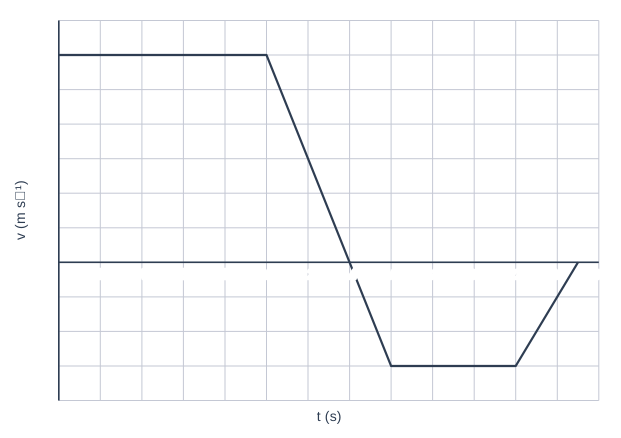
A shunting locomotive moves along a straight horizontal track. At time \(t = 0\) it passes a signal post \(S\). Figure 1 shows the velocity-time graph of the locomotive for \(0 \leqslant t \leqslant 25\), where \(v\ \text{m s}^{-1}\) is its velocity in the direction in which it is moving at \(t = 0\).

Write down the time at which the locomotive changes its direction of motion.

Find the total distance that the locomotive travels during the 25 seconds, and the distance of the locomotive from \(S\) when \(t = 25\).

A graph of v (m s⁻¹) (vertical axis, −4 to 7, marked every 1) against t (s) (horizontal axis, 0 to 26, marked every 2), on a grid. The graph is made of straight-line sections; its values can be read from the grid.

Model answer

The velocity changes sign at \(t = 14\), so the locomotive changes direction when \(t = 14\).
Area above the axis: \(6 \times 10 + \tfrac{1}{2} \times 4 \times 6 = 60 + 12 = 72\)
Area below the axis: \(\tfrac{1}{2} \times 2 \times 3 + 6 \times 3 + \tfrac{1}{2} \times 3 \times 3 = 3 + 18 + 4.5 = 25.5\)
Total distance \(= 72 + 25.5 = 97.5\) m
Displacement from \(S\) \(= 72 - 25.5 = 46.5\) m, so the locomotive is 46.5 m from \(S\).

Explanation

The locomotive reverses where the graph crosses the \(t\)-axis, and the areas above and below the axis are distances travelled in opposite directions. The total distance adds the two areas, but the displacement from \(S\) subtracts the area below the axis from the area above it. A common error is to give 97.5 m as the distance from \(S\).

Mark scheme
  1. 1 mark

    B1 \(t = 14\); correct answers of 97.5 m and 46.5 m with no working score the remaining marks

    Answers of \(t = 14\), 97.5 m and 46.5 m with no working score 7 marks. The time may be read from the grid or found from the gradient \(-1.5\): \(10 + \dfrac{6}{1.5} = 14\).

  2. 1 mark

    M1 Area above the \(t\)-axis (\(0 \leqslant t \leqslant 14\)) by a complete method: \(6 \times 10 + \tfrac{1}{2} \times 4 \times 6\) (or \(\tfrac{1}{2}(10 + 14) \times 6\))

    Must use their time from the first mark. A missing \(\tfrac{1}{2}\) in a triangle or trapezium is M0.

  3. 1 mark

    A1 72

    cao

  4. 1 mark

    M1 Area between the graph and the \(t\)-axis below the axis (\(14 \leqslant t \leqslant 25\)) by a complete method: \(\tfrac{1}{2} \times 2 \times 3 + 6 \times 3 + \tfrac{1}{2} \times 3 \times 3\) (or \(\tfrac{1}{2}(11 + 6) \times 3\))

    The area may be written as negative.

  5. 1 mark

    A1 25.5

    Accept \(-25.5\) at this stage.

  6. 1 mark

    A1ft Total distance \(= 72 + 25.5 = 97.5\) m (their positive area + their negative area, both counted as positive)

    Depends on both M marks. ft their 72 and their 25.5.

  7. 1 mark

    A1ft Distance from \(S\) \(= 72 - 25.5 = 46.5\) m (their 72 minus their 25.5)

    Depends on both M marks. A common error is to give 97.5 m for both answers, treating all of the area as displacement.

Question 4

8 marks

Average speed cameras record the time that each vehicle takes to travel along a 1440 m section of motorway through roadworks. The average speed of a vehicle over the section must not be more than \(20\ \text{m s}^{-1}\).

A car enters the section with speed \(30\ \text{m s}^{-1}\). In a model of its motion, the car decelerates uniformly at \(0.5\ \text{m s}^{-2}\) from the start of the section until its speed is \(V\ \text{m s}^{-1}\), and then keeps a constant speed of \(V\ \text{m s}^{-1}\) until it leaves the section.

By using a speed-time graph, or otherwise, find the value of \(V\) for which the average speed of the car over the section is exactly \(20\ \text{m s}^{-1}\).

Model answer

Time decelerating \(= \dfrac{30 - V}{0.5} = 60 - 2V\)
Distance decelerating (area of the trapezium) \(= \tfrac{1}{2}(30 + V)(60 - 2V) = (30 + V)(30 - V) = 900 - V^2\)
Time at constant speed \(= \dfrac{1440 - (900 - V^2)}{V} = \dfrac{540 + V^2}{V}\)
For an average speed of \(20\ \text{m s}^{-1}\), the total time is \(\dfrac{1440}{20} = 72\) s:
\(60 - 2V + \dfrac{540 + V^2}{V} = 72\)
\(60V - 2V^2 + 540 + V^2 = 72V\)
\(V^2 + 12V - 540 = 0\)
\((V - 18)(V + 30) = 0\)
\(V > 0\), so \(V = 18\)

Explanation

The average speed is the total distance divided by the total time, so the car must take exactly 72 s to cover the 1440 m. Writing the time and distance of the slowing-down stage in terms of \(V\), and then the time for the rest of the section, gives a quadratic in \(V\); on the speed-time graph the same equation says that the area of a rectangle of height \(V\) plus a triangle on top of it is 1440. A common error is to average the speeds 30 and \(V\) instead of using the total time.

Mark scheme
  1. 1 mark

    B1 Time decelerating \(= \dfrac{30 - V}{0.5} = 60 - 2V\) (seen or used); a correct final answer of \(V = 18\) with no working scores 1 mark

    An answer of \(V = 18\) with no working scores 1 mark (the final A1): this is a multi-step problem and the methods must be seen for the other marks.

  2. 1 mark

    M1 Distance while decelerating, by the area of the trapezium or by suvat: \(\tfrac{1}{2}(30 + V)(60 - 2V)\), or \(\dfrac{30^2 - V^2}{2 \times 0.5}\)

    Must be in terms of \(V\) only, with the correct number of terms. Alternative method on the speed-time graph: total time 72 s, and total area \(= 72V + \tfrac{1}{2}(30 - V)(60 - 2V) = 1440\) (a rectangle of height \(V\) and a triangle on top of it); this equation earns M1 A1 M1 M1 A1 when complete and correct.

  3. 1 mark

    A1 \(900 - V^2\)

    Any correct form, e.g. \((30 + V)(30 - V)\).

  4. 1 mark

    M1 Time at constant speed: \(\dfrac{1440 - (900 - V^2)}{V}\) (their deceleration distance)

    Must subtract their distance from 1440 and divide by \(V\).

  5. 1 mark

    M1 (dM1) Equation for the total time, which must be \(\dfrac{1440}{20} = 72\) s: \(60 - 2V + \dfrac{540 + V^2}{V} = 72\)

    Depends on the previous M mark. M0 for averaging speeds, e.g. \(\dfrac{30 + V}{2} = 20\) (a common error, giving 10).

  6. 1 mark

    A1 \(V^2 + 12V - 540 = 0\) oe

    Any correct three-term quadratic, e.g. \(-V^2 - 12V + 540 = 0\).

  7. 1 mark

    M1 (dM1) Solves their three-term quadratic by factorising, the formula or completing the square

    Depends on the third M mark (not on the A mark just before it).

  8. 1 mark

    A1 \(V = 18\) only

    The negative root \(-30\) must be rejected or ignored. Units not required.

Ready to try the rest? Every answer you write is marked against the mark scheme, so you can see exactly where the marks are.

Study Helper Hints first, answers after you try

Stuck on this one? Ask for a hint and I’ll point you in the right direction, without giving the answer away. Once you’ve checked your answer, I’ll show you how the marks are awarded.