
Level:
Correct: 0
Incorrect: 0
Marks: 0/0
Exam Practice
Course:
Topics:
Avg
score:
–
Topics
done:
0/27

Moments: ladders and non-parallel forces

Practise 16 exam-style questions on Moments: ladders and non-parallel forces for Edexcel A-Level Maths (Paper 3). Write your answer as you would in the exam and get it marked in seconds against the mark scheme, point by point, with the Study Helper on hand if you get stuck.

  • 16 questions
  • 3–12 marks each
  • Instant marking
  • No sign-up needed
16 questions, marked as you go

Sample questions with model answers

Here are 4 of the questions in this topic, each with a model answer, an explanation of why it earns the marks and the mark scheme an examiner would use.

Question 1

5 marks

A builder uses a crowbar to lift the edge of a heavy paving slab. The crowbar is modelled as a light rod \(AB\) of length 1.2 m, which rests on a small fixed block at the point \(C\), where \(BC = 0.15\) m. The crowbar lies in a vertical plane and makes an angle of \(20^\circ\) with the horizontal, with \(B\) below \(A\), as shown in Figure 1. The edge of the slab exerts a vertical downward force of 900 N on the crowbar at \(B\). The builder pushes on the crowbar at \(A\) with a force of magnitude \(P\) newtons, perpendicular to \(AB\). The crowbar is in equilibrium.

Find the value of \(P\), and the magnitude of the force exerted on the crowbar by the block at \(C\).

Give your answers to 3 significant figures.
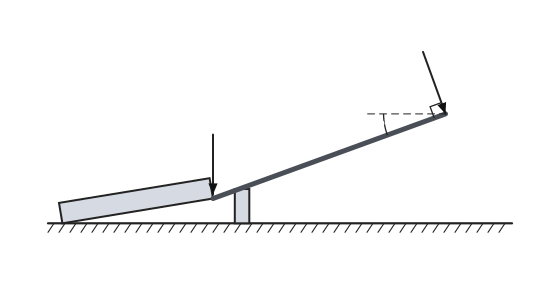
Figure 1: a crowbar AB rises from B, under the raised edge of a slab, to A, making 20 degrees with the horizontal. It rests on a small block at C, a short distance from B. An arrow labelled 900 N acts vertically downwards at B, and an arrow labelled P N acts at A perpendicular to the crowbar.

Model answer

\(AC = 1.2 - 0.15 = 1.05\) m. \(P\) is perpendicular to \(AB\), so its moment arm about \(C\) is 1.05 m; the 900 N force is vertical, so its moment arm is \(0.15\cos 20^\circ\).
Moments about \(C\): \(1.05P = 900 \times 0.15\cos 20^\circ = 126.86\), so \(P = 120.8\); \(P = 121\) (3 s.f.)
\(P\) acts downwards at \(20^\circ\) to the vertical, so its components are \(P\sin 20^\circ = 41.32\) N horizontally and \(P\cos 20^\circ = 113.5\) N vertically downwards.
Force from the block: horizontal component 41.32 N, vertical component \(900 + 113.5 = 1013.5\) N
Magnitude \(= \sqrt{41.32^2 + 1013.5^2} = 1014.4\), i.e. 1010 N (3 s.f.)

Explanation

Taking moments about the fulcrum \(C\) removes the unknown force from the block; the builder's force is perpendicular to the bar, so its arm is the full 1.05 m, while the vertical 900 N force has arm \(0.15\cos 20^\circ\). The block must balance both other forces, so resolving horizontally and vertically gives its components and Pythagoras its magnitude. A common error is to use 0.15 m as the arm of the 900 N force.

Mark scheme
  1. 1 mark

    M1 Moments about \(C\): \(P \times 1.05 = 900 \times 0.15\cos 20^\circ\) (perpendicular distances: 1.05 m for \(P\), \(0.15\cos 20^\circ\) for the vertical force); or correct final answers of \(P = 121\) and 1010 N with no working

    Correct answers of \(P = 121\) and 1010 N (accept 1014 N) with no working score 2 marks (the A marks for the two answers). A distance with a missing or wrong trig factor (e.g. \(900 \times 0.15\) or \(P \times 1.05\cos 20^\circ\)) is M0. Taking moments about \(C\) with the components of \(P\) is fine.

  2. 1 mark

    A1 \(P = 121\)

    Accept awrt 121, i.e. [120.5, 121.5).

  3. 1 mark

    M1 Resolves horizontally and vertically for the force at \(C\): horizontal component \(P\sin 20^\circ\), vertical component \(900 + P\cos 20^\circ\)

    Both resolutions needed, with \(P\) resolved. The force at \(C\) is not perpendicular to the crowbar: the block exerts friction as well as a normal reaction.

  4. 1 mark

    A1 Components 41.3 N and 1014 N (or 1010 N)

    Both needed. Accept awrt 41.3, i.e. [41.25, 41.35), and 1010 to 1014.

  5. 1 mark

    A1 Magnitude \(= 1010\) N (accept 1014 N)

    Depends on the second M mark. \(\sqrt{41.3^2 + 1013.5^2} = 1014.4\); accept 1010 (3 s.f.) or 1014.
Question 2

7 marks

A trapdoor in a horizontal floor is modelled as a uniform rod \(AB\), of length 1.5 m and mass 16 kg, which is freely hinged at \(A\). Rosa holds the trapdoor at rest, open at an angle of \(50^\circ\) to the floor, by applying a single force at \(B\) in the vertical plane containing \(AB\).

Rosa first applies a vertical force at \(B\). Find the magnitude of this force, and the magnitude of the force exerted on the trapdoor by the hinge.

Find the least possible magnitude of a force at \(B\) that holds the trapdoor in this position, and describe its direction.

Explain why the vertical force needed at \(B\) is the same whatever the angle at which the trapdoor is held open, whereas the least force is not.

Use \(g = 9.8\ \text{m s}^{-2}\) and give your answers to 2 or 3 significant figures.

Model answer

Vertical force: moments about \(A\), \(V \times 1.5\cos 50^\circ = 16g \times 0.75\cos 50^\circ\), so \(V = 8g = 78.4\) N
Resolving vertically: hinge force \(= 16g - 8g = 8g = 78.4\) N, vertically upwards
The least force has the largest possible moment arm about \(A\), 1.5 m, so it is perpendicular to \(AB\):
\(P \times 1.5 = 16g \times 0.75\cos 50^\circ\), so \(P = 8g\cos 50^\circ = 50.39\)
Least force \(= 50.4\) N (3 s.f.), perpendicular to the trapdoor, pulling away from the floor.
At angle \(\theta\): a vertical force gives \(V \times 1.5\cos\theta = 16g \times 0.75\cos\theta\), so \(V = 8g\) for every \(\theta\); the least force gives \(1.5P = 12g\cos\theta\), which depends on \(\theta\).

Explanation

Take moments about the hinge so that its unknown force does not appear: a vertical force at \(B\) and the weight at the midpoint both have arms proportional to \(\cos\theta\), so the vertical force is always half the weight. A force perpendicular to the trapdoor has the greatest possible arm, 1.5 m, so it is the least force, \(8g\cos 50^\circ\). A common error is to use the length 1.5 m as the arm of the vertical force.

Mark scheme
  1. 1 mark

    M1 Moments about \(A\) with the vertical force \(V\): \(V \times 1.5\cos 50^\circ = 16g \times 0.75\cos 50^\circ\); or correct final answers of 78.4 N, 78.4 N and 50.4 N with no working

    Correct answers of 78.4 N (vertical force), 78.4 N (hinge) and 50.4 N (least force) with no working score 3 marks (A1 B1 A1); the direction and the explanation are marked separately. An omitted length in a moments equation is a method error; an omitted g is an accuracy error. Accept \(8g\). Answers from g = 9.8 should be given to 2 or 3 s.f. (over-accuracy is penalised once in the question), and use of g = 9.81 is penalised once in the question.

  2. 1 mark

    A1 \(V = 78.4\) N

    Accept \(8g\) or 78.4.

  3. 1 mark

    B1 Force from the hinge \(= 78.4\) N (vertically upwards)

    Follow through \(16g - V\). All the forces are vertical, so the hinge force is vertical. 78.4 = 8g exactly.

  4. 1 mark

    M1 The least force is perpendicular to \(AB\) (largest moment arm, 1.5 m): \(P \times 1.5 = 16g \times 0.75\cos 50^\circ\)

    Using a moment arm of \(1.5\cos 50^\circ\) or \(1.5\sin 50^\circ\) for \(P\) is M0. The lengths are given (exact).

  5. 1 mark

    A1 Least force \(= 50.4\) N

    Accept awrt 50.4, i.e. [50.35, 50.45), or 50; accept \(8g\cos 50^\circ\).

  6. 1 mark

    B1 Direction: perpendicular to \(AB\) (at right angles to the trapdoor), pulling away from the floor

    Accept an equivalent description, e.g. 'at \(40^\circ\) to the horizontal' or 'at \(50^\circ\) to the upward vertical', if it is clearly the upward direction perpendicular to \(AB\).

  7. 1 mark

    B1 For a vertical force both moment arms are proportional to \(\cos\theta\) (\(V \times 1.5\cos\theta = 16g \times 0.75\cos\theta\)), so \(\cos\theta\) cancels and \(V = 8g\) at every angle; the least force always has arm 1.5 m, but the weight's moment \(16g \times 0.75\cos\theta\) changes with the angle, so the least force changes

    Needs both halves: the cancelling of \(\cos\theta\) (or the arms staying in proportion) for the vertical force, and the changing moment of the weight against a fixed arm for the least force. The lengths are given (exact).

Question 3

8 marks

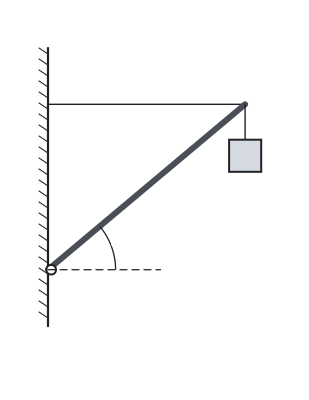
Figure 1 shows a wall lamp. The arm AB of the lamp is 1.6 m long, has mass 3 kg and is hinged to a vertical wall at A. The arm is held at an angle of \(40^\circ\) above the horizontal by a light horizontal cable attached to the arm at B and to the wall. A lamp of mass 2 kg hangs from B.

The arm is modelled as a uniform rod and the lamp as a particle at B.

Find the tension in the cable.

Find the magnitude and direction of the force exerted on the arm by the hinge.

Use \(g = 9.8\ \text{m s}^{-2}\) and give your answers to 2 or 3 significant figures.

An arm AB hinged to a vertical wall at A, sloping upwards away from the wall at 40 degrees to the horizontal. A horizontal cable joins B to the wall. A lamp hangs from B.

Model answer

Moments about A: \(T \times 1.6\sin 40^\circ = 3g \times 0.8\cos 40^\circ + 2g \times 1.6\cos 40^\circ\)
\(1.6T\sin 40^\circ = 5.6g\cos 40^\circ\), so \(T = 3.5g\cot 40^\circ = 40.9\) N (3 s.f.)
Hinge force components: horizontally \(X = T = 40.88\) N (away from the wall); vertically \(Y = 3g + 2g = 49\) N (upwards)
Magnitude: \(\sqrt{40.88^2 + 49^2} = 63.8\) N (3 s.f.)
Direction: \(\tan^{-1}\dfrac{49}{40.88} = 50.2^\circ\) above the horizontal, directed away from the wall.

Explanation

Moments about the hinge give the tension, because the horizontal cable's perpendicular distance from A is \(1.6\sin 40^\circ\) while the weights act at horizontal distances \(0.8\cos 40^\circ\) and \(1.6\cos 40^\circ\). Resolving gives the hinge components, which combine by Pythagoras into a force acting upwards and away from the wall. Common errors are using 1.6 m as the cable's moment arm and giving the hinge force as vertical.

Mark scheme
  1. 1 mark

    M1 Takes moments about A: \(T \times 1.6\sin 40^\circ = 3g \times 0.8\cos 40^\circ + 2g \times 1.6\cos 40^\circ\); or correct final answers of 40.9 N, and 63.8 N at \(50.2^\circ\) above the horizontal (away from the wall) with no working

    Correct answers with no working score 3 marks (the A1 marks for T, for the magnitude and for the direction). An omitted length is a method error: M0. Condone sin/cos confusion for this mark. Accept any equivalent form. An omitted or extra g is an accuracy error.

  2. 1 mark

    A1 \(1.6T\sin 40^\circ = 5.6g\cos 40^\circ\) oe

    Accept any equivalent equation.

  3. 1 mark

    A1 \(T = 40.9\) N (or 41 N)

    Depends on the M mark in point 1 (not on the A mark just before). Accept 3.5g cot 40°. Answers from g = 9.8 should be given to 2 or 3 s.f.: 40.88 loses this mark (once per question). Use of g = 9.81 is penalised once per question.

  4. 1 mark

    M1 Resolves horizontally and vertically for the hinge force components: \(X = T\) and \(Y = 5g\)

    Both components attempted. In a resolution, an omitted mass is a method error (M0) and an omitted or extra g is an accuracy error.

  5. 1 mark

    A1 \(X = 40.9\) N (away from the wall) and \(Y = 49\) N (upwards)

    Both needed. Accept awrt 40.9, i.e. [40.85, 40.95), for X; Y = 49 N exactly.

  6. 1 mark

    M1 Finds the magnitude by Pythagoras and the direction by trigonometry from their components

    Adding the components is M0.

  7. 1 mark

    A1 Magnitude of the hinge force 63.8 N (or 64 N)

    Accept awrt 63.8, i.e. [63.75, 63.85), or 64.

  8. 1 mark

    A1 Direction \(50.2^\circ\) above the horizontal, directed away from the wall

    Depends on the M mark in point 6. Accept the angle as \(39.8^\circ\) to the vertical (or to the wall) if clearly described. Accept awrt 50.2, i.e. [50.15, 50.25), or 50°. Both 'above the horizontal' (upwards) and 'away from the wall' are needed.

Question 4

11 marks

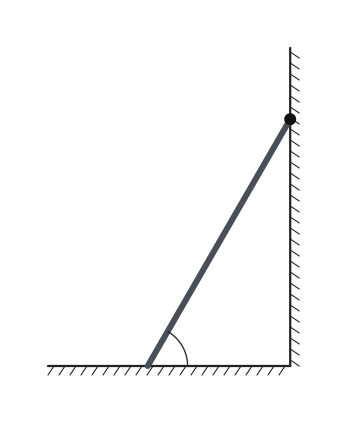
Figure 1 shows a uniform ladder AB, of length 2l and weight W, resting with its foot A on rough horizontal ground and its top B against a rough vertical wall. The ladder lies in a vertical plane perpendicular to the wall and is inclined to the ground at an angle θ. A decorator of weight 3W is at the top of the ladder. The coefficient of friction is \(\mu_1\) at the ground and \(\mu_2\) at the wall.

The ladder is on the point of slipping, with friction limiting at both A and B.

The ladder is modelled as a uniform rod and the decorator as a particle at B.

Show that
\[\tan\theta = \dfrac{7 - \mu_1\mu_2}{8\mu_1}\]
Given that \(\mu_1 = 0.6\) and \(\mu_2 = 0.5\), find the least angle that the ladder can make with the ground without slipping while the decorator is at the top.

A ladder AB leaning against a vertical wall, with its foot A on horizontal ground and its top B against the wall, making an angle theta with the ground. A dot at B marks the decorator.

Model answer

Let R and S be the normal reactions at A and B. Friction at A, \(\mu_1 R\), acts towards the wall; friction at B, \(\mu_2 S\), acts upwards.
Resolving horizontally: \(S = \mu_1 R\)
Resolving vertically: \(R + \mu_2 S = W + 3W = 4W\), so \(R(1 + \mu_1\mu_2) = 4W\)
Moments about A: \(S \times 2l\sin\theta + \mu_2 S \times 2l\cos\theta = W \times l\cos\theta + 3W \times 2l\cos\theta = 7Wl\cos\theta\)
Dividing by \(l\cos\theta\): \(2S\tan\theta + 2\mu_2 S = 7W\)
Substituting \(S = \mu_1 R\) and \(7W = \dfrac{7}{4}R(1 + \mu_1\mu_2)\): \(2\mu_1 R\tan\theta + 2\mu_1\mu_2 R = \dfrac{7}{4}R(1 + \mu_1\mu_2)\)
\(8\mu_1\tan\theta + 8\mu_1\mu_2 = 7 + 7\mu_1\mu_2\)
\(\tan\theta = \dfrac{7 - \mu_1\mu_2}{8\mu_1}\)
With \(\mu_1 = 0.6\) and \(\mu_2 = 0.5\): \(\tan\theta = \dfrac{7 - 0.3}{4.8} = 1.396\), so \(\theta = 54.4^\circ\)
The least angle is \(54.4^\circ\) (3 s.f.).

Explanation

With both contacts rough there are four unknown forces, but limiting friction at both ends links them in pairs, so two resolutions and one moments equation are enough; the decorator's weight 3W appears in the vertical resolution and, with lever arm \(2l\cos\theta\), in the moments equation. Friction at the wall acts upwards because the top of the ladder tends to slide down, and its moment about A must be included. Common errors are leaving out the decorator's weight in one of the equations and leaving the wall friction out of the moments equation.

Mark scheme
  1. 1 mark

    B1 Friction at B acts vertically upwards (B tends to slide down the wall) and friction at A acts horizontally towards the wall. An answer with no working scores 0 marks for the show that; a correct angle of \(54.4^\circ\) with no working scores 1 mark.

    An answer with no working scores 0 marks for the 'show that'. SC: a correct final angle of 54.4° with no working scores 1 mark (the final A1; accept awrt 54.4, i.e. [54.35, 54.45)). The directions may be shown on a diagram or implied by correct equations.

  2. 1 mark

    M1 Resolves horizontally: \(S = F_A\), with \(F_A = \mu_1 R\)

    R and S are the normal reactions at A and B; \(F = \mu R\) used at A (both F and R replaced).

  3. 1 mark

    A1 \(S = \mu_1 R\)

  4. 1 mark

    M1 Resolves vertically, including the decorator's weight: \(R + F_B = 4W\), with \(F_B = \mu_2 S\)

    Correct number of terms. Leaving out the decorator's weight (R + μ₂S = W) is M0.

  5. 1 mark

    A1 \(R + \mu_2 S = 4W\), so \(R = \dfrac{4W}{1 + \mu_1\mu_2}\) oe

  6. 1 mark

    M1 Takes moments about A: \(S \times 2l\sin\theta + \mu_2 S \times 2l\cos\theta = W \times l\cos\theta + 3W \times 2l\cos\theta\)

    All four terms, each with its correct length. An omitted length is a method error: M0; condone sin/cos confusion. Moments about another point are fine if every term is included.

  7. 1 mark

    A1 Correct moments equation oe, e.g. \(2S\sin\theta + 2\mu_2 S\cos\theta = 7W\cos\theta\)

  8. 1 mark

    M1 (dM1) Eliminates R, S and W to obtain an equation in θ, \(\mu_1\) and \(\mu_2\) only, e.g. \(8\mu_1\tan\theta + 8\mu_1\mu_2 = 7 + 7\mu_1\mu_2\)

    Depends on all three previous M marks (not on the A mark just before).

  9. 1 mark

    A1* \(\tan\theta = \dfrac{7 - \mu_1\mu_2}{8\mu_1}\) (cso)

    Given answer: must be obtained from correct working with no errors, including a line dividing through by \(\cos\theta\).

  10. 1 mark

    M1 Substitutes: \(\tan\theta = \dfrac{7 - 0.3}{4.8} = 1.396\)

    May use the printed result even if the 'show that' was not completed. Accept \(\dfrac{67}{48}\).

  11. 1 mark

    A1 \(\theta = 54.4^\circ\)

    Accept awrt 54.4, i.e. [54.35, 54.45), or 54°. This is the least angle: at a steeper angle the friction needed is less than the limiting friction.

Ready to try the rest? Every answer you write is marked against the mark scheme, so you can see exactly where the marks are.

Study Helper Hints first, answers after you try

Stuck on this one? Ask for a hint and I’ll point you in the right direction, without giving the answer away. Once you’ve checked your answer, I’ll show you how the marks are awarded.