
Level:
Correct: 0
Incorrect: 0
Marks: 0/0
Exam Practice
Course:
Topics:
Avg
score:
–
Topics
done:
0/27

Measures of location and spread

Practise 18 exam-style questions on Measures of location and spread for Edexcel A-Level Maths (Paper 3). Write your answer as you would in the exam and get it marked in seconds against the mark scheme, point by point, with the Study Helper on hand if you get stuck.

  • 18 questions
  • 3–9 marks each
  • Instant marking
  • No sign-up needed
18 questions, marked as you go

Sample questions with model answers

Here are 4 of the questions in this topic, each with a model answer, an explanation of why it earns the marks and the mark scheme an examiner would use.

Question 1

3 marks

In a swimming gala, each swimmer's time, \(t\) seconds, for 100 m is converted into a points score, \(P\), using
\[P = 1000 - 8t\]
For the 15 swimmers from one club, the times have mean 68.4 seconds and standard deviation 3.2 seconds.

Find the mean and the standard deviation of the points scores of these 15 swimmers.

Model answer

Mean of \(P = 1000 - 8 \times 68.4 = 452.8\) points
Standard deviation of \(P = 8 \times 3.2 = 25.6\) points
(Subtracting from 1000 does not change the spread, and multiplying by \(-8\) multiplies the standard deviation by 8.)

Explanation

Under a linear coding \(P = a + bt\), the mean becomes \(a + b\bar{t}\) and the standard deviation is multiplied by \(\lvert b\rvert\); adding or subtracting a constant does not change the spread. A standard deviation can never be negative, so -25.6 is wrong. Another common error is to apply the 1000 to the standard deviation as well.

Mark scheme
  1. 1 mark

    B1 Mean of \(P = 1000 - 8 \times 68.4 = 452.8\); correct answers of 452.8 and 25.6 with no working score 3 marks

    Answers of 452.8 and 25.6 with no working score 3 marks. Accept 453.

  2. 1 mark

    M1 Standard deviation of \(P\) is \(8 \times 3.2\): multiplied by 8 (the size of the multiplier) and not affected by the 1000

    \(1000 - 8 \times 3.2\) or \(-8 \times 3.2\) as the final standard deviation scores M0.

  3. 1 mark

    A1 25.6 (points)

    cao. A negative standard deviation (-25.6) scores A0.
Question 2

4 marks

The Daily Total Sunshine, in hours, at Camborne for the 15 days from 18/09/2015 to 02/10/2015 is taken from the large data set. The values, in date order, are

1.8   5.9   0.2   5.2   4.9   1.7   7.5   8.6   10.5   8.3   10.9   7.9   9   10.3   10.6

Find the median and the interquartile range of these values.

State, with a reason, whether the mean of these values is greater than or less than the median.

Model answer

In order: 0.2, 1.7, 1.8, 4.9, 5.2, 5.9, 7.5, 7.9, 8.3, 8.6, 9, 10.3, 10.5, 10.6, 10.9
Median: \(\dfrac{15}{2} = 7.5\), so the 8th value: 7.9 hours
\(Q_1\): \(\dfrac{15}{4} = 3.75\), so the 4th value: 4.9 hours
\(Q_3\): \(\dfrac{45}{4} = 11.25\), so the 12th value: 10.3 hours
Interquartile range \(= 10.3 - 4.9 = 5.4\) hours
The mean is \(\dfrac{103.3}{15} = 6.89\) hours, which is less than the median: the three very dull days pull the mean down.

Explanation

Order the values first, then use the positions n/2, n/4 and 3n/4, rounding up because none is a whole number. Values in a list are treated as discrete, so no interpolation is used. The mean is affected by the few very dull days while the median is not, so here the mean is smaller.

Mark scheme
  1. 1 mark

    B1 Median \(= 7.9\) hours

    The 8th value of the ordered list: 0.2, 1.7, 1.8, 4.9, 5.2, 5.9, 7.5, 7.9, 8.3, 8.6, 9, 10.3, 10.5, 10.6, 10.9.

  2. 1 mark

    B1 \(Q_1 = 4.9\) and \(Q_3 = 10.3\)

    Both needed: the 4th and 12th values (\(\dfrac{15}{4} = 3.75\) and \(\dfrac{45}{4} = 11.25\), rounded up). The \((n + 1)\) method gives the same values.

  3. 1 mark

    B1 Interquartile range \(= 10.3 - 4.9 = 5.4\) hours

    Ft their quartiles.

  4. 1 mark

    B1 The mean is less than the median, because a few days had very little sunshine (0.2, 1.7 and 1.8 hours), which lower the mean but not the median (mean \(= \dfrac{103.3}{15} = 6.89\))

    Needs "less" with a reason: either the calculated mean (awrt 6.89, i.e. in [6.885, 6.895)) compared with 7.9, or the effect of the small values (negative skew).

Question 3

5 marks

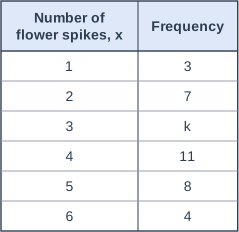
A gardener counted the number of flower spikes, \(x\), on each of the lavender plants in a bed. The table shows the results, where \(k\) is a positive integer.

The mean number of flower spikes per plant is 3.65

Find the value of \(k\), and hence find the median and the standard deviation of \(x\).

[Standard deviation: \(\sqrt{\dfrac{S_{xx}}{n}}\) or \(\sqrt{\dfrac{\sum x^2}{n} - \bar{x}^2}\), where \(S_{xx} = \sum(x - \bar{x})^2 = \sum x^2 - \dfrac{(\sum x)^2}{n}\)]

Table with columns "Number of flower spikes, x", "Frequency". Number of flower spikes, x: 1; Frequency: 3 | Number of flower spikes, x: 2; Frequency: 7 | Number of flower spikes, x: 3; Frequency: k | Number of flower spikes, x: 4; Frequency: 11 | Number of flower spikes, x: 5; Frequency: 8 | Number of flower spikes, x: 6; Frequency: 4.

Model answer

\(\sum f = 33 + k\), \(\sum fx = 3 + 14 + 3k + 44 + 40 + 24 = 125 + 3k\)
\(\dfrac{125 + 3k}{33 + k} = 3.65\)
\(125 + 3k = 120.45 + 3.65k\)
\(4.55 = 0.65k\), so \(k = 7\)
\(n = 40\): median is the mean of the 20th and 21st values. Cumulative frequencies 3, 10, 17, 28, ..., so both are 4: median \(= 4\)
\(\sum fx^2 = 3 + 28 + 63 + 176 + 200 + 144 = 614\)
\(\sigma = \sqrt{\dfrac{614}{40} - 3.65^2} = \sqrt{2.0275} = 1.42\) (3 s.f.)

Explanation

Write the mean as \(\sum fx \div \sum f\) with k in both the numerator and the denominator, then solve the linear equation. Once k is known the table is complete, so the median position and the standard deviation follow in the usual way. A common error is to forget that k also changes the total frequency.

Mark scheme
  1. 1 mark

    M1 Forms an equation in \(k\) using the mean: \(\dfrac{125 + 3k}{33 + k} = 3.65\); or correct answers of \(k = 7\), median 4 and standard deviation 1.42 with no working

    Answers of \(k = 7\), median 4 and standard deviation 1.42 (or 1.44) with no working score 5 marks. \(\sum fx = 3 + 14 + 3k + 44 + 40 + 24 = 125 + 3k\).

  2. 1 mark

    A1 \(k = 7\)

    cao.

  3. 1 mark

    B1 Median \(= 4\)

    With \(k = 7\), \(n = 40\): the 20th and 21st values are both 4. Ft their k only if it is a positive integer.

  4. 1 mark

    M1 A correct expression for the standard deviation with their \(k\), including the square root: \(\sqrt{\dfrac{614}{40} - 3.65^2}\)

    \(\sum fx^2 = 3 + 28 + 9k + 176 + 200 + 144 = 551 + 9k = 614\). Using 3.65 squared is required; omitting the square root is M0.

  5. 1 mark

    A1 awrt 1.42, i.e. in \([1.415, 1.425)\)

    Allow s = 1.442..., i.e. awrt 1.44 in [1.435, 1.445).

Question 4

7 marks

In this question you must show all stages of your working.
Solutions relying entirely on calculator technology are not acceptable.

The numbers of seedlings that came up in five trays were

6   9   14   \(a\)   \(b\)

where \(a\) and \(b\) are integers and \(a < b\). For these five values, the mean is 10 and \(S_{xx} = 58\)

Find the value of \(a\) and the value of \(b\).

[\(S_{xx} = \sum(x - \bar{x})^2 = \sum x^2 - \dfrac{(\sum x)^2}{n}\)]

Model answer

Mean 10, so \(6 + 9 + 14 + a + b = 50\), giving \(a + b = 21\)
\(S_{xx} = \sum x^2 - \dfrac{(\sum x)^2}{n}\): \(36 + 81 + 196 + a^2 + b^2 - \dfrac{50^2}{5} = 58\)
\(313 + a^2 + b^2 - 500 = 58\), so \(a^2 + b^2 = 245\)
Substitute \(b = 21 - a\): \(a^2 + (21 - a)^2 = 245\)
\(2a^2 - 42a + 441 = 245\)
\(a^2 - 21a + 98 = 0\)
\((a - 7)(a - 14) = 0\), so \(a = 7\) or \(a = 14\)
Since \(a < b\): \(a = 7\), \(b = 14\)

Explanation

The mean gives a linear equation and \(S_{xx}\) gives a quadratic one; substituting one into the other produces a quadratic in a single unknown. The condition a < b decides which root is a. The working must be shown, because the question says so; a common error is to use \(S_{xx}\) as if it were \(\sum x^2\).

Mark scheme
  1. 1 mark

    B1 \(a + b = 21\) (from \(6 + 9 + 14 + a + b = 50\)). An answer with no working scores 0 marks

    An answer with no working scores 0 marks (the question demands working). A solution that only checks a = 7 and b = 14 satisfy the conditions scores B1 M1 A1 at most (no marks for solving).

  2. 1 mark

    M1 Uses \(S_{xx}\) to form an equation in \(a\) and \(b\): \(36 + 81 + 196 + a^2 + b^2 - \dfrac{50^2}{5} = 58\), or \(16 + 1 + 16 + (a - 10)^2 + (b - 10)^2 = 58\)

    Either form of \(S_{xx}\).

  3. 1 mark

    A1 \(a^2 + b^2 = 245\) or \((a - 10)^2 + (b - 10)^2 = 25\)

    Any correct simplified equation in a and b.

  4. 1 mark

    M1 Substitutes \(b = 21 - a\) (or \(a = 21 - b\)) to form a three-term quadratic in one unknown

    Depends on having a linear and a quadratic equation in a and b.

  5. 1 mark

    A1 \(a^2 - 21a + 98 = 0\) (or \(2a^2 - 42a + 196 = 0\), or \(b^2 - 21b + 98 = 0\))

    Any correct three-term quadratic equation.

  6. 1 mark

    M1 (dM1) Solves their 3TQ by factorising, the formula or completing the square: \((a - 7)(a - 14) = 0\)

    Depends on the previous M mark. The solving must be seen (not just roots from a calculator).

  7. 1 mark

    A1 \(a = 7\), \(b = 14\)

    Both values needed, with \(a < b\) used to choose. Giving a = 14, b = 7 scores A0.

Ready to try the rest? Every answer you write is marked against the mark scheme, so you can see exactly where the marks are.

Study Helper Hints first, answers after you try

Stuck on this one? Ask for a hint and I’ll point you in the right direction, without giving the answer away. Once you’ve checked your answer, I’ll show you how the marks are awarded.