Level:
Correct: 0
Incorrect: 0
Marks: 0/0
Exam Practice
Subject:
Topics:
OCR GCSE Classical Civilisation (Women in the Ancient World) Smart practice A mixed round aimed at your weak spots
Unit 1
Greece
Unit 2
Rome
Unit 3
Greece and Rome
Avg
score:
–
Topics
done:
0/21

Young women in Rome: education and marriage

Practise 30 exam-style questions on Young women in Rome: education and marriage for OCR GCSE Classical Civilisation (Women in the Ancient World). Write your answer as you would in the exam and get it marked in seconds against the mark scheme, point by point, with an AI tutor on hand if you get stuck.

  • 30 questions
  • 1–8 marks each
  • Instant marking
  • No sign-up needed
20 questions, marked as you go

Sample questions with model answers

Here are 4 of the questions in this topic, each with a model answer, an explanation of why it earns the marks and the mark scheme an examiner would use.

Question 1

1 mark

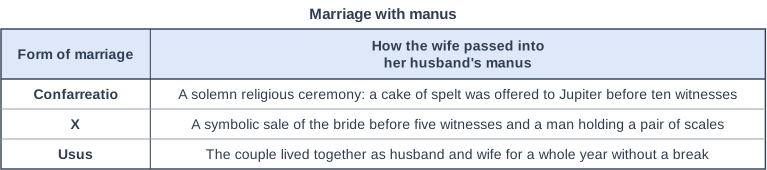
Figure 1 shows three ways in which a Roman wife could pass into the manus (legal power) of her husband.

Name the form of marriage labelled X.

Marriage with manus. Table with columns "Form of marriage", "How the wife passed into her husband's manus". Form of marriage: Confarreatio; How the wife passed into her husband's manus: A solemn religious ceremony: a cake of spelt was offered to Jupiter before ten witnesses | Form of marriage: X; How the wife passed into her husband's manus: A symbolic sale of the bride before five witnesses and a man holding a pair of scales | Form of marriage: Usus; How the wife passed into her husband's manus: The couple lived together as husband and wife for a whole year without a break.

Model answer

Coemptio.

Explanation

Coemptio was a symbolic purchase: in front of five witnesses and a scale-holder (libripens), the husband 'bought' the bride, and she passed from her father's power into his manus. By the late Republic this and the other forms of marriage with manus were becoming rare, as most marriages were sine manu.

Mark scheme
  1. 1 mark

    Coemptio.

    Accept close spellings (co-emptio, coemtio). Do not accept confarreatio or usus, or a description ('sale') without the name.

Question 2

2 marks

Source A: Plautus, The Pot of Gold (Aulularia), from a speech by Megadorus, a rich old bachelor who wants to marry a poor man's daughter without a dowry (early 2nd century BC)

'For a wife without a dowry is under her husband's control; wives with dowries destroy their husbands with trouble and expense.'

What does Source A suggest about the effect of a dowry (dos) on a Roman marriage? Make two points.

Model answer

It suggests that a dowry gave a wife power in the marriage, since a wife without one was 'under her husband's control' while a dowered wife could make his life difficult. This was probably because the dowry had to be returned if they divorced, so a husband could not easily get rid of a rich wife and might feel he had to give in to her demands.

Explanation

The dowry (dos) was property given by the bride's family to help support the new household; in a sine manu marriage it usually had to be returned on divorce, which gave the wife's family leverage. Plautus adapted Greek comedies, set in Athens, for Roman audiences, and the 'dowered wife who rules her husband' is a comic stereotype, but the joke only works if the audience recognised the situation.

Mark scheme
  1. 1 mark

    First valid point, e.g.: a dowry gave a wife power / independence / influence over her husband.

    Two from: a dowry gave the wife power or influence in the marriage; a wife without a dowry was more dependent on / under the control of her husband; because a dowry had to be returned on divorce, the husband could not easily get rid of her, and she (or her family) could threaten to take it back; wives with large dowries were seen (in comedy) as extravagant or demanding - 'trouble and expense'; men felt threatened by rich wives; marriage was partly a financial arrangement.

  2. 1 mark

    Second, different valid point.

    As above; must be a different point.

Question 3

3 marks

Source A: Tacitus, Annals 4.16 (about AD 23, when a new priest of Jupiter, the Flamen Dialis, had to be chosen)

'By a very ancient custom, three patricians born of parents married by confarreatio had to be nominated, and one of them chosen. But there was no longer the same supply as in the past, because the custom of confarreatio had been abandoned or was kept up by only a few. The emperor gave several reasons for this, the chief being the indifference of men and women; in addition, the difficulties of the ceremony itself were deliberately avoided; and also the man who gained this priesthood, and the woman who passed into the flamen's manus, left the power of their fathers.'

Using Source A and your own knowledge, explain why confarreatio had become rare by the early Empire. Make three points.

Model answer

Tacitus says that men and women had become indifferent to the old custom, and that people deliberately avoided the difficult ceremony. Also, a woman married by confarreatio passed into her husband's manus and left her father's power, so her property passed to her husband's family; by this time fathers preferred sine manu marriages, which kept the property in their own family and were easy to end by divorce, whereas confarreatio was almost impossible to dissolve.

Explanation

Confarreatio was the oldest and most solemn form of marriage, for patricians only, with a spelt cake offered to Jupiter. Because the major priesthoods required parents married this way, its decline caused a real religious problem, which is why Tiberius raised it in the Senate. Its unpopularity reflects the general move to sine manu marriage in the late Republic.

Mark scheme
  1. 1 mark

    First valid reason, e.g.: men and women were indifferent to it / no longer cared about the old custom.

    Three from: indifference of men and women (Source A); the ceremony was difficult / complicated and people avoided it (Source A) - e.g. it needed the Pontifex Maximus, the Flamen Dialis and ten witnesses; the man and the woman left their fathers' power - fathers did not want to lose control of their children or their property (Source A); the wife passed into her husband's manus, so her property went to his family - families preferred sine manu marriages; it was very hard to dissolve (needed a special ceremony, diffarreatio) when divorce had become common; it was only for patricians, a shrinking group; the duties and restrictions of the priesthoods it was needed for (e.g. the Flamen Dialis) were unattractive.

  2. 1 mark

    Second, different valid reason.

    As above.

  3. 1 mark

    Third, different valid reason.

    As above; each reason must be different. Credit reasons from Source A or own knowledge.

Question 4

8 marks

Source A: Suetonius, Life of Augustus 64

'He brought up his daughter and granddaughters in such a way that they were even trained in wool-working, and he forbade them to say or do anything except openly, in a way that could be written down in the household's daily records.'

To what extent was the education of Roman girls only a preparation for marriage? Use Source A as a starting point and your own knowledge.

Model answer

Source A suggests that even in the emperor's own family a girl's upbringing was aimed at making her a traditional wife: Augustus had his daughter Julia and his granddaughters trained in wool-working, the symbol of the virtuous matrona, and insisted that they behaved so modestly that nothing they said or did could cause scandal. This fits much other evidence. Most girls learned spinning, weaving and household management from their mothers, since a matrona's job was to run the house and its slaves; epitaphs such as Claudia's praise a woman because 'she kept the house, she worked wool'. Girls could marry from the age of twelve, so any schooling was short; while boys went on to the grammaticus and the rhetor, girls usually left to be married.

However, some girls' education went far beyond practical training. Wealthy girls attended the litterator's school, like Verginia in Livy, or had tutors at home, like Minicia Marcella, whom Pliny praises for reading eagerly. A few became highly cultured: Cornelia's letters were admired for their style, Hortensia argued against the triumvirs' tax in the Forum, and Pompey's wife Cornelia studied literature, the lyre, geometry and philosophy.

Even so, much of this learning was valued because it helped a marriage or a family. Cornelia used her education to train her sons as orators; Calpurnia took up literature 'out of love' for Pliny; Plutarch praises Pompey's Cornelia partly because her learning had not made her tiresome. Augustus, too, chose to advertise his family's wool-working rather than their learning, because it supported his message about traditional morals.

So, to a large extent the education of Roman girls was a preparation for marriage and motherhood, but not only that: some elite women gained real learning, and Hortensia shows that it could be used in public in women's own interests.

Explanation

A good answer distinguishes home training (wool-working, household management) from academic education, and then asks what the academic education was for. The best answers notice that even learned women were usually praised for how their learning served sons or husbands, while still recognising exceptions such as Hortensia. Answers that only list educated women, without linking them to the question of marriage, stay in the lower levels.

Mark scheme
  1. 8 marks

    Levels of response (8 marks). AO1 (4) and AO2 (4) are equally weighted.
    Level 4 (7-8 marks): consistently accurate and detailed knowledge of the education of Roman girls, both at home and academic, using both Source A and own wider knowledge; very good understanding of the cultural context (early marriage, the role of the matrona, the elite nature of academic education); a well-argued response with a clear, substantiated judgement on whether girls' education was only a preparation for marriage, supported by a range of well-selected evidence, including critical analysis.
    Level 3 (5-6 marks): accurate knowledge, using both the source and own knowledge; a focused response with relevant analysis and a judgement.
    Level 2 (3-4 marks): sound, mostly accurate knowledge; engages with the general topic of girls' education; limited range of evidence; some analysis.
    Level 1 (1-2 marks): limited knowledge, may only use the source given; isolated analysis.
    0 marks: no response or no response worthy of credit.
    A mainly descriptive answer with little analysis or judgement cannot go above Level 2.

    Indicative content (not a checklist; credit other valid points): AO1: Augustus had his daughter Julia and granddaughters trained in wool-working and kept them to modest, public behaviour (Source A); girls learned spinning, weaving and household management from their mothers; wool-working (lanificium) was the symbol of the good matrona (Lucretia in Livy; Claudia's epitaph 'she kept the house, she worked wool'); girls could marry from 12, so schooling was short, while boys went on to the grammaticus and rhetor; wealthy girls attended the litterator's school (Verginia, Livy 3.44; Martial 9.68) or had tutors (Minicia Marcella, Pliny 5.16); Cornelia, mother of the Gracchi, Hortensia, Calpurnia, Pompey's wife Cornelia (literature, lyre, geometry, philosophy); the 'Sappho' fresco. AO2: for most girls education was clearly aimed at running a household - Augustus even used his family's wool-working as moral propaganda; academic learning was often valued because it made a woman a better companion or mother: Cornelia trained her sons' eloquence, Calpurnia took up literature 'out of love' for Pliny, Plutarch praises Pompey's Cornelia partly because her learning did not make her unpleasant; but some women used learning for themselves or in public - Hortensia's speech defended women's own property, Cornelia's letters were published; academic education was limited to the elite; possible judgement: largely, but not only, a preparation for marriage.

Ready to try the rest? Every answer you write is marked against the mark scheme, so you can see exactly where the marks are.

AI Tutor Hints first, answers after you try

Hi! Stuck? Ask me for a hint and I’ll help you work it out. Once you’ve checked your answer I can explain exactly where the marks are.