Source A: Cicero, Pro Caelio 49 (56 BC)
'If a woman without a husband has opened her house to the desires of every man, and has openly set herself up to live the life of a prostitute; if she has made a habit of holding dinner parties with men who are complete strangers; if she does this in Rome, in her gardens, amid the crowds at Baiae; if, finally, she behaves in such a way - not only in her walk, but in her clothes and her companions, in the flash of her eyes and the freedom of her talk, and also in her embraces and kisses, her beach parties, her boating trips and her dinner parties - that she seems to be not just a prostitute, but a shameless and wanton one: if some young man happened to have spent time with her, would you think, Lucius Herennius, that he was an adulterer or simply a lover, that he wanted to storm her chastity or just to satisfy his desire?'
To what extent is Cicero's picture of Clodia in the Pro Caelio a fair one? Use Source A as a starting point and your own knowledge.
Model answer
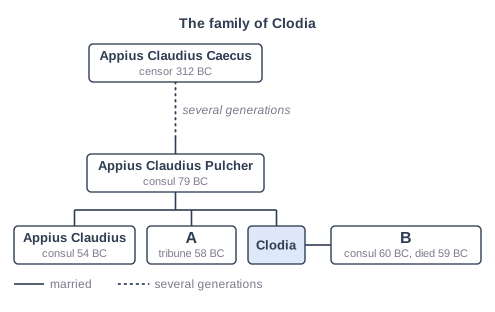
In Source A Cicero paints a vivid picture of a woman who, 'without a husband', has opened her house to every man's desire, lives openly like a prostitute and holds parties with strangers in Rome, in her gardens and at Baiae. He never names her here, but every detail fits Clodia: she had been a widow since Metellus Celer died in 59 BC, she owned gardens by the Tiber and she spent time at Baiae. Elsewhere in the speech he calls her the 'Palatine Medea', makes her ancestor Appius Claudius Caecus rise from the dead to condemn her affairs with 'other women's husbands', hints at incest by 'mistakenly' calling her brother her husband, and even suggests that she poisoned Metellus.
There are strong reasons to think this picture is unfair. It comes from a defence speech: Cicero's job was to win, and since Clodia's evidence was central to the case against Caelius, destroying her reputation destroyed the prosecution. He also had a personal motive, as her brother Clodius had driven him into exile in 58 BC. Sexual slander was a normal weapon in Roman invective, used against men as well as women, so the jury may not have taken it all literally - the speech was meant to entertain as well as persuade. Cicero carefully avoids direct accusations, using phrases like 'if a woman ...' so that he can deny slandering her, and we have no account from Clodia herself.
On the other hand, there may be some truth behind it. Clodia was a wealthy, independent widow from one of Rome's greatest families who clearly lived a free social life, with parties, gardens and holidays at Baiae, and Caelius had been her lover. If Catullus' Lesbia is Clodia, his poems also show a sophisticated woman with several lovers. But what Cicero presents as the behaviour of a prostitute may simply have been the lifestyle of a rich woman who ignored traditional ideas of female modesty.
Overall, Cicero's picture is not fair: it exaggerates and distorts real details for the purposes of a law-court speech and a personal feud, though it shows how conservative Romans viewed an independent woman.
Explanation
Strong answers analyse why Cicero wrote as he did (purpose, audience, feud, invective conventions) and separate the likely facts (widow, gardens, Baiae, an affair with Caelius) from the interpretation he puts on them. The judgement should recognise that the speech tells us at least as much about Roman ideas of 'proper' female behaviour as about Clodia herself.