Level:
Correct: 0
Incorrect: 0
Marks: 0/0
Exam Practice
Subject:
Topics:
OCR GCSE Classical Civilisation (Women in the Ancient World) Smart practice A mixed round aimed at your weak spots
Unit 1
Greece
Unit 2
Rome
Unit 3
Greece and Rome
Avg
score:
–
Topics
done:
0/21

Young women in Athens and Sparta: education and marriage

Practise 31 exam-style questions on Young women in Athens and Sparta: education and marriage for OCR GCSE Classical Civilisation (Women in the Ancient World). Write your answer as you would in the exam and get it marked in seconds against the mark scheme, point by point, with an AI tutor on hand if you get stuck.

  • 31 questions
  • 1–8 marks each
  • Instant marking
  • No sign-up needed
20 questions, marked as you go

Sample questions with model answers

Here are 4 of the questions in this topic, each with a model answer, an explanation of why it earns the marks and the mark scheme an examiner would use.

Question 1

1 mark

During an Athenian wedding, what happened at the anakalypteria?

Model answer

The bride's veil was lifted and she was shown to the groom and the guests.

Explanation

The anakalypteria ('unveiling') was a key moment of the gamos, when the bride revealed herself to her husband; she often received gifts from him at the same time. Many vase paintings show the bride lifting her veil in a gesture that symbolised her becoming a wife.

Mark scheme
  1. 1 mark

    The bride was unveiled / her veil was lifted (in front of the groom and guests).

    Accept 'she showed her face for the first time', 'the bride took off her veil'. Gifts were also given at this point: accept a mention of gifts only together with the unveiling. Do not accept 'the bride was bathed' or 'the bride was showered with nuts'.

Question 2

2 marks

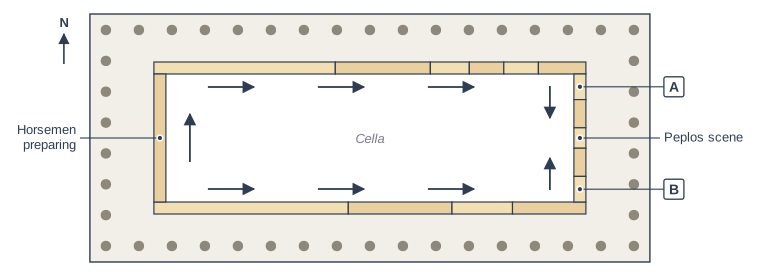
Figure 1 is a plan of the Parthenon showing where the frieze of the Panathenaic procession ran. The sections labelled A and B show young women taking part in the procession.

Give two objects that young women such as these carried in the procession.

Plan of a Greek temple with a band marked round its inner building. Plan of a temple, north at the top (a north arrow is drawn): an outer rectangle of columns (dots) on a platform, and inside it a long inner building. A coloured band runs right round the inner building, divided into sections: six along the top, four along the bottom, one down the whole left end and five down the right end. Arrows inside the band point right along the top and bottom, up the left end, and on the right end from both corners towards the middle. The word Cella is written inside. The drawing shows where things are on the object, not the figures themselves. Label A points to the top section of the right (east) band; label B points to the bottom section of the right (east) band; the label "Peplos scene" points to the middle section of the right (east) band; the label "Horsemen preparing" points to the whole of the left (west) band.

Model answer

They carried jugs for pouring libations and shallow bowls (phialai); some carried incense burners, and the kanephoroi carried baskets of sacrificial equipment.

Explanation

The east frieze shows maidens moving towards the gods and the peplos scene, carrying vessels for the sacrifice. These girls came from respected Athenian families, and taking part was an honour; some scholars identify them with the girls who wove Athena's new peplos. It was one of the few occasions when unmarried girls were seen by the whole city.

Mark scheme
  1. 1 mark

    First object.

    Two from: jugs (oinochoai) for pouring libations; shallow libation bowls (phialai); incense burners (thymiateria); baskets (kana) holding the sacrificial equipment (carried by the kanephoroi); stools (carried by the girls in the peplos scene). Accept 'offerings' only with a specific object.

  2. 1 mark

    Second, different object.

    As above; must be a different object.

Question 3

3 marks

Source A: Pausanias, Description of Greece 1.27.3

'Two maidens live not far from the temple of Athena Polias; the Athenians call them arrephoroi. For a time they live with the goddess, but when the festival comes round they do the following at night. They place on their heads what the priestess of Athena gives them to carry - neither does she know what it is she gives, nor do they know what they carry. In the city there is an enclosure with a natural underground passage. The maidens go down by this, leave below what they carry, and take something else, which is covered up, and bring it back. After this they are released, and other maidens are brought to the Acropolis in their place.'

Explain why being an arrephoros was a great honour for an Athenian girl.

Model answer

Only a tiny number of girls were chosen, and they came from noble families, so being selected showed the high status of the girl's family. The arrephoroi lived on the Acropolis 'with the goddess', close to the temple of Athena Polias, and performed a secret rite at night that mattered to the whole city. They also helped to begin weaving the new peplos for Athena, so they served the city's goddess directly.

Explanation

The arrephoroi were girls of about seven to eleven, and the mysterious objects they carried are still debated (perhaps linked to fertility, or to the myth of Erichthonios). In Aristophanes' Lysistrata a chorus member proudly says she was an arrephoros at seven. The role shows how religion gave girls of good families a public part in the city's life.

Mark scheme
  1. 1 mark

    First valid point.

    Three from: only a very few girls were chosen (two in Pausanias), so it was exclusive; they came from noble / leading families and were selected by an official (the archon basileus), showing the family's status; they lived on the Acropolis 'with the goddess', close to Athena's temple; they performed a secret, sacred rite on behalf of the whole city; they helped begin the weaving of Athena's new peplos for the Panathenaia; they were young (about 7-11) and pure, so the role marked them as virtuous and respectable; it was a public religious role, one of the few open to girls. Each mark needs a reason.

  2. 1 mark

    Second, different valid point.

    As above.

  3. 1 mark

    Third, different valid point.

    As above. Max 3.

Question 4

8 marks

Source A: Aristophanes, Lysistrata 641-647

The chorus of Athenian women explain why they have the right to advise the city.

'As soon as I was seven years old I was an arrephoros; then, when I was ten, I ground the grain for our Lady Athena; then, shedding my saffron robe, I was a bear at the Brauronia; and once, when I was a lovely grown girl, I carried the basket, wearing a necklace of dried figs.'

To what extent did religion give young Athenian women an important role in the life of the city? Use Source A as a starting point and your own knowledge.

Model answer

Religion gave some young Athenian women an important and very public role in the life of the city, but it was limited to a privileged few and to the years before marriage.

Source A lists a series of honours. At seven the speaker was an arrephoros: Pausanias tells us that two girls lived on the Acropolis near the temple of Athena Polias and carried mysterious objects at night down an underground passage, and the arrephoroi also helped begin weaving Athena's peplos. At ten she ground the grain for Athena's sacred cakes; then she was a 'bear' at Brauron, where young girls served Artemis before marriage, running races and dancing in saffron robes. Finally she was a kanephoros, carrying the basket with the sacrificial equipment at the head of a procession. These roles were genuinely important: they served the gods on whom the city's safety depended, and they were performed in front of the whole city. The maidens on the east frieze of the Parthenon, carrying jugs and incense burners, show that the city celebrated its girls on its greatest temple. The roles were also great honours for families: Thucydides shows how deadly an insult it was when Harmodius' sister was rejected as a basket-carrier.

However, the roles were limited. Only a handful of girls, usually from noble families, could be arrephoroi or kanephoroi, and the roles ended with marriage. Many of them were really about preparing girls for marriage: the arkteia marked the passage from childhood to womanhood, and the kanephoroi displayed beautiful, virgin girls to the citizens. Girls still had no political voice, and the claim of Aristophanes' chorus that this entitles women to advise the city is part of a comedy written by a man.

Overall, religion gave young women their most important public role in Athens, but it was a role for a few, and one that celebrated their purity and readiness for marriage rather than giving them real power.

Explanation

Top answers explain each role in Source A with wider knowledge (Pausanias on the arrephoroi, Brauron, kanephoroi, the Parthenon frieze) and then assess how far these roles really mattered: who held them, for how long, and whether they gave girls influence or just displayed them. Recognising that Lysistrata is a comedy shows critical use of the source.

Mark scheme
  1. 8 marks

    Levels of response (8 marks). AO1 (4) and AO2 (4) are equally weighted.
    Level 4 (7-8 marks): consistently accurate and detailed knowledge of the religious roles of young Athenian women, using both Source A and own wider knowledge; shows very good understanding of the cultural context and possible interpretations; a well-argued response with a clear, substantiated judgement on how important a role religion gave them in the life of the city, supported by a range of well-selected evidence, including critical analysis.
    Level 3 (5-6 marks): accurate knowledge, using both the source and own knowledge; a focused response with relevant analysis and a judgement.
    Level 2 (3-4 marks): sound, mostly accurate knowledge; engages with the general topic, limited range of evidence, some analysis.
    Level 1 (1-2 marks): limited knowledge, may only use the source given; isolated analysis.
    0 marks: no response or no response worthy of credit.
    A mainly descriptive answer with little analysis or judgement cannot go above Level 2.

    Indicative content (not a checklist; credit other valid points): AO1: Source A - arrephoros at seven; grinder of grain for Athena at ten; 'bear' at Brauron in a saffron robe; kanephoros (basket-carrier) as a grown girl. Arrephoroi: two (or four) girls aged about 7-11 from noble families, chosen by the archon basileus, lived on the Acropolis near the temple of Athena Polias, carried secret objects at night down an underground passage (Pausanias 1.27.3), helped begin weaving the peplos. Arkteia at Brauron: young girls 'played the bear' for Artemis before marriage, ran races and danced (krateriskoi). Kanephoroi: unmarried girls of good family carried the basket with the sacrificial knife and barley at the head of processions (Panathenaia, Dionysia); Harmodius' sister rejected as 'not worthy' (Thucydides 6.56). Parthenon frieze: maidens carrying jugs, bowls and incense burners lead the procession on the east side; girls in the peplos scene. The chorus goes on to say they therefore owe the city good advice. AO2: important - these roles were public and visible to the whole city at its greatest festivals; they served the city's gods (Athena, Artemis), on whom Athens' safety depended; the girls are shown on the Parthenon itself; the honour reflected on their families; religion was almost the only public role open to girls, and Aristophanes' chorus claims it gives women a stake in the city. Limited - only a few girls, mostly from wealthy noble families, held these roles; they were short and ended at marriage; many roles stressed virginity and readiness for marriage, displaying girls as future brides; girls had no political rights; Lysistrata is a comedy written by a man, and the chorus' claim was meant to be funny. Judgement: e.g. religion gave some girls a genuinely honoured public role, but it was limited to a few and served to prepare them for marriage rather than giving them real influence.

Ready to try the rest? Every answer you write is marked against the mark scheme, so you can see exactly where the marks are.

AI Tutor Hints first, answers after you try

Hi! Stuck? Ask me for a hint and I’ll help you work it out. Once you’ve checked your answer I can explain exactly where the marks are.