Level:
Correct: 0
Incorrect: 0
Marks: 0/0
Exam Practice
Subject:
Topics:
OCR GCSE Classical Civilisation (Women in the Ancient World) Smart practice A mixed round aimed at your weak spots
Unit 1
Greece
Unit 2
Rome
Unit 3
Greece and Rome
Avg
score:
–
Topics
done:
0/21

Comparing women of legend

Practise 24 exam-style questions on Comparing women of legend for OCR GCSE Classical Civilisation (Women in the Ancient World). Write your answer as you would in the exam and get it marked in seconds against the mark scheme, point by point, with an AI tutor on hand if you get stuck.

  • 24 questions
  • 2–15 marks each
  • Instant marking
  • No sign-up needed
20 questions, marked as you go

Sample questions with model answers

Here are 4 of the questions in this topic, each with a model answer, an explanation of why it earns the marks and the mark scheme an examiner would use.

Question 1

2 marks

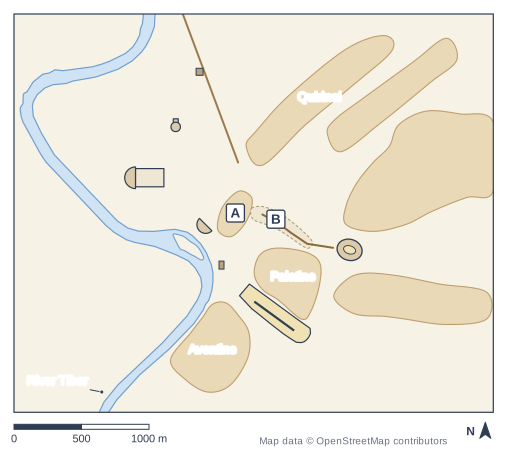
Figure 1 is a plan of central Rome.

Name the hill labelled A, whose citadel Tarpeia betrayed to the Sabines, and the area labelled B, the valley where the Romans and Sabines fought until the Sabine women ran between the armies.

Plan of part of an ancient city by a river, north at the top, with a scale bar of 1 km. A river winds down the west side, bending round a large area of flat land and flowing past a small boat-shaped island. Seven areas of higher ground (hills) are shaded pale brown: a small one by the river opposite the island, one south-east of it, a large one by the river in the south-west, a long one in the south-east, a large one in the east and two long narrow ridges in the north-east and north. A dashed-edged paved area lies in the valley between the small hill and the hill south-east of it, with a road running east from it to a large oval building with an arena. A long racetrack with a central barrier and one curved end lies in the valley between the two southern hills. On the flat land are a round building with a porch on its north side, a semicircular building with a large courtyard to its east, and in the north a small square monument beside a straight road running north-north-west from the small hill. A second semicircular building stands between the small hill and the river, and a small rectangular building stands near the river bank just downstream of the island. Label A is written on the small hill just west of the paved area, nearest the river; label B is written on the paved open area between the small hill by the river and the oval amphitheatre; the label "Palatine" is written on the hill between the paved area and the long racetrack, south of the paved area; the label "Aventine" is written on the large hill by the river at the south-west, beyond the long racetrack; the label "Quirinal" is written on the long ridge in the north, east of the straight road; the label "River Tiber" points to the river that winds through the west of the city.

Model answer

A is the Capitoline Hill and B is the Forum Romanum.

Explanation

The Sabines took the citadel on the Capitoline through Tarpeia's treachery; the Tarpeian Rock on its cliff, where traitors were later thrown down, kept her name. The battle was fought in the marshy valley between the Capitoline and the Palatine, the later Forum, and it was there that the Sabine women parted the armies.

Mark scheme
  1. 1 mark

    A: the Capitoline (Capitol) Hill

    Accept the Capitol / Capitolium. Do not accept Palatine, Quirinal or Aventine.

  2. 1 mark

    B: the Forum (Forum Romanum)

    Accept the Roman Forum / the valley between the Capitoline and Palatine. Do not accept Circus Maximus or Campus Martius.

Question 2

6 marks

Source A: Hesiod, Works and Days 90-101

'Before this, the tribes of men lived on the earth free from evils, free from harsh toil and the painful diseases that bring death to men... But the woman lifted the great lid from the jar with her hands and scattered them, and devised grim sorrows for men. Only Hope stayed there inside, in her unbreakable home under the rim of the jar, and did not fly out of the opening; for before she could, the woman put the lid back on, by the will of Zeus who holds the aegis and gathers the clouds. But countless other miseries wander among men; for the earth is full of evils, and the sea is full.'

Source B: the reverse of a silver denarius (coin) issued in Rome in 89 BC by the moneyer Lucius Titurius Sabinus, whose family claimed descent from the Sabines. It shows the punishment of Tarpeia: a young woman is buried up to her waist in a heap of shields and raises her hands; on each side a soldier is about to throw another shield on to her. Above her is a star in a crescent moon.

Explain how both sources show that women could be dangerous.

Model answer

Source A shows that a woman could bring disaster on the whole human race. Before Pandora, men lived 'free from evils', 'harsh toil' and 'painful diseases', but 'the woman lifted the great lid from the jar' and scattered them, so that now 'the earth is full of evils'. Hesiod calls her only 'the woman', so she represents all women as the source of men's suffering, and she even traps Hope inside the jar.

Source B shows the danger of a woman who betrays her own people. Tarpeia, the daughter of the commander of Rome's citadel, was bribed with gold to let the Sabines in, putting the whole city at risk. The coin shows her buried in a heap of shields as soldiers hurl more on to her, so it displays her punishment as a warning to every Roman who handled the coin.

Both women open something that should have stayed closed - the jar and the gate of the citadel - and let disaster in. But Pandora is part of Zeus' plan to punish men, whereas Tarpeia chooses to betray Rome and is punished for it.

Explanation

Both myths present a woman's action as a threat to a whole community, but the Greek myth makes women's nature the problem, while the Roman story punishes one woman's treachery as an example. Full marks need a detail from each source and explanation of how each shows danger; answers using only one source are capped at 3 AO2 marks.

Mark scheme
  1. 2 marks

    AO1 (2 marks): a relevant detail selected from each source - 1 mark for Source A, 1 mark for Source B.

    Source A, e.g.: men lived 'free from evils' until 'the woman lifted the great lid from the jar'; she 'scattered them' / 'devised grim sorrows for men'; 'the earth is full of evils, and the sea is full'. Source B, e.g.: Tarpeia buried up to her waist in a heap of shields; soldiers about to throw more shields on her (her punishment for betraying the citadel).

  2. 4 marks

    AO2 (4 marks): explanation of how the selected details show that women could be dangerous - 1 mark for each valid explanatory point or development. Both sources must be discussed for full marks: if only one source is used, maximum 3 marks for AO2.

    Indicative content (not a checklist; credit other valid points): Pandora's single action ends a life 'free from evils' and brings toil, disease and death to all men, so one woman is the source of all human suffering; Hesiod calls her simply 'the woman', so she stands for all women; she acts deliberately ('with her hands') and even shuts Hope inside; Tarpeia let the Sabine enemy into Rome's citadel (for gold, in Livy), so one woman's greed endangered the whole city; she was trusted - the daughter of the commander of the citadel (a Vestal Virgin in some versions) - so the danger came from inside; her punishment shows how serious her betrayal was and makes her a warning (traitors were later thrown from the Tarpeian Rock), and a coin spread that warning widely; both women open what should stay shut - the jar and the citadel - and let disaster in; difference: Pandora's danger is part of Zeus' plan to punish men, while Tarpeia chooses to betray and is punished by men. An answer cannot gain two AO2 marks for listing traits; each mark needs an explanation of how the detail shows the idea.

Question 3

6 marks

Source A: Livy, The Early History of Rome 1.57-58. During the siege of Ardea, Collatinus has brought the king's sons to his house at Collatia to see his wife Lucretia.

'When her husband and the Tarquins arrived, they were kindly welcomed; the victorious husband courteously invited the young princes to stay. There Sextus Tarquinius was seized by a wicked desire to violate Lucretia by force; both her beauty and her proven chastity spurred him on... A few days later, without Collatinus knowing, Sextus Tarquinius came to Collatia with one companion. He was kindly welcomed by people who knew nothing of his plan, and after dinner he was taken to the guest bedroom. Burning with passion, when everything around seemed safe and everyone asleep, he drew his sword and came to the sleeping Lucretia.'

Source B: an Athenian vase painting of about 460 BC showing the making of Pandora. A young woman stands in the centre facing the viewer, stiff and motionless like a statue, in a long, finely pleated robe. Two gods put the finishing touches to her: a goddess in a helmet adjusts her robe, and a god on the other side places a crown on her head.

Explain how both sources show that a woman's beauty could be dangerous.

Model answer

In Source A Lucretia's beauty puts her in danger. Livy says Sextus Tarquinius was 'seized by a wicked desire' because 'both her beauty and her proven chastity spurred him on'. Burning with passion, he returned secretly and 'drew his sword' on her as she slept. Her beauty therefore leads to her rape and suicide, and, in the end, to the overthrow of the kings. Yet Lucretia herself does nothing wrong: the danger comes from the man who desires her.

In Source B Pandora's beauty is dangerous to men. The gods are finishing her like a work of art: she stands 'stiff and motionless like a statue' while a goddess adjusts her fine robe and a god crowns her. Her beauty has been manufactured as a trap - Hesiod calls her a 'beautiful evil' - to make men welcome her, though she brings evils into the world.

In both sources beauty attracts disaster. But in the Greek myth beauty is a deceptive weapon that harms men, while in the Roman story beauty joined with virtue makes the woman a victim of a man's violence.

Explanation

Both sources link beauty with disaster, but in opposite directions: Pandora's crafted beauty is a weapon against men, Lucretia's beauty and virtue make her a victim. Strong answers bring in knowledge of how each story continues (the evils of the jar; the rape, suicide and Republic) to explain the danger.

Mark scheme
  1. 2 marks

    AO1 (2 marks): a relevant detail selected from each source - 1 mark for Source A, 1 mark for Source B.

    Source A, e.g.: Sextus 'seized by a wicked desire'; 'both her beauty and her proven chastity spurred him on'; 'burning with passion'; 'he drew his sword'. Source B, e.g.: Pandora standing stiff 'like a statue' in a fine robe; gods adjusting her robe and placing a crown on her head (adorning her).

  2. 4 marks

    AO2 (4 marks): explanation of how the selected details show that a woman's beauty could be dangerous - 1 mark for each valid explanatory point or development. Both sources must be discussed for full marks: if only one source is used, maximum 3 marks for AO2.

    Indicative content (not a checklist; credit other valid points): Lucretia's beauty, together with her chastity, provokes Sextus' crime, leading to her rape and suicide and then to the fall of the monarchy - so beauty endangers the woman herself, her family and the state; she is not at fault: the danger lies in the man's reaction to her beauty; the sword shows that beauty attracts violence; Pandora's beauty is deliberately made by the gods as a trap - Hesiod's 'beautiful evil' - lovely outside but with a deceitful mind within; the statue-like pose shows she is a manufactured object of desire, and the gods' adornment (robe, crown) makes her irresistible to men; her beauty endangers all men, since her coming brings evils into the world; contrast: Greek beauty as deception and a danger to men, Roman beauty (with virtue) as a danger to the woman that provokes male violence. An answer cannot gain two AO2 marks for listing traits; each mark needs an explanation of how the detail shows the idea.

Question 4

15 marks

'In Greek and Roman legend, a woman's beauty always brings disaster.'

How far do you agree with this statement?

Model answer

Beauty is at the centre of many Greek and Roman legends about women, and it often brings disaster. Pandora's beauty is designed by the gods as a trap: Zeus orders Hephaestus to make her face like the immortal goddesses, and Aphrodite to pour grace around her head, so that men will welcome the 'evil' he sends them. Hesiod calls her a 'beautiful evil' in the Theogony, and once she lifts the lid of the jar, the world fills with diseases and sorrows. Helen, 'terribly like the immortal goddesses to look at' according to the Trojan elders, is the cause of the Trojan War and the destruction of Troy; Paris chose Aphrodite in the Judgement because she promised him the most beautiful woman in the world.

In Rome, Lucretia's beauty also brings disaster. Livy says that Sextus Tarquinius was seized by a wicked desire because 'both her beauty and her proven chastity spurred him on'. The result was her rape and suicide.

However, the word 'always' is too strong. First, beauty sometimes saves. When Menelaus finds Helen at the sack of Troy, Athenian vase painters show his sword falling from his hand as Aphrodite and Eros intervene, and in the Odyssey Helen lives on as his queen in Sparta. Second, the disaster is often caused by men rather than by the women: Sextus' lust, Paris' desire, Zeus' anger with Prometheus. Lucretia is innocent - 'only my body has been violated; my mind is guiltless' - and her beauty is a danger to herself rather than to others. Even Virgil's Venus tells Aeneas that it is not Helen's beauty but the cruelty of the gods that destroys Troy.

Third, in Roman legend disaster can lead to good. Lucretia's death leads Brutus to expel the kings and found the Republic, so Romans saw her story as the origin of their liberty. The Sabine women were seized because Rome needed wives, not mainly for their beauty (though Livy mentions one outstanding girl taken for Thalassius), and their courage turns the war into peace and unites Romans and Sabines.

Finally, other legends show disaster coming from qualities other than beauty. Tarpeia brings disaster on herself through greed for the Sabines' gold, not through beauty, and Pandora's danger lies as much in the 'mind of a dog and thieving nature' that Hermes gives her as in her looks.

The difference between Greece and Rome is revealing. Greek legends tend to see beauty itself as deceptive and destructive - Pandora's lovely exterior hides evil, and Helen's beauty destroys a city. Roman legends value beauty only when joined with virtue, and they blame the disaster on the man who abuses it.

Overall, beauty brings disaster in many legends, especially Greek ones, but not always: it can disarm anger, and in Rome the suffering it causes can lead to the birth of the Republic. The disaster usually comes from men's reaction to beauty or from women's other choices, so the statement is only partly true.

Explanation

An absolute word like 'always' invites counter-examples: Helen disarming Menelaus, the good outcome of Lucretia's story, and disasters caused by greed rather than beauty. Top answers use these to build a nuanced argument across both cultures and explain who is really responsible for the 'disaster' - often the men who desire beautiful women.

Mark scheme
  1. 15 marks

    Levels of response (15 marks). AO1 (5) knowledge and understanding; AO2 (10) analysis, evaluation and argument.
    Level 5 (13-15 marks): very good, detailed and accurate knowledge of a wide range of Greek AND Roman legends and sources and their contexts; very good analysis of well-selected evidence; a coherent argument with a clear line of reasoning, successful evaluation of whether beauty 'always' brings disaster, and a convincing, substantiated conclusion.
    Level 4 (10-12 marks): good, accurate knowledge of both Greek and Roman legends; good analysis of a wide range of evidence; a consistently well-structured argument about beauty and its results, and a sound conclusion.
    Level 3 (7-9 marks): reasonable, mostly accurate knowledge; reasonable analysis of a range of evidence, perhaps unbalanced between Greece and Rome; a relevant conclusion.
    Level 2 (4-6 marks): basic knowledge; some relevant evidence; some structure and a credible conclusion.
    Level 1 (1-3 marks): limited knowledge, little relevant evidence, weak conclusion.
    0 marks: no response or no response worthy of credit.
    An answer that is mostly description, or that discusses only Greece or only Rome, cannot go above Level 3.

    Indicative content (not a checklist; credit other valid points): AO1: Pandora - Zeus orders a face like the immortal goddesses and Aphrodite's grace so that men will welcome the evil; 'beautiful evil' (Theogony); the jar's evils; vase paintings of her being adorned. Helen - 'terribly like the immortal goddesses' (Iliad 3); the Judgement of Paris, where Aphrodite promises the most beautiful woman; the Trojan War and the fall of Troy; but Menelaus drops his sword at her beauty (vase paintings) and she lives on in Sparta (Odyssey 4); Venus in Aeneid 2: not Helen's beauty but the gods destroyed Troy. Lucretia - 'both her beauty and her proven chastity' spur Sextus on; rape and suicide; Brutus' oath; expulsion of the Tarquins and the Republic (509 BC). Sabine women - seized because Rome needed wives, not chiefly for beauty (though Livy mentions an outstanding girl taken for Thalassius); peace and union. Tarpeia - disaster through greed or treachery, not beauty (love for Tatius in Propertius). AO2: beauty often brings disaster, especially in Greek legend, where it is deceptive and destructive; but 'always' is too strong: beauty can disarm anger (Menelaus); disaster is often caused by men's reaction to beauty (Sextus, Paris, Zeus' anger) rather than by women; in Rome disaster leads to good outcomes (the Republic, unity with the Sabines); other qualities, not beauty, cause disaster (Tarpeia's greed, Pandora's thieving mind); Greek legends treat beauty itself as dangerous, Roman legends value beauty only with virtue. Judgement, e.g.: often but not always, and the disaster usually comes from male desire or women's other choices.

Ready to try the rest? Every answer you write is marked against the mark scheme, so you can see exactly where the marks are.

AI Tutor Hints first, answers after you try

Hi! Stuck? Ask me for a hint and I’ll help you work it out. Once you’ve checked your answer I can explain exactly where the marks are.