Level:
Correct: 0
Incorrect: 0
Marks: 0/0
Exam Practice
Subject:
Topics:
OCR GCSE Classical Civilisation (Women in the Ancient World) Smart practice A mixed round aimed at your weak spots
Unit 1
Greece
Unit 2
Rome
Unit 3
Greece and Rome
Avg
score:
–
Topics
done:
0/21

Women to be feared in Rome: Cleopatra

Practise 31 exam-style questions on Women to be feared in Rome: Cleopatra for OCR GCSE Classical Civilisation (Women in the Ancient World). Write your answer as you would in the exam and get it marked in seconds against the mark scheme, point by point, with an AI tutor on hand if you get stuck.

  • 31 questions
  • 1–8 marks each
  • Instant marking
  • No sign-up needed
20 questions, marked as you go

Sample questions with model answers

Here are 4 of the questions in this topic, each with a model answer, an explanation of why it earns the marks and the mark scheme an examiner would use.

Question 1

1 mark

Source A: Virgil, Aeneid 8.678-681. This is part of the description of the shield made by Vulcan for Aeneas.

'On one side Augustus Caesar leads the Italians into battle, with the Senate and the people, the household gods and the great gods; he stands on the high stern, his joyful brow pours out twin flames, and his father's star appears above his head.'

Who is the 'father' whose star appears above Augustus' head?

Model answer

Julius Caesar, Augustus' adoptive father.

Explanation

A comet appeared during games held in Caesar's honour soon after his murder in 44 BC, and it was taken as a sign that he had become a god (the 'Julian star'). Octavian, his adopted son, used it to show that heaven favoured him. Virgil shows Augustus fighting at Actium with his deified father, the Senate, the people and the gods of Rome behind him - the opposite of Antony's foreign forces.

Mark scheme
  1. 1 mark

    Julius Caesar

    Accept (the deified) Julius / Divus Iulius / Caesar, his adoptive father or great-uncle. Do not accept Gaius Octavius (his birth father), Aeneas, Jupiter or Augustus.

Question 2

2 marks

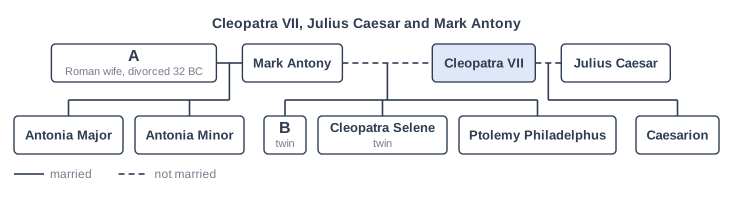
Figure 1 is a family tree showing Cleopatra VII's children by two Roman generals, and Mark Antony's children by one of his Roman wives. A dashed line means that the couple were not married under Roman law.

Name the person labelled A and the child labelled B.

Family tree titled "Cleopatra VII, Julius Caesar and Mark Antony": names in boxes joined by lines, with 2 generations in rows from the oldest at the top to the youngest at the bottom. A line between two boxes in a row joins a couple (solid: married; dashed: not married), and a line coming down from a couple, or from one person on their own, leads to their children. Top row, left to right: box A (Roman wife, divorced 32 BC), Mark Antony, Cleopatra VII and Julius Caesar. Second row, left to right: Antonia Major, Antonia Minor, box B (twin), Cleopatra Selene (twin), Ptolemy Philadelphus and Caesarion. Box A and Mark Antony are married; their children are Antonia Major and Antonia Minor. Mark Antony and Cleopatra VII are joined by a dashed line (not married); their children are box B, Cleopatra Selene and Ptolemy Philadelphus. Cleopatra VII and Julius Caesar are joined by a dashed line (not married); their child is Caesarion. The box of Cleopatra VII is shaded. Boxes A and B show letters instead of names.

Model answer

A is Octavia, Octavian's sister, whom Antony married in 40 BC and divorced in 32 BC. B is Alexander Helios, the twin brother of Cleopatra Selene.

Explanation

Antony married Octavia in 40 BC to seal his alliance with her brother Octavian, and she bore him two daughters, Antonia Major and Antonia Minor. In the same year Cleopatra bore him the twins Alexander Helios ('Sun') and Cleopatra Selene ('Moon'); Ptolemy Philadelphus followed in 36 BC. Octavia later brought up Cleopatra's surviving children in Rome.

Mark scheme
  1. 1 mark

    A: Octavia (the Younger), sister of Octavian

    Accept Octavia. Do not accept Fulvia (Antony's earlier wife, the mother of his sons), Octavian or Livia.

  2. 1 mark

    B: Alexander Helios

    Accept Alexander / Helios. Do not accept Ptolemy Philadelphus, Caesarion or Cleopatra Selene.

Question 3

3 marks

Source A: Plutarch, Life of Antony 58. In 32 BC Octavian took Antony's will from the Vestal Virgins, who kept it, and read it aloud in the Senate.

'He picked out above all the clause about Antony's burial. For Antony had ordered that his body, even if he died in Rome, should be carried in procession through the Forum and then sent away to Cleopatra in Egypt.'

Using Source A and your own knowledge, explain why the reading of Antony's will turned many Romans against him and Cleopatra. Make three points.

Model answer

The burial clause in Source A suggested that Antony had turned his back on Rome, since he wanted his body sent to Cleopatra in Egypt even if he died in Rome. This seemed to prove Octavian's claim that Antony was completely under the control of the foreign queen, and people feared he would move the centre of power to Alexandria. The will also recognised Caesarion as Julius Caesar's son, which threatened Octavian's position as Caesar's heir.

Explanation

Seizing a will from the Vestals was irregular, but its contents gave Octavian a propaganda triumph in 32 BC: Antony seemed to have become an eastern monarch's husband rather than a Roman. Soon afterwards the Senate declared war on Cleopatra. Good answers explain why each detail mattered to Romans, not just what the will said.

Mark scheme
  1. 3 marks

    Three from: one mark for each valid explanation, from Source A or own knowledge.

    e.g. wanting to be buried in Egypt with Cleopatra, even if he died in Rome, showed he had rejected Rome and Roman tradition (burial with his ancestors); it seemed to prove he was completely under Cleopatra's control / bewitched by her; it fed fears that he meant to rule from Alexandria and hand Rome over to Cleopatra; the will also recognised Caesarion as Julius Caesar's true son, a threat to Octavian's position as Caesar's heir; it left large gifts to his children by Cleopatra; it supported Octavian's claim that the coming war was against a foreign queen, and the Senate soon declared war on Cleopatra and stripped Antony of his powers. Credit also: some Romans were shocked that Octavian had seized a will from the Vestals and read it while its author was alive, but the contents outweighed this. Max 3.

Question 4

8 marks

Source A: Cassius Dio, Roman History 50.24-25 (written in the early 3rd century AD). Before the Battle of Actium, Octavian speaks to his soldiers.

'We are Romans, the rulers of the greatest and best part of the world, and yet we are despised and trampled underfoot by an Egyptian woman... Antony has abandoned all the ways of his ancestors and copies everything foreign and barbarian. He pays no honour to us, or to the laws, or to the gods of his fathers, but he worships that woman as if she were an Isis or a Selene, calls her children Helios and Selene, and in the end calls himself Osiris or Dionysus.'

To what extent did the Romans fear Cleopatra because of her power over a Roman general? Use Source A as a starting point and your own knowledge.

Model answer

Source A suggests that her power over Antony was the main reason. Octavian complains that Romans are 'trampled underfoot by an Egyptian woman', and that Antony has abandoned the ways of his ancestors, the laws and the gods of Rome. Instead he worships her 'as if she were an Isis', names their children Helios and Selene and calls himself Osiris. The fear is that a Roman general, with Roman legions, has become the servant of a foreign queen.

My own knowledge supports this. Cleopatra had already influenced Caesar, who brought her to Rome and put her golden statue in the Temple of Venus Genetrix. Antony gave her and her children lands at the Donations of Alexandria in 34 BC, divorced Octavia, and in his will asked to be buried with her in Egypt. Plutarch says that at Actium Antony was 'dragged along by the woman' when she fled. Octavian even claimed that Antony had been drugged and that Rome was really fighting her eunuch and her maids.

However, Cleopatra was also feared in her own right. She was the richest ruler in the Mediterranean, and Egypt's money and ships paid for much of Antony's fleet. She had ambitions for her children, especially Caesarion, a rival 'son of Caesar' to Octavian. Horace says she was plotting 'ruin for the Capitol', and Propertius has her set barking Anubis against Jupiter, so her foreign religion and her power as a woman and a monarch offended Roman values.

Overall, her power over Antony was the main reason for Roman fear, because it put Roman armies at her service. But this fear was partly created by Octavian's propaganda - and Dio wrote his version of the speech centuries later - while her wealth, ambition and foreignness made her a threat even without Antony.

Explanation

The question asks about one reason, so the best answers test it against others (wealth, Caesarion, religion, gender, monarchy) and reach a judgement. Recognising that Dio's speech is a later composition and that Octavian deliberately stressed Antony's 'enslavement' to turn civil war into foreign war shows the critical analysis Level 4 needs.

Mark scheme
  1. 8 marks

    Levels of response (8 marks). AO1 (4) and AO2 (4) are equally weighted.
    Level 4 (7-8 marks): consistently accurate and detailed knowledge of Cleopatra's relationships with Caesar and Antony and of other reasons for Roman fear of her, using both Source A and own wider knowledge; very good understanding of the political and cultural context and of the propaganda purpose of the sources; a well-argued response with a clear, substantiated judgement on how far her power over a Roman general was the main reason for fear, supported by a range of well-selected evidence, including critical analysis.
    Level 3 (5-6 marks): accurate knowledge, using both the source and own knowledge; a focused response with relevant analysis of her power over Antony (and Caesar) and other reasons, and a judgement.
    Level 2 (3-4 marks): sound, mostly accurate knowledge; engages with the general topic of Roman fear of Cleopatra; limited range of evidence; some analysis.
    Level 1 (1-2 marks): limited knowledge, may only use the source given; isolated analysis.
    0 marks: no response or no response worthy of credit.
    A mainly descriptive answer with little analysis or judgement cannot go above Level 2.

    Indicative content (not a checklist; credit other valid points): AO1: Source A - Romans 'despised and trampled underfoot by an Egyptian woman'; Antony has abandoned his ancestors' ways, copies foreign customs, ignores Roman laws and gods; worships her as Isis or Selene; his children named Helios and Selene; calls himself Osiris or Dionysus. Own knowledge: Caesar - the affair, Caesarion, her stay in Rome 46-44 BC, her golden statue in the Temple of Venus Genetrix; Antony - Tarsus, the winter in Alexandria, the Donations of 34 BC (Queen of Kings, Roman-claimed lands to her children), the divorce of Octavia, the will (burial with her in Egypt); Plutarch: at Actium Antony was 'dragged along by the woman'; Octavian claimed Antony was drugged and that Rome was really fighting her eunuch and her maids. Other reasons for fear: the wealth of Egypt and the ships and money she supplied for Antony's war; her ambitions for her children, especially Caesarion as a rival 'son of Caesar'; Horace's queen plotting 'ruin for the Capitol'; Propertius' Anubis against Jupiter; a woman with political and military power, and a monarch, offended Roman values. AO2: For - her hold over Antony was the centre of Octavian's propaganda: it explained why a Roman general would fight Rome, and the thought of Roman legions serving a foreign queen was frightening; she had already influenced Caesar. Against - she was feared in her own right as a rich, ambitious ruler with a fleet; her foreign religion and her sex made her threatening even without Antony; the fear was partly manufactured by Octavian to turn civil war into foreign war; Dio wrote over 200 years later and composed the speech himself. Judgement, e.g.: her power over Antony was the main reason the Romans feared her, because it put Roman armies at her service, but Octavian exaggerated it, and her wealth, ambition and foreignness made her frightening too.

Ready to try the rest? Every answer you write is marked against the mark scheme, so you can see exactly where the marks are.

AI Tutor Hints first, answers after you try

Hi! Stuck? Ask me for a hint and I’ll help you work it out. Once you’ve checked your answer I can explain exactly where the marks are.