Level:
Correct: 0
Incorrect: 0
Marks: 0/0
Exam Practice
Subject:
Topics:
OCR GCSE Classical Civilisation (Women in the Ancient World) Smart practice A mixed round aimed at your weak spots
Unit 1
Greece
Unit 2
Rome
Unit 3
Greece and Rome
Avg
score:
–
Topics
done:
0/21

Women and power in Greece: the Assembly, the Assemblywomen and Agnodice

Practise 30 exam-style questions on Women and power in Greece: the Assembly, the Assemblywomen and Agnodice for OCR GCSE Classical Civilisation (Women in the Ancient World). Write your answer as you would in the exam and get it marked in seconds against the mark scheme, point by point, with an AI tutor on hand if you get stuck.

  • 30 questions
  • 1–8 marks each
  • Instant marking
  • No sign-up needed
20 questions, marked as you go

Sample questions with model answers

Here are 4 of the questions in this topic, each with a model answer, an explanation of why it earns the marks and the mark scheme an examiner would use.

Question 1

1 mark

According to Hyginus (Fabulae 274), under which doctor did Agnodice study medicine, disguised as a man?

Model answer

Herophilus.

Explanation

Hyginus says Agnodice cut her hair, put on men's clothes and entrusted herself to Herophilus to be trained. Herophilus was a real and famous doctor, but he worked in Alexandria in the third century BC, which is one reason historians doubt that the story is an accurate account of Athenian history.

Mark scheme
  1. 1 mark

    Herophilus

    Accept Herophilos. Do not accept Hippocrates, Asclepius or Galen.

Question 2

2 marks

In the rehearsal scene of Aristophanes' Assemblywomen, one woman practising her speech swears 'by the two goddesses', and Praxagora tells her off.

Name the two goddesses, and explain why swearing by them was a mistake.

Model answer

The two goddesses were Demeter and Persephone. Only women swore by them, so a 'man' using this oath in the Assembly would immediately be exposed as a woman.

Explanation

Women and men used different oaths in everyday speech, and the oath by the two goddesses was linked to women's worship, such as the Thesmophoria. The rehearsal slips - swearing like a woman, wanting to card wool, asking for a drink - show the comedy of women trying and failing to behave like men. The question has two parts: one mark for the goddesses, one for the explanation.

Mark scheme
  1. 1 mark

    Demeter and Persephone (Kore)

    Both needed. Accept Demeter and Kore / 'Demeter and her daughter'. Do not accept Athena or Artemis.

  2. 1 mark

    This oath was used only by women, so it would give her away as a woman in the Assembly

    Accept 'men did not swear by them', 'she is supposed to be a man', 'it would reveal her disguise'.

Question 3

3 marks

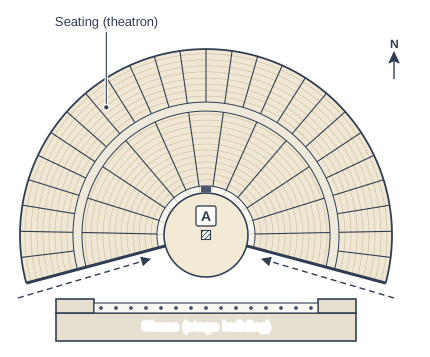
Figure 1 is a plan of a Greek theatre like the Theatre of Dionysus in Athens, where Assemblywomen was first performed in about 391 BC.

Name the area labelled A, where the chorus of Athenian women sang and danced, and explain why the audience would have found the chorus of women disguised as men especially funny.

Plan of an open-air building. Plan of an open-air building with north at the top. A large circle with a small hatched square at its centre is surrounded on the north side by curved banks of seats, more than a semicircle, divided by staircases into wedge-shaped blocks (13 in the lower part, twice as many in the upper part), with a curved walkway between the lower and upper parts. The front row of seats is shaded differently, with a dark seat in the middle. On the south side of the circle is a long building with wings at each end and a row of small columns along its front. Between the ends of the seating and the long building, two dashed arrows lead in from each side towards the circle. A north arrow points up. Label A points to the large circle in front of the seating; the label "Skene (stage building)" points to the long building on the far side of the circle from the seating; the label "Seating (theatron)" points to the curved banks of seating.

Model answer

Area A is the orchestra. The chorus was especially funny because every performer in Athenian drama was a man, so the audience was watching men playing women who were trying to pass as men - a double disguise made obvious by masks, padded costumes and fake beards. For a mainly male audience, the very idea of women sitting in the Assembly was an absurd reversal, so every clumsy attempt by the 'women' to look and behave like men got a laugh.

Explanation

The orchestra was the circular dancing floor in front of the stage building where the chorus performed. Remembering that women did not act, and probably made up little or none of the audience, is essential to understanding the play: it shows men's ideas about women, not women's own views. One mark is for the orchestra and two for explanation.

Mark scheme
  1. 1 mark

    Orchestra

    Do not accept skene, theatron, stage or 'the dancing area' without the name.

  2. 2 marks

    Explanation of why the disguised chorus was funny: 1 mark for each valid point or development, max 2.

    E.g.: all the performers were men, so the audience watched men playing women pretending to be men - a double disguise (1); masks and padded costumes made the 'women' and their fake beards look ridiculous (1); the audience (mainly or entirely men) would laugh at the women's clumsy attempts to behave like men (1); the idea of women in the Assembly was absurd to them / a reversal of the normal order (1); jokes about the disguise (tanned skin, body hair, men's shoes and sticks) highlight the differences between men and women (1). Credit other valid points.

Question 4

8 marks

Source A: Aristophanes, Assemblywomen, from the rehearsal scene (lines 1-240). A woman has put on the garland worn by speakers in the Assembly.

WOMAN: 'So where's the drink?'
PRAXAGORA: 'Drink? Did you think you'd come here to drink?'
WOMAN: 'Well, don't men drink in the Assembly?'
PRAXAGORA: 'Oh, so they drink, do they?'
WOMAN: 'Yes, by Artemis, and unmixed wine too! That's why all their decisions, if you think about them, are crazy, like the decisions of drunk men. And they pour libations - why else would they pray so much, if there were no wine? And they shout abuse at each other like drunks, and the archers carry out anyone who has had too much.'
PRAXAGORA: 'Go and sit down. You're useless.'

To what extent is Assemblywomen simply a joke at women's expense? Use Source A as a starting point and your own knowledge.

Model answer

Source A is partly a joke at women's expense. The woman puts on the speaker's garland and immediately assumes it means a party, playing on the stereotype, found throughout the opening of the play, that women are secret drinkers. Elsewhere in lines 1-240 the women give themselves away by swearing by the two goddesses and wanting to card wool in the Assembly, the lamp speech presents them as secretive, lustful and fond of wine, and even Praxagora's own list of women's virtues ends with lovers, unmixed wine and sex. The basic joke of the play - women disguised as men taking over the Assembly - only works if the audience thinks women in politics are absurd, and every role was played by a man for a mainly male audience.

However, Source A also turns the joke against men. The woman's 'evidence' that men drink is that their decisions are 'crazy, like the decisions of drunk men', that they shout abuse at each other and that the archers have to carry out the drunk. This is a sharp attack on how the Athenian Assembly actually behaved. Praxagora's speech continues this satire, complaining that Athenian politicians are fickle and that the city is always chasing new ideas, and the play was written in the 390s, after Athens' defeat in the Peloponnesian War, when many Athenians were disillusioned with their leaders. Praxagora herself is the cleverest and most persuasive character on stage and wins the vote.

Overall, Assemblywomen constantly laughs at women, using stereotypes the audience shared, but it is not simply a joke at women's expense. Its sharpest satire is aimed at Athenian men and their democracy, and women are the comic device that lets Aristophanes show how badly the men were running the city.

Explanation

Strong answers notice that the same joke can have two targets: Source A mocks women as drinkers and men as drunk decision-makers. They balance the play's reliance on stereotypes against its satire of male politics and Praxagora's competence, and place it in its context. Listing jokes about women without weighing them stays in Level 2.

Mark scheme
  1. 8 marks

    Levels of response (8 marks). AO1 (4) and AO2 (4) are equally weighted.
    Level 4 (7-8 marks): consistently accurate and detailed knowledge of Assemblywomen 1-240 and its context, using both Source A and own wider knowledge; very good understanding of the cultural context (farce, stereotypes, male actors and audience, the state of Athens in the 390s) and possible interpretations; a well-argued response with a clear, substantiated judgement on how far the play is simply a joke at women's expense, supported by a range of well-selected evidence, including critical analysis.
    Level 3 (5-6 marks): accurate knowledge, using both the source and own knowledge; a focused response with relevant analysis of the targets of the humour and a judgement.
    Level 2 (3-4 marks): sound, mostly accurate knowledge; engages with the general topic of the play; limited range of evidence, some analysis.
    Level 1 (1-2 marks): limited knowledge, may only use the source given; isolated analysis.
    0 marks: no response or no response worthy of credit.
    A mainly descriptive answer with little analysis or judgement cannot go above Level 2.

    Indicative content (not a checklist; credit other valid points): AO1: Source A - the woman wants a drink, assuming the speaker's garland means a party (stereotype of women as drinkers); but her answer mocks men - their decisions are 'crazy, like the decisions of drunk men', they abuse each other, the archers carry out the drunk; Praxagora dismisses her as useless; other stereotypes in lines 1-240: the lamp speech (secret drinking, lust, vanity), the slips (swearing by the two goddesses, carding wool in the Assembly), Praxagora's list of women's habits ending in lovers, unmixed wine and sex; the disguise jokes (tans, body hair, beards); satire of men and politics: politicians who are bad for ten days for every good one, the Assembly that always wants something new, men attending for pay, the women's argument that they could not do worse; Praxagora's intelligence and eloquence; male actors, male audience; the play's later communism. AO2: a joke at women's expense - much of the humour uses female stereotypes; the idea of women in power is itself the joke; the women's failures in rehearsal reinforce the view that they are unfit for politics. Not simply - the targets include male politicians and the Assembly itself (Source A turns the drinking joke against men); Praxagora outshines the men; the play explores serious questions about how Athens was governed after its defeat in 404 BC; women are a comic device for criticising men. Judgement: e.g. the play laughs at women constantly, but its sharpest satire is aimed at Athenian men and democracy, so it is not simply a joke at women's expense.

Ready to try the rest? Every answer you write is marked against the mark scheme, so you can see exactly where the marks are.

AI Tutor Hints first, answers after you try

Hi! Stuck? Ask me for a hint and I’ll help you work it out. Once you’ve checked your answer I can explain exactly where the marks are.