Level:
Correct: 0
Incorrect: 0
Marks: 0/0
Exam Practice
Subject:
Topics:
OCR GCSE Classical Civilisation (Women in the Ancient World) Smart practice A mixed round aimed at your weak spots
Unit 1
Greece
Unit 2
Rome
Unit 3
Greece and Rome
Avg
score:
–
Topics
done:
0/21

Comparing 'improper' women and women in religion

Practise 25 exam-style questions on Comparing 'improper' women and women in religion for OCR GCSE Classical Civilisation (Women in the Ancient World). Write your answer as you would in the exam and get it marked in seconds against the mark scheme, point by point, with an AI tutor on hand if you get stuck.

  • 25 questions
  • 2–15 marks each
  • Instant marking
  • No sign-up needed
20 questions, marked as you go

Sample questions with model answers

Here are 4 of the questions in this topic, each with a model answer, an explanation of why it earns the marks and the mark scheme an examiner would use.

Question 1

2 marks

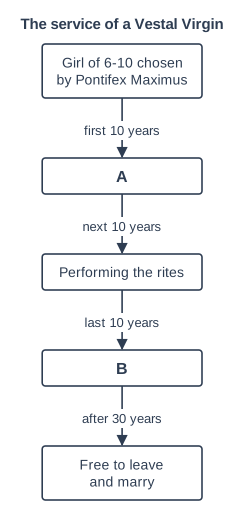
Figure 1 shows the stages of a Vestal Virgin's 30 years of service, as Plutarch describes them in his Life of Numa.

What did a Vestal do in the stages labelled A and B?

The service of a Vestal Virgin. Flow chart of 5 boxes joined by arrows, read from top to bottom. The first box is "Girl of 6-10 chosen by Pontifex Maximus", which leads (along an arrow labelled "first 10 years") to box A, which leads (along an arrow labelled "next 10 years") to "Performing the rites", which leads (along an arrow labelled "last 10 years") to box B, which leads (along an arrow labelled "after 30 years") to "Free to leave and marry".

Model answer

In stage A she learned the rites and duties of a Vestal, and in stage B she taught them to the younger Vestals.

Explanation

Plutarch (Numa 10) says the Vestals spent ten years learning, ten performing the rites and ten teaching. After 30 years a Vestal was free to leave and marry, but Plutarch says few did and those who did were said to be unhappy. Their long service, tending the eternal flame of Vesta and guarding the sacred objects, made them unlike any Greek priestess, most of whom served for a festival, a year or, like the priestess of Athena Polias, for life.

Mark scheme
  1. 1 mark

    A: she learned her duties / was taught the rites (as a pupil).

    Accept 'training', 'learning how to be a Vestal'.

  2. 1 mark

    B: she taught the younger Vestals (passed on what she knew).

    Accept 'teaching / training the new Vestals'. Do not accept 'performing the rites' (that is the middle stage).

Question 2

3 marks

Source B: the House of the Vestal Virgins (Atrium Vestae) in the Roman Forum, next to the round Temple of Vesta. Its remains are of a large building of two or more storeys arranged round a long courtyard with pools and gardens. Along the courtyard stood statues of senior Vestals (Vestales Maximae) on bases inscribed with their names and praise of their virtues.

Explain one limitation of using Source B to learn about the lives of the Vestal Virgins in the time of the Republic.

Model answer

Most of the remains date from the imperial period, when the house was rebuilt after the fire of AD 64 and enlarged later, and the statues of senior Vestals are from the 3rd and 4th centuries AD. So the building shows how Vestals lived centuries after the Republic; we cannot tell how large or grand their house was in the Republic, and the official statues show only the praise given to a few chief Vestals, not the daily lives, duties or punishments of ordinary Vestals.

Explanation

Material remains need dating: the visible House of the Vestals is largely imperial, and the honorific statues are late. A good answer links this to the question's focus on the Republic or explains that statues and inscriptions present an official ideal. 'It is a ruin so we can't see much' needs developing to earn the AO2 marks.

Mark scheme
  1. 1 mark

    AO1 (1 mark): identifies a relevant feature of Source B that limits what it can tell us about the Vestals' lives in the Republic.

    e.g.: the remains are mostly from the imperial period (rebuilt after the fire of AD 64 and later); the statues and inscriptions are of senior Vestals of the 3rd and 4th centuries AD; it is a ruin; the statues show only the chief Vestals; a building cannot show their duties or feelings.

  2. 2 marks

    AO2 (2 marks): explains why this feature limits the source as evidence for the Vestals in the Republic (1), with a development (1).

    e.g.: because what survives was built and enlarged long after the Republic (1), we cannot tell how big or comfortable the Republican house was, so it may exaggerate their status in that period (1). Or: the statues and inscriptions are official praise of a few senior Vestals (1), so they show the ideal and the honours, not the daily routine, discipline or punishments of ordinary Vestals (1). Or: the house shows where they lived but not their duties, such as tending the flame in the temple or making the mola salsa (1).

Question 3

6 marks

Source A: Herodotus, Histories 5.72. Cleomenes, king of Sparta, has occupied the Acropolis of Athens (about 508 BC).

'When Cleomenes went up to the Acropolis intending to take control of it, he went towards the shrine of the goddess to speak to her. But the priestess rose from her seat before he had passed through the doors and said: "Spartan stranger, go back and do not enter the holy place, for it is not lawful for Dorians to come in here." He replied, "Woman, I am not a Dorian but an Achaean." Paying no attention to the warning, he went ahead with his attempt, and then he was thrown out again, together with the Spartans.'

Source B: a marble statue of a senior Vestal Virgin (Vestalis Maxima) of the 3rd century AD from the House of the Vestal Virgins in the Roman Forum. She stands in a long dress and mantle; her hair is bound with thick woollen bands (infulae) and covered with a short veil fastened at the front with a brooch (the suffibulum). The statue stood on a base inscribed with her name and praise of her virtues.

Explain how both sources show that priestesses could have status and authority.

Model answer

In Source A the priestess of Athena rises from her seat and orders the king of Sparta, who has an army with him, to 'go back'. No Athenian woman could have spoken to a king like this in politics, but her authority comes from the goddess and from sacred law: 'it is not lawful for Dorians to come in here'. Herodotus implies her warning had divine weight, because Cleomenes ignored it and was thrown out with his Spartans.

In Source B the senior Vestal is honoured with a marble statue on an inscribed base praising her virtues. Public statues were usually given to men or great benefactors, so this shows her position was officially recognised and admired. Her woollen bands and veil mark her sacred office, making her status visible to everyone in the Forum; as Vestalis Maxima she led the priestesses who guarded the flame of Vesta and the sacred objects on which Rome's safety was thought to depend.

So both sources show priestesses gaining status and authority from their sacred office, a kind of power ordinary women did not have, although it was religious rather than political and belonged to very few women.

Explanation

AO2 marks reward explaining where the authority comes from (the goddess, sacred law, the state's gratitude) and why it was unusual for women. Strong answers compare the kinds of evidence too: a dramatic story in Herodotus against an official, permanent monument in Rome.

Mark scheme
  1. 2 marks

    AO1 (2 marks): a relevant detail selected from each source - 1 mark for Source A, 1 mark for Source B.

    Source A, e.g.: the priestess rises from her seat and orders Cleomenes to go back; she tells him it is not lawful for Dorians to enter; Cleomenes ignores her and is thrown out. Source B, e.g.: she was honoured with a marble statue; the inscribed base names and praises her; she wears the infulae and the suffibulum.

  2. 4 marks

    AO2 (4 marks): explanation of how the selected details show that priestesses could have status and authority - 1 mark for each valid explanatory point or development. Both sources must be discussed for full marks: if only one source is used, maximum 3 marks for AO2.

    Indicative content (not a checklist; credit other valid points): Source A - a woman gives orders to a king at the head of an army, which no Athenian woman could do in politics; her authority comes from the goddess and from sacred law ('it is not lawful'); her seat (a throne) marks her official position; Herodotus' story suggests that ignoring her led to Cleomenes' failure, so her warning carried divine weight; the priestess of Athena Polias held a life office in a leading family. Source B - a public statue was an honour normally given to men or great benefactors, so the Vestal's position was officially recognised; the inscription praising her virtues records public gratitude; the infulae and suffibulum mark her sacred office, making her status visible; as Vestalis Maxima she led the order that guarded Vesta's flame and the sacred objects on which Rome's safety depended. Both - priestesses' status came from their office and the gods; it was religious authority rather than political power; it belonged to a few exceptional women; the Roman evidence is official and lasting, the Greek a dramatic story in a history. An answer cannot gain two AO2 marks for listing traits; each mark needs an explanation of how the detail shows the idea.

Question 4

15 marks

'Women's religious festivals in Greece and Rome gave women a real chance to escape male control.'

How far do you agree with this statement? Use evidence from both Greece and Rome to support your answer.

Model answer

Women's festivals did give Greek and Roman women some of the very few occasions when they acted together, outside the home and without men. But in both cultures these escapes were temporary and permitted by men, and they usually celebrated the roles men expected women to play.

The Thesmophoria is the strongest Greek evidence. For three days married citizen women camped together in the sanctuary of Demeter, chose their own officials, fasted and performed secret rites from which men were completely excluded. For an Athenian wife, normally expected to stay indoors, this was extraordinary. The worship of Dionysus went further: the Maenad Cup shows a maenad in ecstasy with a leopard and a snake, and in Euripides' Bacchae the women leave their looms for the mountains. In Rome the Bona Dea rites, as Plutarch describes them, meant that the consul or praetor and 'every male' had to leave his own house while his wife ran an all-night festival with music and games.

However, these escapes were carefully contained. The Thesmophoria was a state festival on a fixed date, and Isaeus shows that a husband was expected to pay for the women's feast; the rites themselves were about the fertility of crops and the bearing of children, exactly what society wanted from wives. The Panathenaia gave girls honoured roles, such as weaving the peplos and carrying baskets, but on the Parthenon frieze the maidens are received by male marshals, and Thucydides tells how Hipparchus humiliated Harmodius' sister by rejecting her as a basket-carrier. The Bona Dea rites were held in a magistrate's house for the good of the state and led by respectable matronae and the Vestals, so they reinforced the social order.

Men were also deeply suspicious whenever women's religion seemed to escape their control. Aristophanes imagines the women at the Thesmophoria plotting against Euripides; Clodius' intrusion into the Bona Dea rites in 62 BC became a political scandal, and Caesar divorced his wife because she had to be 'above suspicion'. Most strikingly, Livy says the Bacchic rites were originally for women in daylight, but when they became night-time and mixed, the Senate suppressed them in 186 BC, arresting thousands. The Pudicitia cults show religion being used to control women: only univirae, women married once, could worship, and Verginia founded Plebeian Pudicitia to show plebeian wives were just as chaste.

In conclusion, I disagree with the statement to a large extent. Festivals gave women real experiences of independence - gathering, leading rites, excluding men - which they had nowhere else, especially in Athens. But these were permitted, time-limited breaks that celebrated chastity, fertility and motherhood, and when women's worship seemed truly uncontrolled, as with the Bacchanalia, men stepped in at once. They were a safety valve rather than a real escape.

Explanation

Strong answers balance the genuine independence of festivals such as the Thesmophoria and the Bona Dea against the ways they were permitted, funded, timed and policed by men, and use the Bacchanalia or Clodius' scandal to show male suspicion. The Pudicitia cults are a good example of religion reinforcing male values. Describing festivals without evaluating 'escape' or 'control' keeps an answer in Levels 2-3.

Mark scheme
  1. 15 marks

    Levels of response (15 marks). AO1 (5) knowledge and understanding; AO2 (10) analysis, evaluation and argument.
    Level 5 (13-15 marks): very good, detailed and accurate knowledge of a wide range of Greek AND Roman festivals and cults involving women (e.g. the Thesmophoria, the Panathenaia, the worship of Dionysus; the Bona Dea, the Pudicitia cults, the Bacchanalia) and of their contexts; very good analysis of well-selected evidence; a coherent argument with a clear line of reasoning, successful evaluation of how far festivals let women escape male control, and a convincing, substantiated conclusion.
    Level 4 (10-12 marks): good, accurate knowledge of women's festivals in both cultures; good analysis of a wide range of evidence; a consistently well-structured argument and a sound conclusion.
    Level 3 (7-9 marks): reasonable, mostly accurate knowledge; reasonable analysis of a range of evidence, perhaps unbalanced between Greece and Rome; a relevant conclusion.
    Level 2 (4-6 marks): basic knowledge of some festivals; some relevant evidence; some structure and a credible conclusion.
    Level 1 (1-3 marks): limited knowledge, little relevant evidence; a weak or no conclusion.
    0 marks: no response or no response worthy of credit.
    An answer that is mostly description, or that discusses only Greece or only Rome, cannot go above Level 3.

    Indicative content (not a checklist; credit other valid points): AO1: Greece - Thesmophoria: festival of Demeter for married citizen women only, three days (Anodos, Nesteia, Kalligeneia), women camped in the sanctuary, chose their own officials, fasted, mixed the remains of sacrificed piglets with seed; husbands paid for it (Isaeus 3.80); Aristophanes' Thesmophoriazusae imagines women plotting there against Euripides. Panathenaia: arrephoroi and ergastinai wove the peplos; kanephoroi led the procession; maidens on the Parthenon east frieze, but met by male marshals; Harmodius' sister rejected as a basket-carrier (Thucydides 6.56). Dionysus: maenads on the Maenad Cup, the oreibasia; Euripides' Bacchae (women leave the looms for the mountains); the Lenaia; the basilinna's sacred marriage at the Anthesteria. Rome - Bona Dea: one night in a magistrate's house, men including the husband sent out, led by his wife and the Vestals, music and games (Plutarch, Caesar 9); Clodius' intrusion in 62 BC and Caesar's divorce of Pompeia; Pudicitia cults for univirae only, Verginia founding Plebeian Pudicitia (Livy 10.23); the Bacchanalia (Livy 39): women's rites changed by Paculla Annia, suppressed by the Senate in 186 BC, with strict limits on future gatherings. AO2: For - these were the only occasions when women gathered in numbers, ran their own rites, left the house (even overnight) and excluded men; maenadic worship allowed behaviour forbidden in daily life; women held offices and secret knowledge. Against - the festivals were licensed by the state and timed by the calendar; husbands paid for them and magistrates hosted them; many rites celebrated fertility, chastity and motherhood - the very roles men expected (Pudicitia only for women married once); men were deeply suspicious (Aristophanes, Clodius, Juvenal) and the Senate crushed the Bacchanalia when it seemed uncontrolled; only respectable citizen women took part, so slaves and the poor gained little. Judgement, e.g.: a temporary, permitted escape that ultimately reinforced women's roles - a safety valve rather than real freedom.

Ready to try the rest? Every answer you write is marked against the mark scheme, so you can see exactly where the marks are.

AI Tutor Hints first, answers after you try

Hi! Stuck? Ask me for a hint and I’ll help you work it out. Once you’ve checked your answer I can explain exactly where the marks are.