Level:
Correct: 0
Incorrect: 0
Marks: 0/0
Exam Practice
Subject:
Topics:
OCR GCSE Classical Civilisation (Myth and Religion) Smart practice A mixed round aimed at your weak spots
Unit 1
Greece
Unit 2
Rome
Unit 3
Greece and Rome
Avg
score:
–
Topics
done:
0/22

The foundation of Rome: Aeneas, Alba Longa and Romulus and Remus

Practise 35 exam-style questions on The foundation of Rome: Aeneas, Alba Longa and Romulus and Remus for OCR GCSE Classical Civilisation (Myth and Religion). Write your answer as you would in the exam and get it marked in seconds against the mark scheme, point by point, with an AI tutor on hand if you get stuck.

  • 35 questions
  • 1–8 marks each
  • Instant marking
  • No sign-up needed
20 questions, marked as you go

Sample questions with model answers

Here are 4 of the questions in this topic, each with a model answer, an explanation of why it earns the marks and the mark scheme an examiner would use.

Question 1

1 mark

According to Livy, about how many years passed between the founding of Lavinium and the founding of Alba Longa?

Model answer

About thirty years.

Explanation

Livy says that 'about thirty years' passed between the founding of Lavinium and the sending out of the colony to Alba Longa. Alba then ruled for many generations under the Silvii, the line of Alban kings that leads down to Numitor and Amulius.

Mark scheme
  1. 1 mark

    About thirty years

    Accept 30. Do not accept 300 (the period of Alban rule before Rome in Virgil).

Question 2

2 marks

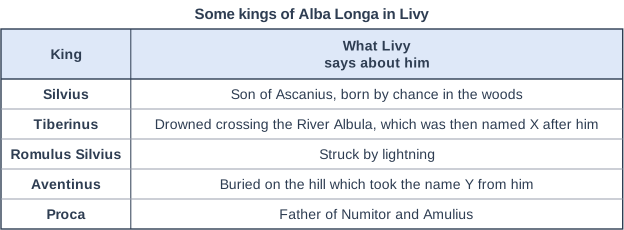
Figure 1 is a table about some of the kings of Alba Longa in Livy's account.

What names should replace X and Y?

Some kings of Alba Longa in Livy. Table with columns "King", "What Livy says about him". King: Silvius; What Livy says about him: Son of Ascanius, born by chance in the woods | King: Tiberinus; What Livy says about him: Drowned crossing the River Albula, which was then named X after him | King: Romulus Silvius; What Livy says about him: Struck by lightning | King: Aventinus; What Livy says about him: Buried on the hill which took the name Y from him | King: Proca; What Livy says about him: Father of Numitor and Amulius.

Model answer

X is the Tiber and Y is the Aventine.

Explanation

Livy's list of Alban kings explains several Roman place-names: King Tiberinus drowned in the River Albula, which was renamed the Tiber, and King Aventinus was buried on the hill that became the Aventine, 'now part of the city of Rome'. Such stories tied the landscape of Rome to the Alban kings descended from Aeneas.

Mark scheme
  1. 1 mark

    X: the Tiber

    Accept Tiberis.

  2. 1 mark

    Y: the Aventine (Hill)

    Accept Aventinus.

Question 3

3 marks

Source A: Livy, The Early History of Rome 1.3.10-11

'Proca was the father of Numitor and Amulius. To Numitor, the elder, he left the ancient kingdom of the Silvian family. But force was stronger than a father's wishes or respect for age: Amulius drove out his brother and became king. He added crime to crime: he destroyed his brother's male children; and his brother's daughter, Rhea Silvia, he chose as a Vestal Virgin, pretending to honour her, so that by condemning her to lifelong virginity he took away all hope of children.'

Explain how Amulius tried to make his power secure. Make three points.

Model answer

Amulius drove out his elder brother Numitor, the rightful king, and took the throne. He then killed Numitor's sons so that there was no male heir to challenge him. Finally he made Numitor's daughter Rhea Silvia a Vestal Virgin, pretending it was an honour, so that she could never have children who might claim the throne; when she bore twins anyway, he imprisoned her and ordered the babies to be drowned.

Explanation

Each of Amulius' crimes removes a possible heir, which is why the birth of the twins matters so much. Livy calls desire for kingship the family's 'ancestral evil', and the same evil later sets Romulus against Remus.

Mark scheme
  1. 1 mark

    One valid point.

    Three from: he drove out his elder brother Numitor, the rightful king; he killed Numitor's sons, so there were no male heirs to claim the throne; he made Numitor's daughter Rhea Silvia a Vestal Virgin, so she could not marry or have children / heirs; he disguised this as an honour, so it did not look like a crime; when she gave birth to twins he had her chained / imprisoned; he ordered the twins to be thrown into the Tiber. Max 3.

  2. 1 mark

    A second, different point.

    As above. 'Explain' requires the purpose to be clear (e.g. so there would be no heirs); a bare list of actions without any purpose: max 2.

  3. 1 mark

    A third, different point.

    As above. Credit knowledge beyond the source (1.4).

Question 4

8 marks

Source A: Livy, The Early History of Rome, Preface 6-8

'The traditions about the time before the city was founded, or while it was being founded, which are more suited to poets' tales than to reliable records of events, I intend neither to confirm nor to refute. Antiquity is allowed this indulgence: by mixing the human with the divine it makes the beginnings of cities more impressive. And if any people ought to be allowed to make its origins sacred and to name the gods as its founders, the military glory of the Roman people is such that, when it claims Mars above all as its own father and the father of its founder, the nations of the world should accept this as calmly as they accept its rule. But whatever people think or judge about these and similar matters, I shall not attach great importance to them.'

To what extent does Livy present the stories of Rome's foundation as history rather than legend? Use Source A as a starting point and your own knowledge.

Model answer

In Source A Livy openly admits that the foundation stories are closer to legend than history. He says they are 'more suited to poets' tales than to reliable records of events' and that he will 'neither confirm nor refute' them. He accepts that antiquity mixes 'the human with the divine' to make cities' beginnings more impressive, and he says he will not attach great importance to whether they are true. This suggests he presents them as legend.

However, he still includes them as the start of a historical narrative and treats them in a historian's way. He often gives more than one version: two accounts of how Latinus allied with Aeneas, two of Remus' death, and he refuses to decide whether Ascanius was the son of Lavinia or of Creusa, asking who could be certain about something so old. He offers rational explanations for miracles: Rhea Silvia may have named Mars as father 'because a god was a more honourable author of the fault', and the she-wolf may come from Larentia's nickname 'lupa'. He uses distancing phrases such as 'the story goes' and 'they say', and he gives the details expected in history: the thirty years between Lavinium and Alba Longa, the line of Alban kings, the origins of the names Tiber and Aventine.

At the same time the stories are full of the divine: the origin of Rome was 'owed to the fates', the flood happened 'through the will of the gods', and Aeneas becomes Jupiter Indiges. Livy values them mainly for their meaning - Rome's divine favour and the moral examples his Preface promises.

Overall, Livy presents the foundation stories as legend rather than proven history, but he records them carefully and critically, like a historian, because they matter to Rome's sense of its own greatness.

Explanation

Top answers use the Preface's explicit statements and then show how Livy's narrative matches them: alternative versions, rational explanations and cautious language, alongside fate and the gods. A clear judgement about the balance - and why Livy includes stories he will not vouch for - is needed for Level 4.

Mark scheme
  1. 8 marks

    Levels of response (8 marks). AO1 (4) and AO2 (4) are equally weighted.
    Level 4 (7-8 marks): consistently accurate and detailed knowledge of Livy's Preface and of 1.1, 1.3-1.4 and 1.6-1.7, using both Source A and own wider knowledge; very good understanding of Livy's methods and purpose and of possible interpretations; a well-argued response with a clear judgement on how far the foundation stories are presented as history or legend, supported by a range of well-selected evidence, including critical analysis.
    Level 3 (5-6 marks): accurate knowledge, using both Source A and own knowledge; a focused response with relevant analysis and a judgement.
    Level 2 (3-4 marks): sound, mostly accurate knowledge; engages with the general topic of Livy's account; limited range of evidence; some analysis.
    Level 1 (1-2 marks): limited knowledge, may only use Source A; isolated analysis.
    0 marks: no response or no response worthy of credit.
    A mainly descriptive answer with little analysis or judgement cannot go above Level 2.

    Indicative content (not a checklist; credit other valid points): AO1: Source A - the traditions are 'more suited to poets' tales than to reliable records'; Livy will 'neither confirm nor refute' them; antiquity mixes human and divine to make origins impressive; Rome's military glory entitles it to claim Mars; he will not attach great importance to them. Own knowledge - 'it is generally agreed' (1.1); two versions of the Latinus-Aeneas alliance; Aeneas worshipped as Jupiter Indiges, 'whatever it is right to call him'; refuses to decide Ascanius' mother ('who could state as certain something so old?'); the list of Alban kings with names and explanations (Tiberinus, Aventinus); 'owed to the fates'; Rhea Silvia names Mars 'either because she believed it or because a god was a more honourable author of the fault'; the flood 'by some chance, divinely'; 'the story goes' (she-wolf), with the rational version of Larentia as 'lupa'; six and twelve vultures; two versions of Remus' death ('the more common story'). AO2: as history - he records the stories as the start of a continuous history of Rome, with places, kings, dates (thirty years) and institutions; he offers rational explanations and alternative versions, like a historian weighing evidence; he uses cautious language that distances him from miracles. As legend - he admits they are poets' tales; he includes gods, fate and miracles; he values them for moral examples and Rome's glory rather than truth; he 'will not attach great importance' to whether they are true. Judgement: e.g. Livy treats them as traditions worth recording for their meaning, presented cautiously, rather than as proven history.

Ready to try the rest? Every answer you write is marked against the mark scheme, so you can see exactly where the marks are.

AI Tutor Hints first, answers after you try

Hi! Stuck? Ask me for a hint and I’ll help you work it out. Once you’ve checked your answer I can explain exactly where the marks are.