
Level:
Correct: 0
Incorrect: 0
Marks: 0/0
Exam Practice
Subject:
Topics:
OCR GCSE Classical Civilisation (Myth and Religion) Smart practice A mixed round aimed at your weak spots
Unit 1
Greece
Unit 2
Rome
Unit 3
Greece and Rome
Avg
score:
–
Topics
done:
0/22

Greek festivals: the Great Panathenaia and the City Dionysia

Practise 33 exam-style questions on Greek festivals: the Great Panathenaia and the City Dionysia for OCR GCSE Classical Civilisation (Myth and Religion). Write your answer as you would in the exam and get it marked in seconds against the mark scheme, point by point, with an AI tutor on hand if you get stuck.

  • 33 questions
  • 1–8 marks each
  • Instant marking
  • No sign-up needed
20 questions, marked as you go

Sample questions with model answers

Here are 4 of the questions in this topic, each with a model answer, an explanation of why it earns the marks and the mark scheme an examiner would use.

Question 1

1 mark

Figure 1 is a plan of the Theatre of Dionysus in Athens.

Whose seat is labelled A?
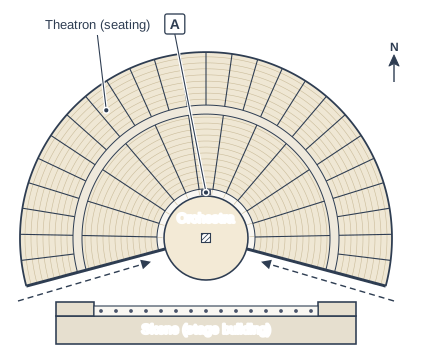
Plan of an open-air building. Plan of an open-air building with north at the top. A large circle with a small hatched square at its centre is surrounded on the north side by curved banks of seats, more than a semicircle, divided by staircases into wedge-shaped blocks (13 in the lower part, twice as many in the upper part), with a curved walkway between the lower and upper parts. The front row of seats is shaded differently, with a dark seat in the middle. On the south side of the circle is a long building with wings at each end and a row of small columns along its front. Between the ends of the seating and the long building, two dashed arrows lead in from each side towards the circle. A north arrow points up. Label A points to the dark seat in the middle of the front row, facing the circle; the label "Orchestra" points to the large circle in front of the seating; the label "Theatron (seating)" points to the curved banks of seating; the label "Skene (stage building)" points to the long building on the far side of the circle from the seating.

Model answer

The priest of Dionysus Eleuthereus.

Explanation

The best seat in the house, in the middle of the front row (the prohedria), belonged to the priest of Dionysus Eleuthereus; the surviving marble throne is inscribed with his title. Other front-row seats were reserved for officials and honoured guests. The priest's seat reminds us that the plays were performed at a religious festival, in the god's own sanctuary.

Mark scheme
  1. 1 mark

    The priest of Dionysus

    Accept the priest of Dionysus Eleuthereus. Do not accept 'a priest' alone, the archon, the judges or Dionysus himself.

Question 2

2 marks

Describe the myth of how the worship of Dionysus Eleuthereus came to Athens. Make two points.

Model answer

Pegasos brought the statue of Dionysus from Eleutherae to Athens, but the Athenians refused to honour the god. Dionysus struck the men with a disease, and an oracle told them to honour him, so they made phalloi in his honour, which were then carried in the festival procession.

Explanation

This origin story (preserved in an ancient commentary on Aristophanes' Acharnians) explains two features of the festival: the god's title Eleuthereus and the phalloi carried in the pompe. It follows a common pattern in myths of Dionysus, in which those who reject the god are punished until they accept him. Historically the festival was greatly developed in the 6th century BC, with the first tragic contest about 534 BC.

Mark scheme
  1. 1 mark

    First valid point.

    Two from: Pegasos brought the statue of Dionysus from Eleutherae to Athens; the Athenians did not welcome / honour the god; Dionysus punished them with a disease (affecting the men's genitals); they consulted an oracle, which told them to honour the god; they made phalloi in his honour (explaining the phalloi in the procession) and the disease ended; they then honoured him with a festival. Max 2.

  2. 1 mark

    Second, different valid point.

    As above.

Question 3

3 marks

Source A: Pausanias, Description of Greece 1.30.2

'In the Academy there is an altar of Prometheus, and from it they run to the city holding burning torches. The contest is to keep the torch alight while running. If the first runner's torch goes out, he no longer has any claim to victory, but the second runner has; if his torch goes out too, the third wins; and if all the torches go out, there is no winner left.'

Torch races were run at several Athenian festivals, including the Panathenaia. Using Source A and your own knowledge, explain why a torch race was exciting to watch. Make three points.

Model answer

The runners had to run fast and keep their torches alight at the same time, so the race was a test of skill as well as speed. It was unpredictable, because the leader lost if his torch went out, and the second or third runner could then win. At the Panathenaia it was run at night by teams from the tribes, so the crowds would see the flames racing through the dark and cheer for their own tribe.

Explanation

Pausanias' rules explain the drama: speed alone was not enough. The Panathenaic torch race brought fire from an altar outside the city to Athena's altar on the Acropolis, linking the contest to the sacrifice. Top answers use both the source and own knowledge of the night-time, tribal nature of the race.

Mark scheme
  1. 1 mark

    First valid reason.

    Three from, e.g.: runners had to be fast and also keep the flame alight - two challenges at once; the leader could suddenly lose if his torch went out, so the result was unpredictable; a runner in second or third place could still win; all the torches might go out, leaving no winner; it was a long race from the Academy right into the city; (own knowledge) it was run at night, so the flames would be spectacular; teams from the ten tribes competed in relays, so spectators cheered for their own tribe; the winning torch lit the fire on Athena's altar, a dramatic climax before the sacrifice. Max 3.

  2. 1 mark

    Second, different valid reason.

    As above.

  3. 1 mark

    Third, different valid reason.

    As above.

Question 4

8 marks

Source A: part of the north frieze of the Parthenon, Athens (about 442-438 BC). Ranks of young horsemen gallop forward; chariots carry armed warriors who leap on and off them; then come elderly men, musicians playing pipes and lyres, young men carrying water jars on their shoulders and others carrying trays, and finally attendants leading cows and sheep to sacrifice.

To what extent was the Great Panathenaia more about displaying the power of Athens than about worshipping Athena? Use Source A as a starting point and your own knowledge.

Model answer

The Great Panathenaia was first and foremost Athena's birthday festival, but in the 5th century it was also a deliberate display of Athenian power, and the two cannot really be separated.

Source A shows how the procession could display power. It begins with ranks of young horsemen and chariots carrying armed warriors who leap on and off them - the apobates contest - which shows off the city's military skill and wealth. It was carved on the Parthenon, part of Pericles' building programme paid for partly with money from the Delian League. At the Great Panathenaia the allies and colonies had to send a cow and a suit of armour to the festival, so the procession displayed Athens' empire as well as its citizens. The prizes, huge numbers of amphorae of oil, the hecatomb of cattle, and contests that drew competitors from all over Greece, along with the recitation of Homer, all advertised Athens as the leading city of Greece.

However, Source A also shows that the procession was religious. Musicians, water-carriers, tray-bearers with offerings and animals for sacrifice all prepared for the worship of Athena, and the procession ended at her altar, where a hecatomb was sacrificed on her birthday. The centre of the festival was the new peplos for her ancient statue, shown at the climax of the frieze. Even the prizes were oil from her sacred olives.

Overall, the festival existed to worship Athena, but the Athenians of the 5th century made it a showcase for their power. Since Athena was the city's protector, showing Athens' greatness was itself a way of honouring her, so the festival was as much about power as worship.

Explanation

Strong answers use the details in Source A (horsemen and apobatai on one side; offerings and sacrificial animals on the other) and add own knowledge such as the allies' tribute of a cow and armour, the peplos and the hecatomb. The best judgements recognise that for Athenians civic display and religious worship were intertwined. Description of the procession without argument stays in Level 2.

Mark scheme
  1. 8 marks

    Levels of response (8 marks). AO1 (4) and AO2 (4) are equally weighted.
    Level 4 (7-8 marks): consistently accurate and detailed knowledge of the Great Panathenaia (procession, sacrifice, contests, participants), using both Source A and own wider knowledge; very good understanding of the cultural context and possible interpretations; a well-argued response with a clear, substantiated judgement on whether the festival was more about Athens' power or about worshipping Athena, supported by a range of well-selected evidence, including critical analysis.
    Level 3 (5-6 marks): accurate knowledge, using both the source and own knowledge; a focused response with relevant analysis of both aspects and a judgement.
    Level 2 (3-4 marks): sound, mostly accurate knowledge; engages with the general topic, limited range of evidence, some analysis.
    Level 1 (1-2 marks): limited knowledge, may only use the source given; isolated analysis.
    0 marks: no response or no response worthy of credit.
    A mainly descriptive answer with little analysis or judgement cannot go above Level 2.

    Indicative content (not a checklist; credit other valid points): AO1: Source A - cavalry, apobatai (armed warriors leaping from chariots), elders, musicians, water-carriers, tray-bearers, cattle and sheep for sacrifice; the frieze on Athena's temple, built in Pericles' programme partly with Delian League money; the peplos for Athena Polias, carried like a ship's sail at the Great Panathenaia; the hecatomb on the Great Altar and the meat shared among citizens; Athena's birthday (28 Hekatombaion); allies and colonies required to send a cow and a suit of armour; Panathenaic amphorae of oil from the sacred olives; athletic, musical, equestrian and tribal contests (pyrrhic dance, euandria, torch race, boat race), with competitors from all over Greece; rhapsodes reciting Homer; the all-night pannychis; officials (athlothetai, one per tribe). AO2: power - military display (cavalry, hoplites, apobatai) in the procession and on the frieze; allies forced to take part as subjects of the empire; lavish prizes and a hecatomb show Athens' wealth; Panhellenic contests and Homer advertised Athens as leader of Greece; metics and allies placed in subordinate roles show the city's order. Worship - the festival was Athena's birthday and every element (peplos, sacrifice, hymns, prizes of her oil) honoured her; the procession ended at her altar; contests themselves were offerings to the goddess; Greeks did not separate civic pride from religion - glorifying Athens glorified its goddess. Judgement e.g. worship was the purpose, but in the 5th century the festival was shaped to display imperial power.

Ready to try the rest? Every answer you write is marked against the mark scheme, so you can see exactly where the marks are.

AI Tutor Hints first, answers after you try

Hi! Stuck? Ask me for a hint and I’ll help you work it out. Once you’ve checked your answer I can explain exactly where the marks are.