Level:
Correct: 0
Incorrect: 0
Marks: 0/0
Exam Practice
Subject:
Topics:
OCR GCSE Classical Civilisation (Myth and Religion) Smart practice A mixed round aimed at your weak spots
Unit 1
Greece
Unit 2
Rome
Unit 3
Greece and Rome
Avg
score:
–
Topics
done:
0/22

Greek temples, priests and sacrifice

Practise 36 exam-style questions on Greek temples, priests and sacrifice for OCR GCSE Classical Civilisation (Myth and Religion). Write your answer as you would in the exam and get it marked in seconds against the mark scheme, point by point, with an AI tutor on hand if you get stuck.

  • 36 questions
  • 1–8 marks each
  • Instant marking
  • No sign-up needed
20 questions, marked as you go

Sample questions with model answers

Here are 4 of the questions in this topic, each with a model answer, an explanation of why it earns the marks and the mark scheme an examiner would use.

Question 1

1 mark

Name the sculptor who made the gold and ivory statue of Zeus for his temple at Olympia, one of the Seven Wonders of the ancient world.

Model answer

Pheidias.

Explanation

Pheidias of Athens, who had already made the Athena Parthenos for the Parthenon, made the seated Zeus at Olympia in the 430s BC, in a workshop just west of the Altis that has been excavated; a cup inscribed 'I belong to Pheidias' was found there. Libon of Elis designed the temple itself.

Mark scheme
  1. 1 mark

    Pheidias

    Accept Phidias. Do not accept Libon (the temple's architect) or Polykleitos.

Question 2

2 marks

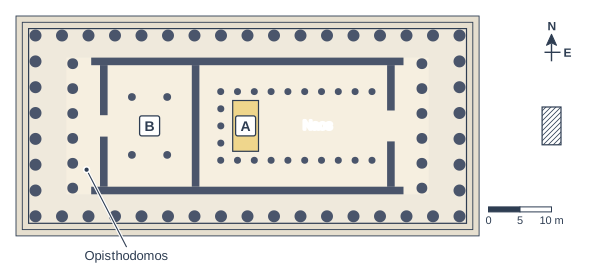
Figure 1 is a plan of the Parthenon in Athens.

Name the statue that stood at A, and state what room B was used for.

Plan of a Greek temple. Plan of a large rectangular building with north at the top and east on the right. A single row of columns runs right round the outside, 8 across each end and 17 along each side, on a platform edged by steps. Inside stands a walled building with a row of 6 columns in front of each end. A wide doorway in the east wall leads into a large main room, in which a row of small columns runs in a U shape (down each side and across the west end) round a rectangular block near the west end. Behind it, with no doorway between them, is a smaller room with 4 columns inside, entered through a doorway from the west end. Outside, east of the building, is a small hatched block on the central line. A compass shows north (up) and east (right); there is a 10 m scale bar. Label A points to the rectangular block near the west end of the large main room; label B points to the smaller room at the west end of the inner building, with four columns inside it; the label "Naos" points to the large main room in the middle of the building; the label "Opisthodomos" points to the space at the west end between the row of six columns and the west wall of the inner building.

Model answer

A was the gold and ivory statue of Athena Parthenos by Pheidias. Room B was used as a treasury, storing valuable offerings and money.

Explanation

The naos was built round Pheidias' Athena Parthenos, about 12 m high, framed by a two-tier colonnade. The back room, entered only from the west, stored treasure: the temple served as a bank for Athena's wealth and, after 454 BC, for the funds of the Delian League. Temples were storehouses as well as homes for the gods.

Mark scheme
  1. 1 mark

    A: the statue of Athena Parthenos

    Accept Athena / Athena Parthenos / the gold and ivory statue of Athena by Pheidias.

  2. 1 mark

    B: a treasury / store for treasure, valuable offerings or money

    Accept: it held Athena's treasures / the funds of the Delian League / valuable dedications. Do not accept 'a room for the priests'.

Question 3

3 marks

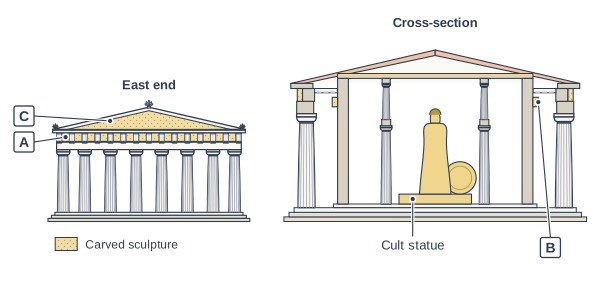
Figure 1 shows where carved sculpture was placed on the Parthenon: on the left is the east end of the temple, on the right a cross-section through the naos.

Name the three kinds of sculpture labelled A, B and C.

Two views of a Greek temple. Two views of a Greek temple; a key under the left view says that dotted areas are carved sculpture. Left, headed "East end": the front of the temple, with 8 columns on three steps, a band of dotted square panels alternating with grooved blocks above the columns, and a dotted triangular gable with an ornament on the top and each corner. Right, headed "Cross-section": a section across the building. From the outside in on each side: an outer column, with the beams above it cut through and a dotted block on their outside face; a covered walkway with a panelled ceiling; an inner wall with a dotted band high up on its outside face, just under the walkway ceiling; then, inside, a stack of two small columns, and in the middle a tall figure on a wide base with a round shield beside it. A pitched roof covers everything. Label A points to a dotted square panel in the band above the columns of the end view; label B points to the dotted band high on the outside face of the right-hand inner wall, under the walkway ceiling, in the cross-section; label C points to the dotted triangular area in the gable of the end view; the label "Cult statue" points to the tall figure on a base in the middle of the cross-section.

Model answer

A shows the metopes, B the frieze and C the pediment sculpture.

Explanation

The Parthenon had more sculpture than any other Greek temple: 92 carved metopes round the outside, a continuous Ionic frieze of the Panathenaic procession high on the cella wall inside the colonnade, and free-standing statues in both pediments (the birth of Athena at the east, her contest with Poseidon at the west). Its sculpture honoured Athena and celebrated Athens.

Mark scheme
  1. 1 mark

    A: metopes

    Accept metope. Do not accept triglyph.

  2. 1 mark

    B: frieze

    Accept Ionic frieze / the Panathenaic frieze.

  3. 1 mark

    C: pediment sculpture

    Accept pediment / pedimental sculpture / pediment statues.

Question 4

8 marks

Source A: Strabo, Geography 8.3.30, on the statue of Zeus at Olympia.

'The greatest of these offerings was the statue of Zeus made of ivory by Pheidias of Athens, son of Charmides. It was so large that, although the temple is very large, the artist seems to have missed the right proportions: he made Zeus seated, but almost touching the roof with the top of his head, so that he gives the impression that if Zeus stood up he would take the roof off the temple. ... They record that when Panainos asked Pheidias what model he was going to follow for his image of Zeus, he replied that he would make it like the image Homer gave in these lines: "The son of Kronos spoke, and nodded his dark brows, and the god's immortal hair flowed down from his deathless head, and he made great Olympus shake."'

To what extent was the cult statue the most important part of a Greek temple? Use Source A as a starting point and your own knowledge.

Model answer

Source A suggests that the cult statue was the most important part of the temple. Strabo calls Pheidias' Zeus 'the greatest of these offerings', and it was so huge that if Zeus stood up 'he would take the roof off the temple'. Pheidias modelled it on Homer's image of Zeus nodding and shaking Olympus, so the statue was meant to show the god's full majesty and fill worshippers with awe.

My own knowledge supports this. A temple was the house of the god, and its main room, the naos, was built to shelter the statue. At Olympia and in the Parthenon the statue stood at the west end facing the east door, framed by two storeys of interior columns, so everything led the eye to it. The statues were made of gold and ivory and carefully looked after: Pausanias says oil was poured in front of the Zeus to protect the ivory from damp, and water was used for the Athena Parthenos.

However, the statue was not the centre of worship. Sacrifices took place at the altar outside, and at Olympia the great ash altar of Zeus was older and more important for ritual than the temple itself. Ordinary worshippers rarely went into the naos, but everyone could see the sculpture on the outside: the pediments and metopes at Olympia and the Parthenon frieze. Temples were also treasuries: the Parthenon's back room stored Athena's wealth and the funds of the Delian League. In Athens the most sacred image was not the Parthenos but the old olive-wood statue of Athena Polias, which received the new peplos at the Panathenaia, so the Parthenos was partly a display of Athenian wealth.

Overall, the cult statue was the most important part of the temple building, which existed to house it, as Strabo's account shows. But it was not the most important part of Greek worship: the altar outside was essential, and temples also served as treasuries and symbols of civic pride.

Explanation

Strabo shows the awe the statue inspired, but a strong answer distinguishes between the temple building (built around the statue) and worship (centred on the altar). Use specific details of the Zeus and the Parthenos, then weigh the altar, the external sculpture and the treasury role before reaching a clear judgement.

Mark scheme
  1. 8 marks

    Levels of response (8 marks). AO1 (4) and AO2 (4) are equally weighted.
    Level 4 (7-8 marks): consistently accurate and detailed knowledge of Greek temples, their cult statues and how they were used, using both Source A and own wider knowledge of the Temple of Zeus and the Parthenon; very good understanding of the religious context and of possible interpretations; a well-argued response with a clear, substantiated judgement on how far the cult statue was the most important part, supported by a range of well-selected evidence, including critical analysis.
    Level 3 (5-6 marks): accurate knowledge, using both the source and own knowledge; a focused response with relevant analysis of the statue and other parts of the temple, and a judgement.
    Level 2 (3-4 marks): sound, mostly accurate knowledge; engages with the general topic of temples and statues; limited range of evidence; some analysis.
    Level 1 (1-2 marks): limited knowledge, may only use the source given; isolated analysis.
    0 marks: no response or no response worthy of credit.
    A mainly descriptive answer with little analysis or judgement cannot go above Level 2.

    Indicative content (not a checklist; credit other valid points): AO1: Source A - the statue was 'the greatest of these offerings'; colossal, seated, nearly touching the roof; of ivory (and gold); modelled on Homer's image of Zeus nodding and shaking Olympus. Own knowledge - the naos was the god's house, built to shelter the statue; it faced east through the door; the plan led towards it (two-storey interior colonnades at Olympia and round the Athena Parthenos); Pausanias' descriptions of the Zeus (throne, Victory, eagle sceptre, olive wreath) and the Athena Parthenos (helmet, aegis, Victory, shield, serpent); care of the ivory with oil at Olympia and water at Athens; Pheidias' workshop; ancient writers said seeing the Zeus deepened religious feeling. Other parts - the altar outside, where sacrifice, the heart of worship, took place (the ash altar at Olympia); worshippers rarely entered the naos; the sculpture on the outside (pediments, metopes, frieze) seen by everyone; the temple as treasury (the Parthenon's back room, Delian League funds) and store of dedications; the building as a display of civic wealth and pride; the most sacred image in Athens was the old olive-wood Athena Polias, which received the peplos, not the Parthenos; the Parthenos' gold could be removed as a financial reserve. AO2: for - the temple existed to house the god's image; the plan, light and decoration focused on it; it made the god present and inspired awe, as Strabo shows. Against - the altar was essential for worship while a temple was not; access to the statue was limited; external sculpture, treasury and civic display were major functions; some great statues were as much displays of wealth as objects of cult. Judgement, e.g.: the statue was the most important part of the temple building, which existed to house it, but not of Greek worship as a whole, which centred on the altar.

Ready to try the rest? Every answer you write is marked against the mark scheme, so you can see exactly where the marks are.

AI Tutor Hints first, answers after you try

Hi! Stuck? Ask me for a hint and I’ll help you work it out. Once you’ve checked your answer I can explain exactly where the marks are.