Level:
Correct: 0
Incorrect: 0
Marks: 0/0
Exam Practice
Subject:
Topics:
OCR GCSE Classical Civilisation (Myth and Religion) Smart practice A mixed round aimed at your weak spots
Unit 1
Greece
Unit 2
Rome
Unit 3
Greece and Rome
Avg
score:
–
Topics
done:
0/22

Myth and power in Greece: the Centauromachy and Amazonomachy

Practise 30 exam-style questions on Myth and power in Greece: the Centauromachy and Amazonomachy for OCR GCSE Classical Civilisation (Myth and Religion). Write your answer as you would in the exam and get it marked in seconds against the mark scheme, point by point, with an AI tutor on hand if you get stuck.

  • 30 questions
  • 1–8 marks each
  • Instant marking
  • No sign-up needed
20 questions, marked as you go

Sample questions with model answers

Here are 4 of the questions in this topic, each with a model answer, an explanation of why it earns the marks and the mark scheme an examiner would use.

Question 1

1 mark

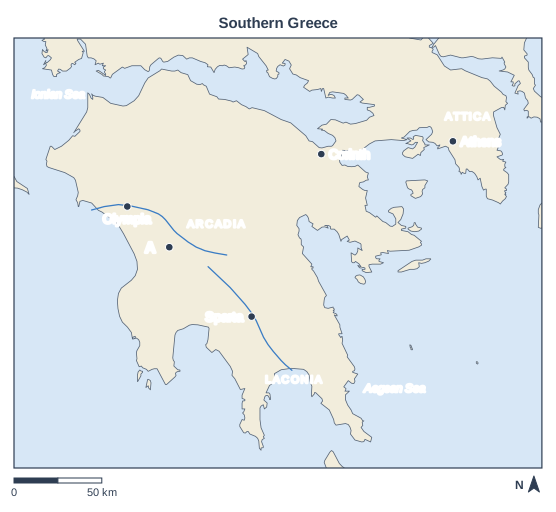
Figure 1 is a map of southern Greece. The site labelled A was the home of a temple whose sculpted frieze of Amazons and centaurs is now in the British Museum.

Name the site labelled A.

Map of the area from 20.9°E to 24.3°E and 36.3°N to 38.5°N, titled "Southern Greece", drawn with real coastlines (land pale buff, sea pale blue) and no modern borders; a north arrow shows north at the top; the scale bar is 50 km long. Ancient region names printed in spaced capitals: Arcadia, Attica and Laconia. Sea names printed in blue italics: Aegean Sea and Ionian Sea. Blue lines show rivers. Points: a dot labelled "Athens" (inland); a dot labelled "Olympia" (inland); a dot labelled "Sparta" (inland); a dot labelled "Corinth" (inland); a dot labelled A inland, towards the left of the map (about 30% of the way across and 50% of the way down), about 35 km south-east of the point labelled "Olympia".

Model answer

Bassae.

Explanation

The Temple of Apollo Epikourios stands at Bassae, high in the mountains of south-west Arcadia, in the territory of Phigalia. Its frieze was found in 1811-12 and bought by the British Museum. Its remote site meant that its audience was very different from that of the Parthenon in the heart of Athens.

Mark scheme
  1. 1 mark

    Bassae

    Accept Bassai; accept Phigalia (the city that owned the temple). Do not accept Olympia or Sparta.

Question 2

2 marks

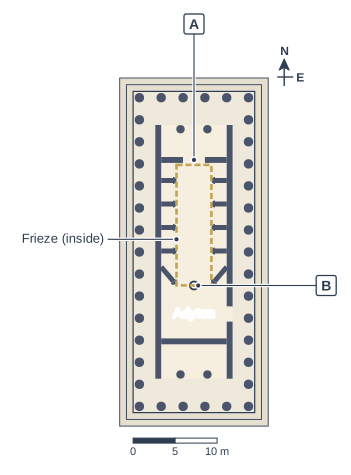
Figure 1 is a plan of the Temple of Apollo at Bassae.

In which direction does the main entrance labelled A face, and which order of architecture is the single column labelled B?

Plan of a Greek temple. Plan of a narrow Greek temple with north at the top and east on the right; it is long from north to south. A row of columns (6 across each end, 15 down each side) stands on a platform edged by steps. Inside is a walled building with two columns at each end and a doorway in its north wall. The long main room has short walls jutting in from each side, each with a half-round end: four on each side at right angles, then a last pair set slanting. Between the slanting pair stands a single free-standing column, drawn as an open circle. Beyond it, at the south end, is a room with a doorway in its east wall. A dashed line runs round the inside of the main room along the ends of the jutting walls. A compass shows north (up) and east (right); there is a 10 m scale bar. Label A points to the doorway in the north wall of the inner building; label B points to the single free-standing open circle at the south end of the main room, between the two slanting walls; the label "Frieze (inside)" points to the dashed line running round the inside of the main room, along the ends of the short jutting walls; the label "Adyton" points to the room at the south end of the inner building, beyond the open circle.

Model answer

The main entrance (A) faces north, and the column B is Corinthian.

Explanation

Most Greek temples faced east, but Bassae faces north, with a side door on the east into the adyton at the back. The temple combines all three orders: Doric outside, Ionic half-columns inside the cella and a single Corinthian column, the earliest known Corinthian capital. Its unusual design is one reason why the placing of its frieze inside the cella is also thought to be deliberate.

Mark scheme
  1. 1 mark

    A: north

    Do not accept east (the usual direction for a Greek temple).

  2. 1 mark

    B: Corinthian

    Do not accept Doric or Ionic.

Question 3

3 marks

Describe how the sculptors of the Parthenon's south metopes made the centaurs look different from the Lapiths. Make three points.

Model answer

The centaurs have the bodies of horses from the waist down, while the Lapiths are completely human, with idealised athletic bodies. The centaurs are usually bearded, and some have coarse, snarling, mask-like faces, while the Lapiths' faces are calm. Some centaurs carry animal skins, a sign of their wild nature, while the Lapiths fight hand to hand like trained athletes.

Explanation

The contrast between the idealised human body and the half-animal centaur expresses the meaning of the myth: reason and civilisation against beastly passion. The quality and style of the metopes vary, which suggests many sculptors worked on them under Pheidias' direction. Credit any three accurate contrasts.

Mark scheme
  1. 1 mark

    First valid point.

    Three from, e.g.: centaurs have the body and legs of a horse from the waist down, Lapiths are fully human; centaurs are usually bearded and older-looking, Lapiths are often young and beardless; some centaurs have coarse, distorted, snarling or mask-like faces, while Lapiths have calm, idealised faces; Lapiths have idealised, athletic, often naked bodies; centaurs use crude weapons or household objects such as wine vessels, or carry animal skins; Lapiths wear or hold cloaks / fight with skill; centaurs rear up wildly / fight with brute strength. Max 3.

  2. 1 mark

    Second, different valid point.

    As above.

  3. 1 mark

    Third, different valid point.

    As above.

Question 4

8 marks

Source A: two marble metopes from the south side of the Parthenon (about 447-442 BC). In the first, a young Lapith grips a rearing centaur by the head from behind and draws back his arm to strike, while the centaur twists back in pain. In the second, a centaur rears up in triumph over the body of a Lapith lying on the ground, an animal skin hanging from his arm.

'The Centauromachy shows civilisation defeating barbarism.' To what extent is this true of the south metopes of the Parthenon? Use Source A as a starting point and your own knowledge.

Model answer

The statement is largely true, but the south metopes show civilisation's victory as a hard and uncertain struggle rather than a simple triumph.

The first metope in Source A fits the statement well. The young Lapith, with an idealised human body, overpowers the half-animal centaur, gripping him by the head and preparing to strike, while the centaur twists in pain. This contrast between man and beast expresses reason and self-control defeating wild passion. The myth itself supports this reading: the centaurs, invited as guests to Peirithous' wedding, got drunk and tried to carry off Hippodameia and the other women, breaking the civilised laws of hospitality and marriage, and the Lapiths, helped by the Athenian Theseus, restored order. The other metope series on the Parthenon - gods against giants, Greeks against Amazons and the Trojan War - share this theme, and after the Persians burned the Acropolis in 480 BC Athenians could see their own victory over the 'barbarians' in it.

However, the second metope in Source A shows a centaur rearing in triumph over a dead Lapith, and several metopes show centaurs winning. The series therefore presents a battle whose outcome is in doubt, and civilisation suffers losses. The 'barbarism' reading is also partly an interpretation: the centaurs were the Lapiths' relatives, and the myth could equally be a warning about wine or about the sanctity of marriage. The central metopes, lost in 1687, may even have shown a different story.

Overall, the metopes do show civilisation defeating barbarism, but their power comes from showing how hard-won that victory was. This made the message stronger for Athenians who had themselves suffered before defeating Persia.

Explanation

Source A gives one scene supporting the statement and one complicating it, so the best answers use both. Strong answers explain the symbolism (human versus beast, breach of xenia, the Persian parallel) and then evaluate it, noting the scenes of centaur victory and other possible meanings. A judgement that addresses 'to what extent' directly is needed for Level 4.

Mark scheme
  1. 8 marks

    Levels of response (8 marks). AO1 (4) and AO2 (4) are equally weighted.
    Level 4 (7-8 marks): consistently accurate and detailed knowledge of the south metopes and the myth, using both Source A and own wider knowledge; very good understanding of the cultural context and possible interpretations; a well-argued response with a clear, substantiated judgement on how far the metopes show civilisation defeating barbarism, supported by a range of well-selected evidence, including critical analysis.
    Level 3 (5-6 marks): accurate knowledge, using both the source and own knowledge; a focused response with relevant analysis and a judgement.
    Level 2 (3-4 marks): sound, mostly accurate knowledge; engages with the general topic, limited range of evidence, some analysis.
    Level 1 (1-2 marks): limited knowledge, may only use the source given; isolated analysis.
    0 marks: no response or no response worthy of credit.
    A mainly descriptive answer with little analysis or judgement cannot go above Level 2.

    Indicative content (not a checklist; credit other valid points): AO1: Source A - one metope with a Lapith overpowering a wounded centaur, one with a centaur triumphant over a dead Lapith; the myth: centaurs as guests at Peirithous' wedding, drunk on wine, seizing Hippodameia and the women; Theseus helping the Lapiths; Lapiths shown as idealised, often young and naked; centaurs half-horse, bearded, some with distorted faces, using animal skins or household objects; some metopes show women being carried off; 32 metopes, mostly one-on-one fights; the central metopes lost in 1687 and known from drawings (their subject is debated); the other metope series (Gigantomachy, Amazonomachy, Trojan War); Persian destruction of the Acropolis in 480 BC. AO2: true - the contrast of human and beast expresses reason over passion; the centaurs break the civilised laws of marriage and hospitality; the Lapiths (with the Athenian Theseus) restore order; the link to Greeks v Persians and to the other series of 'order v chaos' battles; but - several metopes show centaurs winning, so the outcome is not shown as certain; the series emphasises struggle rather than final victory; the 'barbarian' reading is a modern / Athenian interpretation and the myth could carry other meanings (the dangers of wine, the sanctity of marriage, Greek infighting since centaurs were the Lapiths' kin); the central metopes may have shown a different story. Judgement e.g. largely true of the series' message, but the metopes show a hard-fought struggle, not simple triumph.

Ready to try the rest? Every answer you write is marked against the mark scheme, so you can see exactly where the marks are.

AI Tutor Hints first, answers after you try

Hi! Stuck? Ask me for a hint and I’ll help you work it out. Once you’ve checked your answer I can explain exactly where the marks are.