Level:
Correct: 0
Incorrect: 0
Marks: 0/0
Exam Practice
Subject:
Topics:
OCR GCSE Classical Civilisation (Myth and Religion) Smart practice A mixed round aimed at your weak spots
Unit 1
Greece
Unit 2
Rome
Unit 3
Greece and Rome
Avg
score:
–
Topics
done:
0/22

Comparing Greek and Roman gods and heroes

Practise 24 exam-style questions on Comparing Greek and Roman gods and heroes for OCR GCSE Classical Civilisation (Myth and Religion). Write your answer as you would in the exam and get it marked in seconds against the mark scheme, point by point, with an AI tutor on hand if you get stuck.

  • 24 questions
  • 2–15 marks each
  • Instant marking
  • No sign-up needed
20 questions, marked as you go

Sample questions with model answers

Here are 4 of the questions in this topic, each with a model answer, an explanation of why it earns the marks and the mark scheme an examiner would use.

Question 1

2 marks

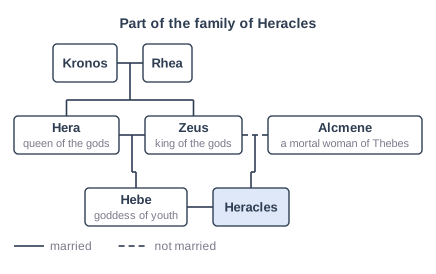
Figure 1 shows part of the family of Heracles.

Using Figure 1 and your own knowledge, explain why Hera was hostile to Heracles, and give one way in which she made his life harder.

Family tree titled "Part of the family of Heracles": names in boxes joined by lines, with 3 generations in rows from the oldest at the top to the youngest at the bottom. A line between two boxes in a row joins a couple (solid: married; dashed: not married), and a line coming down from a couple, or from one person on their own, leads to their children. Top row, left to right: Kronos and Rhea. Second row, left to right: Hera (queen of the gods), Zeus (king of the gods) and Alcmene (a mortal woman of Thebes). Third row, left to right: Hebe (goddess of youth) and Heracles. Kronos and Rhea are married; their children are Hera and Zeus. Hera and Zeus are married; their child is Hebe. Zeus and Alcmene are joined by a dashed line (not married); their child is Heracles. Hebe and Heracles are married (no children shown). The box of Heracles is shaded.

Model answer

Hera was hostile because Heracles was the son of her husband Zeus by another woman, the mortal Alcmene, so he was a living reminder of Zeus' unfaithfulness. She made his life harder by sending a madness on him so that he killed his own wife and children, which led to his having to serve King Eurystheus and perform the labours.

Explanation

The dashed line shows that Zeus and Alcmene were not married, which explains Hera's jealousy. The tree also shows the happy ending: after his death and deification Heracles married Hebe, Hera's daughter, a sign of reconciliation with the goddess who had persecuted him.

Mark scheme
  1. 1 mark

    Why: Heracles was the son of her husband Zeus by another woman (the mortal Alcmene), so Hera was jealous / angry at Zeus' unfaithfulness

    The answer must link Hera's hostility to Zeus' affair with Alcmene. Accept 'he was Zeus' illegitimate son'.

  2. 1 mark

    One way, e.g.: she sent two snakes to kill him in his cradle; she delayed his birth so that Eurystheus became king and Heracles had to serve him; she sent a madness on him so that he killed his wife and children, which led to the labours; she set the labours through Eurystheus; she caused him suffering throughout his life (Ovid's Hercules blames Juno for his labours).

    Any one accurate example. Accept Roman versions with Juno.

Question 2

6 marks

Source A: Pausanias, Description of Greece 5.11.1 (the statue of Zeus by Pheidias in the Temple of Zeus at Olympia)

'The god sits on a throne, and he is made of gold and ivory. On his head lies a wreath made to look like olive shoots. In his right hand he carries a Victory, also of ivory and gold, wearing a ribbon and a wreath on her head. In the god's left hand is a sceptre, decorated with every kind of metal, and the bird perched on the sceptre is the eagle. The god's sandals are of gold, and so is his robe; on the robe are worked figures of animals and lilies.'

Source B: a Roman marble statue of Jupiter of a common type (1st-2nd century AD). The bearded god sits on a throne, his cloak draped over his lap and left shoulder, leaving his muscular chest bare. He holds a tall sceptre upright in his raised left hand and a thunderbolt in his right; an eagle stands at his feet.

Explain how both sources show the king of the gods as powerful.

Model answer

In Source A Pausanias describes Zeus sitting on a throne with a sceptre topped by an eagle. The throne and sceptre are royal symbols, showing that he rules as king over gods and men, and the eagle, the king of birds, was his sacred bird. He also holds a Victory in his right hand, which suggests he is the god who gives victory - fitting for Olympia, where athletes competed in his honour. The statue is made of gold and ivory, with a golden robe and sandals, so its splendour expresses divine glory and the awe of his worshippers.

Source B shows the Roman Jupiter in the same way, seated on a throne holding a sceptre, with an eagle at his feet, so the Romans used the same symbols of kingship. In addition he holds a thunderbolt, his weapon, which shows his control of the sky and his power to punish wrongdoers. His bare, muscular chest and bearded face suggest both strength and mature wisdom. The calm, seated pose in both sources shows a ruler whose power is so great that he does not need to move.

Explanation

Both sources use the symbols of kingship (throne, sceptre, eagle), and the Roman type is modelled on Greek images of Zeus such as Pheidias' statue. Full marks need explanation of what each detail means, for both sources; simply listing the objects earns the AO1 marks but little AO2.

Mark scheme
  1. 2 marks

    AO1 (2 marks): a relevant detail selected from each source - 1 mark for Source A, 1 mark for Source B.

    Source A, e.g.: he sits on a throne; made of gold and ivory; holds a Victory in his right hand; a sceptre with an eagle on it; golden robe and sandals; olive wreath. Source B, e.g.: he sits on a throne; holds a sceptre; holds a thunderbolt; an eagle at his feet; bare, muscular chest; bearded, mature figure.

  2. 4 marks

    AO2 (4 marks): explanation of how the selected details show the king of the gods as powerful - 1 mark for each valid explanatory point or development. Both sources must be discussed for full marks: if only one source is used, maximum 3 marks for AO2.

    Indicative content (not a checklist; credit other valid points): the throne shows him as a king who rules gods and men (both sources); the sceptre is a symbol of royal authority (both); the eagle, king of birds, is his sacred bird and messenger (both); the Victory in his hand (A) shows that he grants victory, in war and to Olympic athletes; gold and ivory (A) show divine glory and splendour, and the huge cost shows the worshippers' awe; the thunderbolt (B) shows his power over the sky and storms and his ability to punish; the muscular chest and mature bearded face (B) suggest strength and wisdom; the calm seated pose in both suggests effortless authority; the Roman statue follows the Greek image, showing that Romans saw Jupiter, like Zeus, as the supreme ruler (Jupiter Optimus Maximus). An answer cannot gain two AO2 marks for listing traits; each mark needs an explanation of how the detail shows the idea.

Question 3

6 marks

Source A: Ovid, Metamorphoses 9 (after Hercules' mortal body has burned on the pyre on Mount Oeta)

'Just as a snake, when it has shed its old age along with its skin, revels in new life and shines with fresh scales, so when the hero of Tiryns had put off his mortal body, he grew strong in his better part; he began to seem greater and became awe-inspiring with majestic dignity. The almighty father carried him up through the hollow clouds in a four-horse chariot and set him among the shining stars.'

Source B: an Athenian black-figure amphora of about 530 BC, showing a popular scene. Athena, wearing her helmet, holds the reins of a four-horse chariot; Heracles, wearing his lion skin, steps up into the chariot beside her. Around them stand other gods, one playing a lyre and another wearing a traveller's hat and winged boots.

Explain how both sources show the hero being rewarded with a place among the gods.

Model answer

Source A uses a simile to show Hercules' transformation into a god: just as a snake sheds its old skin and shines with fresh scales, Hercules 'put off his mortal body' and 'grew strong in his better part'. The fire has burned away only what was mortal, leaving the divine part he inherited from Jupiter, and he becomes 'awe-inspiring with majestic dignity'. His reward comes from his father himself: 'the almighty father' carries him up in a four-horse chariot and sets him 'among the shining stars', showing that his labours have earned him immortality. For Roman readers this also recalled the deification of Julius Caesar.

Source B shows the same reward in Greek terms. Athena, who had helped Heracles throughout his labours, now holds the reins of a chariot to take him up to Olympus, so his patron goddess personally escorts him to his reward. The other gods standing around, such as Apollo with his lyre and Hermes with his hat and winged boots, show that he is welcomed and accepted as one of the Olympians. In both sources a divine chariot carries the hero from earth to the gods.

Explanation

Both the Roman poem and the Greek vase show apotheosis - the hero becoming a god - as the reward for his labours, and both use a chariot journey. Top answers explain the snake simile and Jupiter's role in Ovid, and Athena's escort and the welcoming gods on the vase.

Mark scheme
  1. 2 marks

    AO1 (2 marks): a relevant detail selected from each source - 1 mark for Source A, 1 mark for Source B.

    Source A, e.g.: like a snake shedding its skin he gains new life; his mortal body is put off; he grows strong in his better part; he seems greater, with majestic dignity; Jupiter carries him up in a four-horse chariot; he is set among the stars. Source B, e.g.: Athena holds the reins of a four-horse chariot; Heracles steps into it with her; other gods (Apollo with the lyre, Hermes with his hat and winged boots) stand around.

  2. 4 marks

    AO2 (4 marks): explanation of how the selected details show the hero being rewarded with a place among the gods - 1 mark for each valid explanatory point or development. Both sources must be discussed for full marks: if only one source is used, maximum 3 marks for AO2.

    Indicative content (not a checklist; credit other valid points): Source A - the snake simile shows transformation: the mortal part is discarded and the divine part remains, so he becomes a god; 'majestic dignity' shows his new divine status; Jupiter himself carries him up, showing his father's favour and approval as a reward for his labours; being set among the stars reflects the Roman idea of deification (later applied to Julius Caesar and the emperors). Source B - Athena, his helper during the labours, now escorts him, showing that his service is rewarded; the chariot procession is a triumphal journey to Olympus; the gods gathered around show that he is welcomed and accepted by the Olympians. Comparison - both show a chariot journey to the gods guided by a deity; the Roman source stresses transformation and the stars, the Greek source his welcome by the gods. An answer cannot gain two AO2 marks for listing details; each mark needs an explanation.

Question 4

15 marks

'In Greek and Roman myth, the gods helped heroes far more than they harmed them.'

To what extent do you agree with this statement? Use a range of Greek and Roman sources to support your answer.

Model answer

In both Greek and Roman myth the gods certainly gave heroes great help. On the metopes of the Temple of Zeus at Olympia, Athena appears again and again beside Heracles: she watches with Hermes as the exhausted young hero rests his foot on the Nemean Lion, she receives the Stymphalian birds, she lightly supports the sky while Atlas fetches the apples, and she directs him with her spear as he clears the Augean Stables. On Athenian vases she drives him in a chariot to Olympus. The Homeric Hymn ends with Heracles living happily on Olympus with Hebe, and Ovid's Jupiter reassures the anxious gods that Hercules' divine part cannot be burned, then carries him in a chariot to the stars. Roman myth shows similar help: in the Aeneid Venus persuades her husband Vulcan to make divine armour for her son Aeneas.

However, the gods also caused heroes enormous harm. Hera was Heracles' bitterest enemy because he was the son of Zeus by Alcmene. She sent snakes to his cradle, arranged that Eurystheus would be born first and become his master, and sent the madness in which Heracles killed his wife and children - the reason for the labours. Ovid makes this hostility vivid: the dying Hercules shouts at Juno, 'Feast, daughter of Saturn, on my disasters!' and complains that 'the cruel wife of Jupiter is tired of giving orders'. In Virgil's Aeneid, Juno's anger pursues Aeneas and the Trojans across the sea for years. In Ovid's story of Orpheus, the rulers of the underworld grant his request but set a condition that leads to Eurydice's second death.

When we weigh these, it is clear that hostile gods often drive the story: without Hera there would be no labours, and without Juno no wanderings of Aeneas. The harm is long and terrible. Yet the help is often decisive at key moments, and it usually brings the final outcome. Athena enables Heracles to complete the labours that Hera imposed; Zeus gives him immortality and even the hand of Hera's own daughter, Hebe; and in the Aeneid, Venus and Jupiter ensure that Rome will be founded despite Juno.

It is also important that the gods act for their own reasons. Hera harms Heracles out of jealousy of Zeus, Athena helps him partly out of loyalty to her father, and Venus helps Aeneas because he is her son and because Rome's destiny depends on him. Heroes are caught up in the gods' own quarrels, which suggests that Greeks and Romans saw divine favour as powerful but unpredictable. There is little difference between Greece and Rome here, because the Roman poets drew on the Greek myths; but the Roman sources tie divine help more closely to the destiny of Rome.

In conclusion, I agree with the statement to a large extent. The gods harmed heroes terribly, especially Hera and Juno, but their help was usually decisive and their final reward - immortality for Heracles, success for Aeneas - outweighed the suffering. The harm often even became the opportunity for the hero's greatest glory.

Explanation

The best answers weigh specific examples of divine help (Athena on the metopes, Zeus/Jupiter's reward, Venus and Vulcan) against divine harm (Hera's persecution, Ovid's Juno), consider the gods' own motives, and reach a supported judgement. Narrative retelling of the labours without evaluation will not reach Level 4.

Mark scheme
  1. 15 marks

    Levels of response (15 marks). AO1 (5) knowledge and understanding; AO2 (10) analysis, evaluation and argument.
    Level 5 (13-15 marks): very good, detailed and accurate knowledge of a wide range of Greek AND Roman sources showing the gods' roles in heroes' lives and their contexts; very good analysis of well-selected evidence; a coherent argument with a clear line of reasoning, successful evaluation of help and harm, and a convincing, substantiated conclusion.
    Level 4 (10-12 marks): good, accurate knowledge of both cultures; good analysis of a wide range of evidence; consistently well-structured argument and sound conclusion.
    Level 3 (7-9 marks): reasonable, mostly accurate knowledge; reasonable analysis of a range of evidence, perhaps unbalanced between Greece and Rome; relevant conclusion.
    Level 2 (4-6 marks): basic knowledge; some relevant evidence; some structure and a credible conclusion.
    Level 1 (1-3 marks): limited knowledge, little relevant evidence, weak conclusion.
    0 marks: no response or no response worthy of credit.
    An answer that is mostly description, or that discusses only Greece or only Rome, cannot go above Level 3.

    Indicative content (not a checklist; credit other valid points): AO1: help - Athena on the Olympia metopes (watching after the Nemean Lion with Hermes, receiving the Stymphalian birds, supporting the sky in the Atlas metope, directing him at the Augean Stables); Athena escorting Heracles to Olympus on Athenian vases; Zeus/Jupiter's protection and reward - the Hymn's Heracles living on Olympus with Hebe; Ovid's Jupiter reassuring the gods and taking Hercules to the stars; Venus persuading Vulcan to make armour for Aeneas (Virgil, Aeneid 8); the Naiads turning Achelous' horn into the horn of plenty; Theseus and Romulus helped by divine fathers (credit). Harm - Hera's persecution of Heracles: snakes in the cradle, delayed birth and service to Eurystheus, madness and the killing of his family; Ovid's Hercules blaming Juno ('feast on my disasters'); Juno's hostility to Aeneas and the Trojans in the Aeneid; gods causing suffering through conditions and tests (credit Orpheus: the condition set by the rulers of the underworld). AO2: Help - divine help is often decisive and the final reward (apotheosis) outweighs suffering; helpful gods appear prominently in public art, showing that heroes were thought to need divine favour. Harm - hostile gods often drive the plot and cause the heroes' greatest sufferings; without Hera there would be no labours. Nuance - the same god can do both; harm creates opportunities for glory (Heracles' name, 'glory of Hera'); gods act for their own reasons (jealousy, family loyalty) rather than for heroes; Greek and Roman sources are similar here, as Roman authors drew on Greek myth, but Roman sources link divine help to Rome's destiny. Judgement: e.g. help and harm are balanced in the stories, but the help is usually final and decisive, so the statement is broadly true.

Ready to try the rest? Every answer you write is marked against the mark scheme, so you can see exactly where the marks are.

AI Tutor Hints first, answers after you try

Hi! Stuck? Ask me for a hint and I’ll help you work it out. Once you’ve checked your answer I can explain exactly where the marks are.