Level:
Correct: 0
Incorrect: 0
Marks: 0/0
Exam Practice
Subject:
Topics:
OCR GCSE Classical Civilisation (Myth and Religion) Smart practice A mixed round aimed at your weak spots
Unit 1
Greece
Unit 2
Rome
Unit 3
Greece and Rome
Avg
score:
–
Topics
done:
0/22

Comparing myth and power in Greek and Roman art

Practise 24 exam-style questions on Comparing myth and power in Greek and Roman art for OCR GCSE Classical Civilisation (Myth and Religion). Write your answer as you would in the exam and get it marked in seconds against the mark scheme, point by point, with an AI tutor on hand if you get stuck.

  • 24 questions
  • 2–15 marks each
  • Instant marking
  • No sign-up needed
20 questions, marked as you go

Sample questions with model answers

Here are 4 of the questions in this topic, each with a model answer, an explanation of why it earns the marks and the mark scheme an examiner would use.

Question 1

2 marks

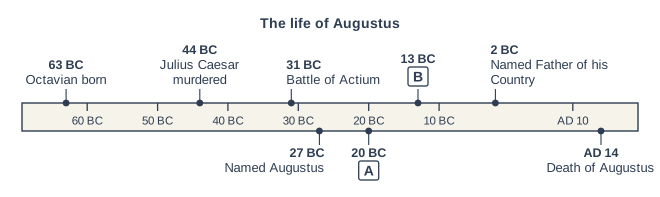
Figure 1 is a timeline of the life of Augustus.

What happened in the years labelled A (20 BC) and B (13 BC)?

Horizontal timeline titled "The life of Augustus", running from 65 BC on the left to AD 15 on the right, with the years marked every 10 years (60 BC to AD 10). The BC dates count down towards the BC/AD boundary and the AD dates count up after it (there is no year 0). Events marked by dots on the line, in date order: 63 BC: Octavian born; 44 BC: Julius Caesar murdered; 31 BC: Battle of Actium; 27 BC: Named Augustus; 20 BC: label A; 13 BC: label B; 2 BC: Named Father of his Country; AD 14: Death of Augustus.

Model answer

In 20 BC the Parthians returned the Roman standards lost by Crassus, and in 13 BC, when Augustus returned from Spain and Gaul, the senate voted to build the Ara Pacis.

Explanation

Both events were celebrated in Augustus' art: the return of the standards is the central scene of the Prima Porta breastplate, and the Ara Pacis, dedicated in 9 BC, commemorated the peace he brought. Augustus records both in the Res Gestae (chapters 29 and 12).

Mark scheme
  1. 1 mark

    A (20 BC): the Parthians returned the Roman military standards (lost by Crassus at Carrhae).

    Accept 'the standards were recovered from the Parthians'. Do not accept 'Battle of Carrhae'.

  2. 1 mark

    B (13 BC): the senate voted to build the Ara Pacis (Altar of Augustan Peace) / Augustus returned from Spain and Gaul.

    Accept 'the Ara Pacis was begun/vowed'. Do not accept 'the Ara Pacis was dedicated' (9 BC).

Question 2

6 marks

Source A: Augustus, Res Gestae 29

'I recovered from Spain, Gaul and the Dalmatians, after defeating the enemy, many military standards lost by other commanders. I compelled the Parthians to give back to me the spoils and standards of three Roman armies and to ask as suppliants for the friendship of the Roman people. These standards I placed in the innermost shrine of the temple of Mars the Avenger.'

Source B: a marble metope from the south side of the Parthenon, Athens (about 447-442 BC). A young Lapith, his cloak spread out behind him, grapples with a Centaur - half man, half horse - which rears up and twists away from him, one hand reaching towards a wound in its back.

Explain how both sources show victory over a dangerous enemy as a source of pride.

Model answer

Source A shows Augustus taking pride in wiping out Rome's past disgraces. He stresses that the standards had been lost 'by other commanders', such as Crassus at Carrhae, while he 'compelled' the powerful Parthians to return them and to ask for friendship 'as suppliants', so a dangerous eastern enemy is shown submitting to Rome. The repeated 'I' gives the credit to Augustus personally, and placing the standards in the temple of Mars the Avenger turned the success into divine vengeance and a permanent public memorial.

Source B shows pride through myth. The young Lapith, calm and idealised with his cloak spread behind him, masters a Centaur, a wild creature that is half animal and that had violently attacked the Lapith women at a wedding. The scene shows order and self-control defeating savagery. On a temple built after the Persians had burnt the Acropolis, such a battle could be read as Greek civilisation triumphing over barbarian invaders, and its place on Athena's temple made it a source of pride for the whole city.

Both sources therefore celebrate the defeat of a dangerous enemy, but the Res Gestae names a real, recent achievement and credits one man, while the metope uses myth and an anonymous hero to express the pride of the community.

Explanation

This pairing sets out the key contrast of the topic: individual achievement and real events in Augustan Rome against myth and collective pride in Athens. AO2 marks come from explaining what each detail implies, such as the Parthians as suppliants or the Centaur as a symbol of savagery.

Mark scheme
  1. 2 marks

    AO1 (2 marks): a relevant detail selected from each source - 1 mark for Source A, 1 mark for Source B.

    Source A, e.g.: standards recovered from Spain, Gaul and the Dalmatians after defeating the enemy; lost by other commanders; the Parthians compelled to return the spoils and standards of three armies; the Parthians asked as suppliants for friendship; placed in the shrine of Mars the Avenger. Source B, e.g.: a young Lapith grapples with a Centaur; the Centaur rears and twists away; it is wounded; the Lapith's calm, idealised body and spread cloak; on the outside of the Parthenon.

  2. 4 marks

    AO2 (4 marks): explanation of how the selected details show victory as a source of pride - 1 mark for each valid explanatory point or development. Both sources must be discussed for full marks: if only one source is used, maximum 3 marks for AO2.

    Indicative content (not a checklist; credit other valid points): Augustus' repeated 'I' claims the credit personally, contrasting his success with the failures of 'other commanders' (Crassus at Carrhae); the Parthians, a powerful eastern enemy, are made to submit as 'suppliants', wiping out a national disgrace without a war; placing the standards in the temple of Mars the Avenger presents the victory as divine vengeance and makes it a permanent public memorial; on the metope the young Greek masters a wild, half-animal enemy - order and self-control defeating violence and lust (the Centaurs attacked the Lapith women at a wedding); after the Persians burned the Acropolis in 480 BC, such myths could stand for Greek victory over 'barbarians'; placed on Athena's temple, it expressed the pride of the whole community; contrast: the Roman source names a real, recent achievement credited to one man, while the Greek uses myth and an anonymous hero for the city. Each AO2 mark needs explanation.

Question 3

6 marks

Source A: Ovid, Fasti 1.709-722 (on 30 January, the day the Ara Pacis was dedicated in 9 BC)

'Our song itself has brought us to the Altar of Peace; this will be the second day from the end of the month. Come, Peace, your neat hair wreathed with the laurel of Actium, and stay gently in all the world. As long as there are no enemies, let there be no reason for a triumph: you will be a greater glory to our leaders than war... Let the nearest and the farthest lands fear the descendants of Aeneas; if any land feared Rome too little, let it love her. Priests, add incense to the flames of Peace, let a white victim fall with its forehead struck, and ask the gods, who favour dutiful prayers, that the house which guarantees peace may last for ever, together with peace.'

Source B: part of the north frieze of the Parthenon (about 443-438 BC). Young men lead cattle and sheep to sacrifice, some animals pulling against their handlers; behind them men carry trays of offerings and water jars on their shoulders, followed by musicians playing pipes and lyres.

Explain how both sources link the worship of the gods with the power of the state.

Model answer

Source A links the worship at the Altar of Peace with the power of Augustus and Rome. Peace is addressed as a goddess wearing the laurel of Actium, so worshipping her celebrates Augustus' victory, and the poem openly says that this peace depends on power: the world should 'fear the descendants of Aeneas', or else love Rome. The priests' sacrifice ends with a prayer that 'the house which guarantees peace may last for ever', so state worship becomes a prayer for the survival of Augustus' family.

Source B shows the community of Athens expressing its strength through worship. Young men lead cattle and sheep to Athena's altar, some animals pulling against them, while others carry trays and water jars and musicians play, so the whole citizen body takes part in an orderly, splendid procession. The scale of the offering shows the city's wealth, and because the frieze was carved on a temple funded partly by the tribute of Athens' empire, worship and the power of the state were bound together.

Both sources therefore link worship and power, but Ovid's prayer centres on one ruling family, while the Parthenon frieze shows the power of the whole citizen community.

Explanation

Ovid's lines on the Ara Pacis reveal its dynastic message; the Parthenon frieze shows a community's collective worship. The AO2 marks come from explaining how the details link religion and power, and the contrast between dynasty and citizen body is the key evaluative point.

Mark scheme
  1. 2 marks

    AO1 (2 marks): a relevant detail selected from each source - 1 mark for Source A, 1 mark for Source B.

    Source A, e.g.: Peace wreathed with the laurel of Actium; peace a greater glory than war; lands to fear the descendants of Aeneas; priests offer incense and a white victim; prayer that the house which guarantees peace may last for ever. Source B, e.g.: young men lead cattle and sheep to sacrifice; restless animals; men carry trays and water jars; musicians with pipes and lyres; part of the procession round Athena's temple.

  2. 4 marks

    AO2 (4 marks): explanation of how the selected details link worship with the power of the state - 1 mark for each valid explanatory point or development. Both sources must be discussed for full marks: if only one source is used, maximum 3 marks for AO2.

    Indicative content (not a checklist; credit other valid points): Ovid turns Peace into a goddess crowned with the laurel of Actium, so worship of Peace celebrates Augustus' victory; the line that the world should fear (or love) the descendants of Aeneas shows that this peace rests on Roman power; the priests' sacrifice and prayer that 'the house which guarantees peace' may last for ever turn state worship into a prayer for Augustus' dynasty; the frieze shows the citizen community itself bringing sacrifices to Athena, so the city's strength is expressed through collective, orderly worship; the restless animals and many participants suggest the scale and wealth of the city's offering (a hecatomb); carved on a temple paid for partly with the tribute of the empire, worship and Athenian power are bound together; contrast: the Roman worship centres on a ruling family, the Greek on the whole citizen body. Each AO2 mark needs explanation.

Question 4

15 marks

'Augustus' monuments were about peace; the Greek sculptures were about war.'

How far do you agree with this statement?

Model answer

At first sight the statement seems accurate: the Parthenon and Bassae are filled with battles, while Augustus' best-known monument is an Altar of Peace. But in both cultures peace and war were closely linked, because peace was understood as the result of victory.

Greek sculpture certainly emphasised war. All four sets of Parthenon metopes showed battles - gods against Giants, Greeks against Amazons, the sack of Troy, Lapiths against Centaurs - and Athena Parthenos held a figure of Victory and had Amazons fighting on her shield. At Bassae the frieze showed the same Amazon and Centaur battles, and the temple of Athena Nike showed Greeks fighting Persians. Herodotus shows Athenians boasting of their victories over the Amazons and at Marathon.

Yet these battles were about the triumph of order, and other Greek sculpture was peaceful. The Parthenon frieze showed a calm procession of citizens bringing offerings to Athena, and the pediments showed Athena's birth and her contest with Poseidon, which was settled by judgement and the gift of the olive. The Bassae temple itself, according to Pausanias, thanked Apollo for ending a plague. War on Greek temples was mythical and represented the restoration of civilisation.

Augustus certainly made peace his central theme. The Ara Pacis was voted by the senate on his return from Spain and Gaul, and its Tellus panel, with babies, fruit and resting animals, and its lush acanthus scrolls, celebrate the fertility of peace. The Res Gestae records that the temple of Janus was closed three times in his principate, and Horace praised his age for bringing back rich crops and closing Janus. Ovid addresses Peace as a goddess at the altar.

But Augustan peace rested openly on war. The Prima Porta statue shows Augustus in armour addressing his troops, with the return of the standards and mourning provinces on his breastplate. On the Ara Pacis itself Roma sits on a pile of weapons and Mars appears in the Lupercal panel. The temple of Mars the Avenger housed the standards, and Virgil shows Augustus winning Actium with the gods' help and defines Rome's mission as 'to spare the conquered and war down the proud'. Ovid's peace hymn adds that the world should 'fear the descendants of Aeneas'. Peace meant order imposed by Roman power.

Overall, I only partly agree. The emphasis differs: Greek temple sculpture showed war, in mythical form, much more than peace, while Augustus made peace the headline of his message. But both cultures saw victory and peace as two sides of the same achievement. The Greek battles celebrated the restoration of order, and Augustus' peace was the peace of a conqueror. It would be truer to say that the Greeks showed the victory and Augustus showed what came after it.

Explanation

Strong answers test both halves of the statement and show that war and peace were linked in each culture: Greek battle-myths symbolised restored order, and Augustan peace was secured by victory. Detailed evidence from monuments and texts on both sides supports a nuanced conclusion.

Mark scheme
  1. 15 marks

    Levels of response (15 marks). AO1 (5) knowledge and understanding; AO2 (10) analysis, evaluation and argument.
    Level 5 (13-15 marks): very good, detailed and accurate knowledge of a wide range of Greek and Roman visual and literary sources and their contexts; very good analysis of well-selected evidence of war and peace in both; a coherent argument with a clear line of reasoning, successful evaluation and a convincing, substantiated conclusion.
    Level 4 (10-12 marks): good, accurate knowledge of both cultures; good analysis of a wide range of evidence; a consistently well-structured argument and a sound conclusion.
    Level 3 (7-9 marks): reasonable, mostly accurate knowledge; reasonable analysis of a range of evidence, perhaps unbalanced between Greece and Rome; a relevant conclusion.
    Level 2 (4-6 marks): basic knowledge; some relevant evidence; some structure and a credible conclusion.
    Level 1 (1-3 marks): limited knowledge, little relevant evidence and a weak or missing conclusion.
    0 marks: no response or no response worthy of credit.
    An answer that is mostly description, or that discusses only Greece or only Rome, cannot go above Level 3.

    Indicative content (not a checklist; credit other valid points): AO1: Greek war: all four sets of Parthenon metopes; Bassae Amazonomachy and Centauromachy; Athena Parthenos holding Victory, shield with Amazons; the Athena Nike frieze with Persians; Herodotus 9.27. Greek peace: the Parthenon frieze's procession; the pediments (birth of Athena; the contest settled by judgement); Bassae as thanks for deliverance from plague. Roman peace: the Ara Pacis (Tellus panel, acanthus scrolls, procession; RG 12); Janus closed (RG 13; Horace Odes 4.15); Ovid's hymn to Peace. Roman war: Prima Porta in armour addressing troops, the standards, mourning provinces; Roma seated on weapons on the Ara Pacis; Mars on the Lupercal panel; temple of Mars Ultor; Virgil's Actium (Aeneid 8) and 'to spare the conquered and war down the proud' (Aeneid 6); Ovid's 'let the world fear the descendants of Aeneas'; the Gemma Augustea's captives. AO2: Augustan peace (pax) was the result of victory - peace through power; Greek war scenes celebrated the restoration of order after victory; both used war and peace together; differences in emphasis; judgement. Credit any well-supported conclusion.

Ready to try the rest? Every answer you write is marked against the mark scheme, so you can see exactly where the marks are.

AI Tutor Hints first, answers after you try

Hi! Stuck? Ask me for a hint and I’ll help you work it out. Once you’ve checked your answer I can explain exactly where the marks are.