Level:
Correct: 0
Incorrect: 0
Marks: 0/0
Exam Practice
Subject:
Topics:
OCR GCSE Classical Civilisation (Myth and Religion) Smart practice A mixed round aimed at your weak spots
Unit 1
Greece
Unit 2
Rome
Unit 3
Greece and Rome
Avg
score:
–
Topics
done:
0/22

Orpheus and Eurydice: Ovid, Metamorphoses 10

Practise 30 exam-style questions on Orpheus and Eurydice: Ovid, Metamorphoses 10 for OCR GCSE Classical Civilisation (Myth and Religion). Write your answer as you would in the exam and get it marked in seconds against the mark scheme, point by point, with an AI tutor on hand if you get stuck.

  • 30 questions
  • 1–8 marks each
  • Instant marking
  • No sign-up needed
20 questions, marked as you go

Sample questions with model answers

Here are 4 of the questions in this topic, each with a model answer, an explanation of why it earns the marks and the mark scheme an examiner would use.

Question 1

1 mark

Source A: Ovid, Metamorphoses 10.15-17

'...he came to Persephone and to the lord of the shades, who rules that joyless kingdom, and, striking the strings to go with his song, he spoke these words:'

What musical instrument does Orpheus play as he sings to the rulers of the underworld?

Model answer

A lyre.

Explanation

Orpheus is the greatest singer of myth, son of the Muse Calliope, and he accompanies his song on the lyre; in art he is almost always shown holding one. Ovid's phrase 'striking the strings' shows that music, not force, is his weapon in the underworld.

Mark scheme
  1. 1 mark

    A lyre

    Accept cithara / kithara. Do not accept harp, pipes or flute.

Question 2

2 marks

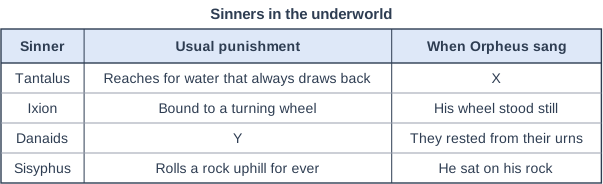
Figure 1 is a table about some of the sinners in the underworld who were affected by Orpheus' song in Ovid's account.

What should replace X and Y in the table?

Sinners in the underworld. Table with columns "Sinner", "Usual punishment", "When Orpheus sang". Sinner: Tantalus; Usual punishment: Reaches for water that always draws back; When Orpheus sang: X | Sinner: Ixion; Usual punishment: Bound to a turning wheel; When Orpheus sang: His wheel stood still | Sinner: Danaids; Usual punishment: Y; When Orpheus sang: They rested from their urns | Sinner: Sisyphus; Usual punishment: Rolls a rock uphill for ever; When Orpheus sang: He sat on his rock.

Model answer

X: Tantalus stopped trying to catch the water that always slipped away. Y: the Danaids had to carry water in urns to fill a vessel that leaked and could never be filled.

Explanation

Ovid shows the power of Orpheus' song by having each sinner pause in an eternal punishment: Tantalus no longer reaches for the water and the Danaids (the 'granddaughters of Belus') rest from their urns. The Danaids were punished for killing their husbands on their wedding night.

Mark scheme
  1. 1 mark

    X: he stopped reaching for / did not try to catch the water

    Accept 'he stopped trying to drink'. Do not accept 'he drank the water'.

  2. 1 mark

    Y: they carry water in urns / jars to fill a leaking vessel (that never fills), for ever

    Accept 'filling a leaky jar' / 'carrying water in sieves'. 'Carrying water' alone is enough.

Question 3

3 marks

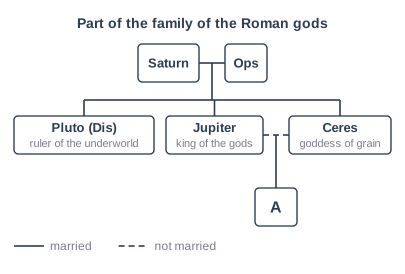
Figure 1 shows part of the family of the Roman gods.

In his song to the rulers of the underworld, Orpheus says that 'if the story of that long-ago abduction is not a lie', Love joined them too.

Name the goddess labelled A, and explain why Orpheus mentions this story.

Family tree titled "Part of the family of the Roman gods": names in boxes joined by lines, with 3 generations in rows from the oldest at the top to the youngest at the bottom. A line between two boxes in a row joins a couple (solid: married; dashed: not married), and a line coming down from a couple, or from one person on their own, leads to their children. Top row, left to right: Saturn and Ops. Second row, left to right: Pluto (Dis) (ruler of the underworld), Jupiter (king of the gods) and Ceres (goddess of grain). Third row, left to right: box A. Saturn and Ops are married; their children are Pluto (Dis), Jupiter and Ceres. Jupiter and Ceres are joined by a dashed line (not married); their child is box A. Box A shows a letter instead of a name.

Model answer

A is Proserpina (Persephone). Orpheus mentions the story of how Pluto carried her off to be his queen because it shows that the rulers of the underworld were themselves joined by Love. By reminding them of their own love, he hopes they will understand and pity his love for Eurydice and grant his request.

Explanation

Proserpina, daughter of Jupiter and Ceres, was snatched by Pluto, her uncle, to rule the underworld with him. Orpheus turns this myth into an argument: Love is a god 'well known in the world above', and the abduction proves he rules below too. The best answers explain the persuasive purpose rather than retelling the myth.

Mark scheme
  1. 1 mark

    A: Proserpina / Persephone

    Accept Kore. Do not accept Ceres or Juno.

  2. 2 marks

    Explanation of why Orpheus mentions the abduction, 1 mark for each valid point, e.g.: Pluto (Dis) seized her to be his wife, so the rulers themselves were brought together by Love (Amor/Cupid); Orpheus reminds them of their own love so that they will sympathise with his love for his wife; he argues that Love is a god even in the underworld, so they should not resist Love's power; it is a clever / flattering piece of persuasion (perhaps also a cheeky reminder that Pluto too once took a bride).

    Max 2. The answer must explain the purpose of the reference, not just retell the abduction. Credit 'to make them feel sorry for him because they also know love' (1) with a development (1).

Question 4

8 marks

Source A: Ovid, Metamorphoses 10.23-31

'The reason for my journey is my wife. A viper she trod on poured its poison into her and stole her growing years. I wanted to be able to bear it, and I will not deny that I tried: Love won. He is a god well known in the world above; whether he is known here too I am not sure, but I guess that he is, and if the story of that long-ago abduction is not a lie, Love joined you two as well. By these places full of fear, by this vast Chaos and the silence of this huge kingdom, I beg you: undo the fate of Eurydice, which was hurried on too soon.'

To what extent is Ovid's story of Orpheus and Eurydice more about love than about the power of music? Use Source A as a starting point and your own knowledge.

Model answer

Source A shows that love is at the heart of the story. Orpheus says plainly that 'the reason for my journey is my wife'; he tried to bear his grief but 'Love won'. His whole argument rests on love: Love is a god known in the world above, and if the story of the abduction is true, 'Love joined you two as well'. He even says that if he cannot have her back he will not return, so his love is stronger than his wish to live.

On the other hand, it is music that actually wins the rulers over. Orpheus speaks 'striking the strings', and when he sings the bloodless spirits weep, Tantalus stops reaching for the water, Ixion's wheel stands still, the birds stop tearing at Tityus' liver, the Danaids rest and Sisyphus sits on his rock. The Furies weep 'for the first time', 'conquered by the song'. No other hero could have done this, so the story celebrates the power of music and poetry to move even death itself - a theme a poet like Ovid would enjoy.

However, music is the means and love is the motive. The song is powerful because it is a song of love, and it is love that also destroys the happy ending: Orpheus looks back because he is afraid she might be flagging and is longing to see her - Ovid calls him 'the lover' at that moment. Eurydice's final thought, that she could complain of nothing 'except that she had been loved', puts love at the very end of the story.

So I think the story is mostly about love. Music gives Orpheus the power to bring Eurydice back, but love explains both why he goes and why he fails.

Explanation

A top answer sees that the two themes are linked: music is how Orpheus overcomes the underworld, but love is why he goes and why he loses her. Weaker answers describe the song and the sinners without deciding which theme matters more, or ignore the ending.

Mark scheme
  1. 8 marks

    Levels of response (8 marks). AO1 (4) and AO2 (4) are equally weighted.
    Level 4 (7-8 marks): consistently accurate and detailed knowledge of Ovid's account, using both Source A and own wider knowledge of Metamorphoses 10.1-64; very good understanding of how Ovid uses the themes of love and music and of how a Roman audience might respond; a well-argued response with a clear, substantiated judgement on whether love or music matters more, supported by a range of well-selected evidence, including critical analysis.
    Level 3 (5-6 marks): accurate knowledge, using both Source A and own knowledge; a focused response with relevant analysis of both themes and a judgement.
    Level 2 (3-4 marks): sound, mostly accurate knowledge; engages with the general topic with a limited range of evidence and some analysis, perhaps discussing only one theme in detail; any judgement is asserted.
    Level 1 (1-2 marks): limited knowledge, may only use Source A; isolated analysis or comment.
    0 marks: no response or no response worthy of credit.
    A mainly descriptive answer with little analysis or judgement cannot go above Level 2.

    Indicative content (not a checklist; credit other valid points): AO1: Source A - 'the reason for my journey is my wife'; 'I tried' to bear it; 'Love won'; Love is a god known above and below; the abduction of Persephone - 'Love joined you two as well'; the plea to undo Eurydice's fate. Own knowledge - Orpheus 'striking the strings' as he sings; the bloodless spirits weep; Tantalus, Ixion, Tityus' birds, the Danaids and Sisyphus pause; the Furies weep 'conquered by the song'; the rulers cannot refuse; he would rather die than return without her; he looks back 'afraid she might be flagging and longing to see her' - 'the lover'; Eurydice cannot complain 'except that she had been loved'. AO2: Love - love is Orpheus' motive and the main argument of his song; it even moves the rulers because of their own love; love also causes the tragedy, since he looks back out of love; the final paradox puts love at the centre. Music - the song is what physically overcomes the underworld; the catalogue of sinners shows music's power over nature and death; Orpheus is the archetypal poet, so the story is also about the power of art (and of poetry like Ovid's own). Interplay - music is the means, love the motive; music wins Eurydice back but love loses her. Judgement: e.g. love is the more important theme because it drives both the success and the failure, while music is the instrument of love.

Ready to try the rest? Every answer you write is marked against the mark scheme, so you can see exactly where the marks are.

AI Tutor Hints first, answers after you try

Hi! Stuck? Ask me for a hint and I’ll help you work it out. Once you’ve checked your answer I can explain exactly where the marks are.