
Level:
Correct: 0
Incorrect: 0
Marks: 0/0
Exam Practice
Subject:
Topics:
OCR GCSE Classical Civilisation (Myth and Religion) Smart practice A mixed round aimed at your weak spots
Unit 1
Greece
Unit 2
Rome
Unit 3
Greece and Rome
Avg
score:
–
Topics
done:
0/22

Comparing death, burial and the underworld

Practise 24 exam-style questions on Comparing death, burial and the underworld for OCR GCSE Classical Civilisation (Myth and Religion). Write your answer as you would in the exam and get it marked in seconds against the mark scheme, point by point, with an AI tutor on hand if you get stuck.

  • 24 questions
  • 2–15 marks each
  • Instant marking
  • No sign-up needed
20 questions, marked as you go

Sample questions with model answers

Here are 4 of the questions in this topic, each with a model answer, an explanation of why it earns the marks and the mark scheme an examiner would use.

Question 1

2 marks

Source A: Ovid, Fasti 5.429-444 (the Lemuria, a Roman festival of the dead held in May)

'When midnight has come and brings silence for sleep, the man who remembers the ancient rite and fears the gods gets up, his feet bare, and makes a sign with his thumb between his closed fingers, so that no silent shade may meet him. He washes his hands clean in spring water, turns, takes black beans and throws them behind him without looking, saying, "These I send; with these beans I ransom myself and my family." He says this nine times and does not look back: the shade is thought to gather the beans and follow unseen. Again he touches water, clashes bronze, and asks the shade to leave his house. When he has said nine times, "Ghosts of my fathers, go out!", he looks back, and believes the rite has been properly performed.'

According to Source A, give two things the head of the household does to drive the ghosts out of his house.

Model answer

He throws black beans behind him without looking, saying that with them he ransoms himself and his family, and he clashes bronze objects and calls nine times for the ghosts of his fathers to leave the house.

Explanation

The Lemuria (9, 11 and 13 May) was a private rite to drive away restless spirits (lemures). Its precise, repeated actions - bare feet, beans, the number nine, not looking back - show how carefully Romans tried to manage their relationship with the dead, in contrast to the loving offerings of the Parentalia.

Mark scheme
  1. 1 mark

    One action from Source A: he gets up at midnight with bare feet; he makes a sign with his thumb between his closed fingers; he washes his hands in spring water; he throws black beans behind him without looking; he says 'These I send; with these beans I ransom myself and my family' nine times; he does not look back; he clashes bronze; he asks the ghost to leave / says 'Ghosts of my fathers, go out!' nine times.

    Max 2 in total. Each action must come from the source.

  2. 1 mark

    A second, different action from Source A.

    As above. 'Throws beans' and 'says the words nine times' are separate actions.
Question 2

6 marks

Source A: Cicero, On the Laws 2.58-59 (written in the 1st century BC, quoting the Twelve Tables, Rome's earliest laws)

'"A dead man," says the law of the Twelve Tables, "shall not be buried or burned in the city"... The law then reduces the expense to three mourning veils, a small purple tunic and ten flute-players, and it also does away with wailing: "Women shall not tear their cheeks or hold a lament on account of a funeral."'

Source B: a huge Athenian Geometric amphora, about 1.6 m tall, made about 760-750 BC to stand over a grave in the Kerameikos cemetery. In a panel between the handles, the dead person lies on a high bier under a checked shroud; on either side rows of mourners, drawn as stick-like figures, raise both arms to their heads as if tearing their hair, and some kneel or sit beside the bier. The rest of the vase is covered with bands of geometric patterns and animals.

Explain how both sources show public mourning as an important part of funerals.

Model answer

Source A shows how important public mourning was by the fact that Rome's earliest laws tried to limit it. The Twelve Tables restricted funerals to three mourning veils, a purple tunic and ten flute-players, and banned women from tearing their cheeks or wailing. A law is needed only against something people actually do, so loud, expensive displays of grief must have been a normal part of Roman funerals, and the limits suggest families used mourning to compete in showing their status.

Source B shows mourning as the very centre of the funeral. The panel between the handles is filled with the dead person on a high bier surrounded by rows of mourners raising their arms to their heads as if tearing their hair, so the lament is the moment the family chose to record. The large number of mourners honoured the dead and displayed the family's importance, and because the vase itself was about 1.6 m tall and stood over the grave, the display became permanent and public.

Both sources therefore show that public mourning mattered greatly, but the Roman source restricts it, while the Greek vase celebrates it - although Athens too later limited mourning under Solon.

Explanation

The Twelve Tables are indirect evidence: restrictions reveal the practices they restrict. The Dipylon-style amphora is direct evidence of prothesis and lament. The best answers explain both kinds of evidence and the contrast between celebration and control.

Mark scheme
  1. 2 marks

    AO1 (2 marks): a relevant detail selected from each source - 1 mark for Source A, 1 mark for Source B.

    Source A, e.g.: no burial or cremation in the city; expense limited to three veils, a purple tunic and ten flute-players; women must not tear their cheeks or hold a lament. Source B, e.g.: the dead person on a high bier under a shroud; rows of mourners raising their arms to their heads; mourners kneeling or sitting by the bier; the huge vase standing over the grave.

  2. 4 marks

    AO2 (4 marks): explanation of how the selected details show public mourning as important - 1 mark for each valid explanatory point or development. Both sources must be discussed for full marks: if only one source is used, maximum 3 marks for AO2.

    Indicative content (not a checklist; credit other valid points): the Twelve Tables had to limit flute-players, clothing and lament, which shows that loud, expensive public mourning was common and important - a law is only needed against something people do; tearing cheeks and wailing show grief was meant to be seen and heard; limiting display suggests families competed to show status through mourning; on the amphora the mourning itself is the main scene, so it was the part of the funeral the family wished to record; the rows of mourners tearing their hair show many people publicly displaying grief, honouring the dead and the family; the vase's huge size and position over the grave made the display permanent and public; contrast: the Roman source restricts mourning, the Greek image celebrates it (though Athens too later restricted mourning under Solon). Each AO2 mark needs explanation.

Question 3

6 marks

Source A: the epitaph of Claudia, a Roman tombstone of the 2nd century BC

'Stranger, what I have to say is short: stop and read it through. Here is the unlovely tomb of a lovely woman. Her parents named her Claudia. She loved her husband with all her heart. She bore two sons: one she leaves on earth, the other she has placed beneath the earth. She was charming in speech and graceful in her bearing. She kept the house; she worked the wool. I have spoken. Go.'

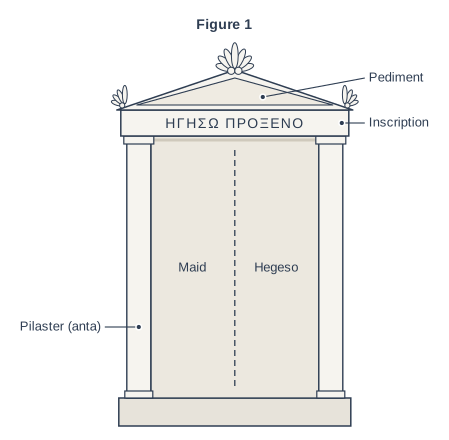
Source B: the grave stele of Hegeso from the Kerameikos cemetery in Athens (about 410-400 BC), shown in Figure 1. In a frame like a small temple front, Hegeso, richly dressed, sits on a chair with her feet on a footstool, taking a piece of jewellery from a box held out by a standing maid. The inscription above names her as 'Hegeso, daughter of Proxenos'.

Explain how both sources show the qualities for which women were remembered after death.

Outline of a grave stele in a shrine-shaped frame. The heading reads "Figure 1". Front view of the outline of a grave stele: a frame shaped like a small temple front. At the top a low triangle with a fan-shaped ornament on its peak and smaller ones at its corners; below it a horizontal band with the letters "ΗΓΗΣΩ ΠΡΟΞΕΝΟ" on it; a flat upright pillar on each side framing a large recessed panel divided by a dashed line into a left and a right half; and a block along the bottom. No figures are drawn. The drawing shows where things are on the object, not the figures themselves. The label "Maid" is written in the left half of the recessed panel (divided by a dashed line); the label "Hegeso" is written in the right half of the recessed panel (divided by a dashed line); the label "Inscription" points to the horizontal band (architrave) just below the triangle, with the letters "ΗΓΗΣΩ ΠΡΟΞΕΝΟ" on it; the label "Pediment" points to the triangular gable at the top; the label "Pilaster (anta)" points to the flat upright pillar on the left side of the frame.

Model answer

Source A remembers Claudia for the virtues of an ideal Roman wife. She 'loved her husband with all her heart' and bore two sons, so she fulfilled the central roles of wife and mother. 'She kept the house; she worked the wool' are the traditional virtues of the Roman matrona, and her charm in speech and grace in bearing show attractive, modest femininity. By addressing the passing stranger, the epitaph made these virtues public, advertising the respectability of her family as well as her own.

Source B remembers Hegeso within the same domestic world. She sits indoors, richly dressed, her feet on a footstool, choosing a piece of jewellery from a box held by her maid, so she is remembered for her beauty, wealth and status as the mistress of a household. The inscription names her as the 'daughter of Proxenos', defining her through her father and family, and her calm, dignified pose shows her as she was in life rather than in death.

Both sources therefore remember women for their place in the household and family, but Claudia is praised in words for active virtues such as wool-working and motherhood, whereas Hegeso is honoured in an image for her beauty, wealth and status.

Explanation

Claudia's epitaph and the Hegeso stele both show the ideals by which women were judged: domestic, modest and family-centred. The best answers explain how each detail expresses these ideals and contrast the verbal praise of virtues with the visual display of status.

Mark scheme
  1. 2 marks

    AO1 (2 marks): a relevant detail selected from each source - 1 mark for Source A, 1 mark for Source B.

    Source A, e.g.: a lovely woman; she loved her husband with all her heart; she bore two sons; charming in speech and graceful in bearing; she kept the house; she worked the wool; the address to the passing stranger. Source B, e.g.: Hegeso richly dressed and seated; her feet on a footstool; taking jewellery from a box; the maid serving her; named as daughter of Proxenos; the temple-like frame.

  2. 4 marks

    AO2 (4 marks): explanation of how the selected details show the qualities for which women were remembered - 1 mark for each valid explanatory point or development. Both sources must be discussed for full marks: if only one source is used, maximum 3 marks for AO2.

    Indicative content (not a checklist; credit other valid points): Claudia is praised for love of her husband and for motherhood, the central roles of a Roman wife; 'she kept the house; she worked the wool' are the traditional virtues of the ideal matrona, so she is remembered as a model of domestic virtue; beauty, charming speech and graceful bearing show attractive, modest femininity; addressing the passing stranger makes her virtues public and advertises the respectability of her family; Hegeso is shown in a domestic, indoor setting, so she too is remembered within the household; the jewellery, fine clothes and maid show beauty, wealth and status; naming her as 'daughter of Proxenos' defines her through her father and family; her calm, dignified pose presents her as she was in life, without grief; the temple-like frame honours her; contrast: Claudia is praised in words for active virtues (wool-working, motherhood), Hegeso in images for beauty, wealth and status. Each AO2 mark needs explanation.

Question 4

15 marks

'Grave markers and tombs tell us more about how people lived than about what they believed about death.'

How far is this true of Greek and Roman sources?

Model answer

Grave markers and tombs were made by the living, for the living to see, so it is not surprising that many of them concentrate on the life of the dead person. But a good number also reveal beliefs about death, and even monuments about life show what people hoped would survive them.

Many Greek monuments show how people lived. The Hegeso stele shows a wealthy woman seated indoors choosing jewellery from a box held by her maid, and names her as 'daughter of Proxenos', so it tells us about her status, her family and the domestic ideal of women. The Ampharete stele shows a grandmother holding her grandchild, and the epitaph of the Kroisos kouros asks passers-by to mourn a young man 'whom raging Ares destroyed as he fought in the front ranks', recording the values of courage and family. The Dipylon amphora shows the lament at an aristocrat's funeral, which tells us more about funeral customs than about the afterlife.

Roman tombs are even more concerned with life. The tomb of Eurysaces, outside the Porta Maggiore, is decorated with scenes of bread-making to record his success as a baker and contractor. The tomb of the freedwoman Naevoleia Tyche at Pompeii advertises the public honours of her husband, and Claudia's epitaph praises her love for her husband, her two sons and the fact that she kept the house and worked the wool. Reliefs of freed couples display their new citizen status. Such monuments, lining the roads outside towns, were advertisements of a life well lived.

Yet some grave markers do reveal beliefs about death. Many white-ground lekythoi show Charon waiting in his boat, Hermes leading the dead, or Sleep and Death carrying a body, which shows how Athenians imagined the journey to the underworld. Ampharete's epitaph imagines the dead no longer seeing the light of the sun, and Phrasikleia's says she will always be called a maiden, having died before marriage. Roman tombstones beginning D M show belief in the Manes, the spirits of the dead, and prayers that the earth may lie light on the dead imply that they can still feel it, while the Epicurean formula 'I was not; I was; I am not; I do not care' denies any afterlife. These show a wide range of belief.

Overall, I largely agree. Most grave markers and tombs tell us more about the status, families, work and virtues of the dead than about the afterlife, because they were made to impress the living. But some, especially the lekythoi and the Roman epitaph formulas, reveal beliefs directly, and the very act of commemoration shows a widespread belief that being remembered was a kind of survival after death.

Explanation

The best answers use a wide range of specific monuments and epitaphs from both cultures, show which reveal life and which reveal belief, and argue towards a judgement - perhaps that commemoration itself expresses a belief about death.

Mark scheme
  1. 15 marks

    Levels of response (15 marks). AO1 (5) knowledge and understanding; AO2 (10) analysis, evaluation and argument.
    Level 5 (13-15 marks): very good, detailed and accurate knowledge of a wide range of Greek and Roman grave markers, tombs and epitaphs and their contexts; very good analysis of well-selected evidence of both life and belief; a coherent argument with a clear line of reasoning, successful evaluation and a convincing, substantiated conclusion.
    Level 4 (10-12 marks): good, accurate knowledge of both cultures; good analysis of a wide range of evidence; a consistently well-structured argument and a sound conclusion.
    Level 3 (7-9 marks): reasonable, mostly accurate knowledge; reasonable analysis of a range of evidence, perhaps unbalanced between Greece and Rome; a relevant conclusion.
    Level 2 (4-6 marks): basic knowledge; some relevant evidence; some structure and a credible conclusion.
    Level 1 (1-3 marks): limited knowledge, little relevant evidence and a weak or missing conclusion.
    0 marks: no response or no response worthy of credit.
    An answer that is mostly description, or that discusses only Greece or only Rome, cannot go above Level 3.

    Indicative content (not a checklist; credit other valid points): AO1: Greek: the Hegeso stele (domestic life, wealth, a maid, 'daughter of Proxenos'); the Ampharete stele and epigram (family; the dead 'no longer seeing the sun'); the Kroisos kouros ('whom raging Ares destroyed as he fought in the front ranks'); the Phrasikleia kore ('I shall always be called maiden'); the Dipylon amphora (prothesis and lament); white-ground lekythoi showing visits to the grave and, on some, Charon's boat, Hermes guiding the dead, or Sleep and Death carrying a body. Roman: the tomb of Eurysaces the baker (his trade); the tomb of Naevoleia Tyche (a freedwoman's honours); Claudia's epitaph (wife, mother, wool-worker); Amymone's epitaph; tomb reliefs of freed couples; D M (the Manes); 'may the earth lie light on you'; the Epicurean 'I was not; I was; I am not; I do not care'; banquet reliefs; the Haterii relief; columbaria and burial clubs. AO2: most monuments record status, work, family and virtues - life, not death; they were made for the living and for passers-by; but some reveal beliefs directly (Charon and Hermes on lekythoi, D M, the Epicurean formula, prayers for a light earth), and the very act of commemoration shows a belief that memory keeps the dead alive; the beliefs shown vary widely; judgement. Credit any well-supported conclusion.

Ready to try the rest? Every answer you write is marked against the mark scheme, so you can see exactly where the marks are.

AI Tutor Hints first, answers after you try

Hi! Stuck? Ask me for a hint and I’ll help you work it out. Once you’ve checked your answer I can explain exactly where the marks are.