Level:
Correct: 0
Incorrect: 0
Marks: 0/0
Exam Practice
Subject:
Topics:
OCR GCSE Classical Civilisation (Myth and Religion) Smart practice A mixed round aimed at your weak spots
Unit 1
Greece
Unit 2
Rome
Unit 3
Greece and Rome
Avg
score:
–
Topics
done:
0/22

Myth and power in Rome: the Prima Porta Augustus and the Ara Pacis

Practise 31 exam-style questions on Myth and power in Rome: the Prima Porta Augustus and the Ara Pacis for OCR GCSE Classical Civilisation (Myth and Religion). Write your answer as you would in the exam and get it marked in seconds against the mark scheme, point by point, with an AI tutor on hand if you get stuck.

  • 31 questions
  • 1–8 marks each
  • Instant marking
  • No sign-up needed
20 questions, marked as you go

Sample questions with model answers

Here are 4 of the questions in this topic, each with a model answer, an explanation of why it earns the marks and the mark scheme an examiner would use.

Question 1

1 mark

In which year was the Ara Pacis Augustae (the Altar of Augustan Peace) dedicated?

Model answer

9 BC.

Explanation

The Senate voted for the altar in 13 BC, on Augustus' return from Spain and Gaul, and it was dedicated on 30 January 9 BC, the birthday of his wife Livia. The common mistake is to give the date of the vote instead of the dedication.

Mark scheme
  1. 1 mark

    9 BC

    Accept 30 January 9 BC. Do not accept 13 BC (the year the Senate voted for it) or a date without BC.

Question 2

2 marks

Source A: a marble relief panel from the west side of the Ara Pacis (13-9 BC). A bearded man wearing a toga, with a fold of it drawn over his head, stands beside a rough stone altar, holding a staff. Two young attendants bring a sow to be sacrificed and carry a dish of fruit and a jug. Above, on a rocky hill, is a small temple with two seated figures inside it. Most scholars identify the bearded man as Aeneas.

Explain why Augustus wanted Aeneas to be shown on the Ara Pacis. Make two points.

Model answer

Aeneas was the son of Venus and the ancestor of the Julian family through his son Iulus, so showing him reminded everyone that Augustus was descended from the gods. Aeneas is also shown performing a sacrifice with his head veiled, a model of pietas, and Augustus wanted to be seen as just as pious: he himself appears veiled in the procession on the south frieze.

Explanation

The sow refers to the prophecy of the white sow with thirty piglets that marked the site of Lavinium, Aeneas' first city in Italy, and the small temple holds the Penates he rescued from Troy. Some scholars identify the man as King Numa, but either way the panel stresses Rome's pious origins.

Mark scheme
  1. 1 mark

    Any two valid points, 1 mark each, e.g.: Aeneas was the ancestor of the Julian family (through Iulus), so it reminds viewers of Augustus' descent from Venus; Aeneas is a model of pietas (duty to the gods) - he sacrifices with his head veiled - and Augustus wanted to be seen as equally pious (he too appears veiled on the south frieze); Aeneas brought the household gods (Penates) from Troy and founded Lavinium (the sow), so he stands for the origins of the Roman people; as a founder figure he matches Augustus' image as a new founder of Rome after the civil wars; it links the altar with Virgil's Aeneid.

    Two different points needed. Accept the alternative identification as Numa if linked to piety / religious foundations.

  2. 1 mark

    Second, different point (see above).

Question 3

3 marks

Source A: Horace, Odes 4.15.4-9 (addressed to Augustus)

'Your age, Caesar, has brought back rich crops to the fields, and has restored to our Jupiter the standards torn down from the proud doorposts of the Parthians, and has closed the temple of Janus Quirinus, empty of wars ...'

The breastplate of the Prima Porta statue gives some of the same messages as this poem. Explain three ways in which it does so.

Model answer

First, Horace says that Augustus' age has brought back 'rich crops', and the breastplate shows Tellus at the bottom with her cornucopia, a sign of prosperity. Second, Horace celebrates the standards taken back from the proud Parthians, and the central scene shows a Parthian handing a standard back to a Roman. Third, Horace says the temple of Janus is closed because there are no wars, and the breastplate places the victory in a calm, ordered universe, with the sky, sun and dawn above, suggesting a new age of peace.

Explanation

Horace's Odes 4 (about 13 BC) and the statue use the same Augustan vocabulary: victory leads to peace, peace to plenty. Each mark needs a precise match between the poem and a scene on the breastplate.

Mark scheme
  1. 3 marks

    Any three valid links, 1 mark each, e.g.: 'rich crops' - Tellus (Mother Earth) with her cornucopia shows prosperity and plenty; 'restored ... the standards' - the central scene shows a Parthian handing back a standard to a Roman; 'proud ... Parthians' humbled - the Parthian is shown giving way / the mourning provinces show conquered peoples; 'closed the temple of Janus, empty of wars' - peace after victory, with the gods and the cosmos (Caelus, Sol, Aurora) in harmony; 'your age' - a new era / golden age, suggested by the dawn (Aurora, Sol) and the gods Apollo and Diana; 'our Jupiter' - the gods support Rome, as the gods on the breastplate do.

    Max 3. Each mark needs a link between a message of the poem and a specific feature of the breastplate.

Question 4

8 marks

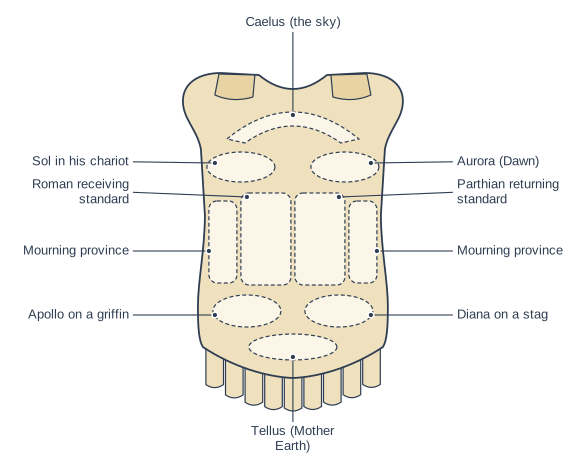
Figure 1 shows the layout of the scenes on the breastplate of the Prima Porta statue of Augustus.

To what extent is the Prima Porta statue mainly a celebration of Augustus' military success? Use Figure 1 as a starting point and your own knowledge.

Layout of the breastplate (cuirass) of the Augustus of Prima Porta statue (Vatican Museums). Front view of the breastplate (cuirass) of the Augustus of Prima Porta statue, drawn as an outline of the armour only, with its relief scenes shown as outlined zones (no figures). Left and right are as you look at the statue. At the top, just below the neck, Caelus (the sky) spreads his cloak like a canopy. Below him Sol in his chariot (left) and Aurora, the dawn (right). In the centre a Parthian (right) hands back a Roman legionary standard to a Roman figure in armour (left), often identified as Mars or Tiberius: the return in 20 BC of the standards lost by Crassus. On each side of the central scene sits a mourning personification of a conquered province. Lower down, Apollo riding a griffin (left) and Diana riding a stag (right). At the bottom Tellus (Mother Earth) reclines with a cornucopia and two babies. Shoulder flaps sit on the shoulders and a row of lappets hangs below the lower edge. The label "Caelus (the sky)" points to the curved band across the top of the chest, just below the neck; the label "Sol in his chariot" points to the oval zone below the curved band, on the left; the label "Aurora (Dawn)" points to the oval zone below the curved band, on the right; the label "Roman receiving standard" points to the left half of the central zone; the label "Parthian returning standard" points to the right half of the central zone; the label "Mourning province" points to the tall narrow zone on the left side of the body; the label "Mourning province" points to the tall narrow zone on the right side of the body; the label "Apollo on a griffin" points to the oval zone low down on the left; the label "Diana on a stag" points to the oval zone low down on the right; the label "Tellus (Mother Earth)" points to the oval zone at the bottom of the breastplate, in the middle.

Model answer

Figure 1 shows that military success is at the very centre of the breastplate. A Parthian hands back a Roman legionary standard to a Roman in armour, recalling the return in 20 BC of the standards lost by Crassus at Carrhae and by Antony's commanders. On each side sits a mourning province, a conquered people. The rest of the statue supports this: Augustus wears a general's cuirass and cloak, and his raised arm is the adlocutio gesture of a commander addressing his troops. In the Res Gestae Augustus boasted that he 'compelled the Parthians' to return the standards, and he placed them in the temple of Mars the Avenger.

However, the standards were in fact recovered by diplomacy, not in battle, so the statue presents a negotiated agreement as a triumph. This suggests that its purpose was not simply to record military success but to build up an image.

Moreover, the breastplate places the victory in a much wider setting. Above it are Caelus, the sky, Sol in his chariot and Aurora, the dawn; below are Apollo and Diana, Augustus' protecting gods, and at the bottom Tellus, Mother Earth, with a cornucopia and babies. The message is that the gods support Augustus and that his victory has brought peace and prosperity to the whole world, a new golden age.

Other parts of the statue have nothing to do with war. Cupid on a dolphin recalls Augustus' descent from Venus, the bare feet suggest a hero or god, and the idealised face and Doryphoros pose make him a timeless Greek ideal.

In conclusion, the statue celebrates military success to a large extent, since the armour, gesture and central scene all focus on it. But it is not mainly about war: the victory is shown as the gods' gift that brings peace, and divine ancestry and heroic perfection are equally important. Its overall message is that Augustus is a divinely favoured ruler whose success guarantees a new age.

Explanation

Level 4 answers use the figure precisely (the central scene, provinces, gods, Tellus), add knowledge of 20 BC and of the rest of the statue, and judge whether military success is the main message or a means to the message of peace and divine favour. Remember that the standards were recovered by diplomacy.

Mark scheme
  1. 8 marks

    Levels of response (8 marks). AO1 (4) and AO2 (4) are equally weighted.
    Level 4 (7-8 marks): consistently accurate and detailed knowledge of the breastplate and the rest of the statue, using both Figure 1 and own wider knowledge; shows very good understanding of the historical context (the Parthian standards, 20 BC) and of the different messages of the statue; a well-argued response with a clear, substantiated judgement on how far it is mainly about military success, supported by a range of well-selected evidence, including critical analysis.
    Level 3 (5-6 marks): accurate knowledge, using both the figure and own knowledge; a focused response with relevant analysis of military and other messages, and a judgement.
    Level 2 (3-4 marks): sound, mostly accurate knowledge; engages with the general topic, limited range of evidence, some analysis.
    Level 1 (1-2 marks): limited knowledge, may only use the figure given; isolated analysis.
    0 marks: no response or no response worthy of credit.
    A mainly descriptive answer with little analysis or judgement cannot go above Level 2.

    Indicative content (not a checklist; credit other valid points): AO1: Figure 1 - the central scene of a Parthian returning a standard to a Roman in armour (Mars, Tiberius or the army); mourning provinces on each side (conquered peoples, often identified as Spain and Gaul); Apollo (credited with Actium) and Diana; Caelus, Sol and Aurora above; Tellus with cornucopia and babies below. Historical context: the standards lost by Crassus at Carrhae (53 BC) and by Antony's commanders were returned by Phraates IV in 20 BC through diplomacy, not battle; Res Gestae 29 ('I compelled the Parthians ... as suppliants'); the standards placed in the temple of Mars Ultor; 'signis receptis' coins. Rest of the statue: the cuirass and paludamentum of a general; adlocutio gesture addressing troops. Other messages: Cupid on a dolphin (divine descent from Venus); bare feet (heroic / divine); idealised youthful face and Doryphoros pose (Greek ideal); Tellus and the cosmic gods (peace, prosperity, a golden age); probably a posthumous copy found at Livia's villa. AO2: military imagery is dominant - the armour, the gesture and the central scene - and the statue was probably made to celebrate 20 BC. But the 'victory' was a diplomatic deal presented as a military triumph, so the statue constructs military success rather than records it. The breastplate sets that success in a cosmic frame: victory leads to peace and plenty (Tellus), with divine support (Apollo, Diana, Caelus, Sol). Divine ancestry and heroic idealisation are just as prominent in the lower half of the statue. Possible judgements: military success is the starting point, but the statue's main message is that Augustus' victories, backed by the gods, have brought a new age of peace and prosperity.

Ready to try the rest? Every answer you write is marked against the mark scheme, so you can see exactly where the marks are.

AI Tutor Hints first, answers after you try

Hi! Stuck? Ask me for a hint and I’ll help you work it out. Once you’ve checked your answer I can explain exactly where the marks are.