Level:
Correct: 0
Incorrect: 0
Marks: 0/0
Exam Practice
Subject:
Topics:
OCR GCSE Classical Civilisation (Myth and Religion) Smart practice A mixed round aimed at your weak spots
Unit 1
Greece
Unit 2
Rome
Unit 3
Greece and Rome
Avg
score:
–
Topics
done:
0/22

Comparing foundation myths: Theseus and Romulus

Practise 24 exam-style questions on Comparing foundation myths: Theseus and Romulus for OCR GCSE Classical Civilisation (Myth and Religion). Write your answer as you would in the exam and get it marked in seconds against the mark scheme, point by point, with an AI tutor on hand if you get stuck.

  • 24 questions
  • 2–15 marks each
  • Instant marking
  • No sign-up needed
20 questions, marked as you go

Sample questions with model answers

Here are 4 of the questions in this topic, each with a model answer, an explanation of why it earns the marks and the mark scheme an examiner would use.

Question 1

2 marks

In his comparison of Theseus and Romulus, Plutarch criticises Theseus for carrying off women by force.

Name two women whom Theseus carried off or tried to carry off.

Model answer

Theseus carried off Ariadne from Crete and Helen of Sparta when she was still a girl.

Explanation

Plutarch lists Ariadne, Antiope, Anaxo of Troezen and Helen, and argues that these abductions had no honourable excuse and brought only wars on Athens. Theseus and Peirithous also tried to carry off Persephone from the underworld. The point is contrasted with Romulus' seizure of the Sabine women, which Plutarch thought led to union.

Mark scheme
  1. 1 mark

    One woman from: Ariadne; Antiope (the Amazon queen); Helen (of Sparta, when still a girl); Anaxo (of Troezen); Persephone (an attempt, with Peirithous).

    Accept Hippolyta for the Amazon queen. Max 2 in total.

  2. 1 mark

    A second, different woman from the list.

    As above. Do not accept Phaedra (whom he married), Medea or Aethra.

Question 2

6 marks

Source A: Livy, The Early History of Rome 1.4.8-9

'Born and raised in this way, as soon as they were grown the young men did not idle around the farmsteads or among the flocks, but roamed the forest glades hunting. Strong in body and spirit from this life, they no longer just stood up to wild beasts but launched attacks on robbers loaded with plunder, and shared out the spoils among the shepherds. With a band of young men that grew larger every day, they shared both serious business and fun.'

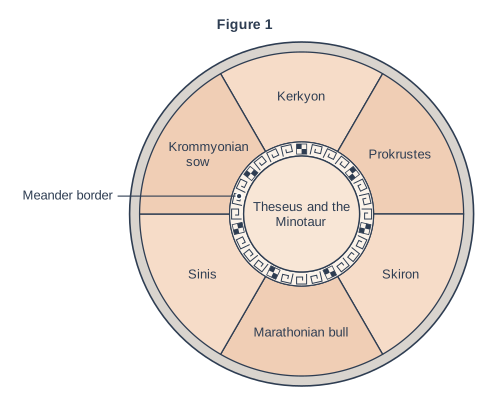
Source B: the Theseus Kylix, an Athenian red-figure drinking cup of about 440-430 BC. Figure 1 shows the layout of the inside of the cup. In the central picture Theseus drags the dead Minotaur out of the labyrinth; in the six scenes around it he overcomes Kerkyon, Prokrustes, Skiron, the Marathonian bull, Sinis and the Krommyonian sow.

Explain how both sources show the young founder proving himself through strength and courage.

Layout of the decoration of the Theseus kylix (British Museum 1850,0302.3, Attic red-figure cup attributed to the Codrus Painter, about 440-430 BC). The heading reads "Figure 1". Inside of the cup, seen from above: in the centre, the tondo shows Theseus dragging the dead Minotaur out of the labyrinth (a building), framed by a border of meanders and chequer squares. Round it, a ring of six scenes shows his other deeds, clockwise from the top: Theseus wrestling Kerkyon, Prokrustes (upper right), Skiron (lower right), the bull of Marathon (bottom), Sinis the pine-bender (lower left) and the Krommyonian sow (upper left). A narrow rim runs round the edge. Only the zones are drawn, not the figures. The label "Kerkyon" is written in the zone at the top of the ring; the label "Prokrustes" is written in the zone at the upper right of the ring; the label "Skiron" is written in the zone at the lower right of the ring; the label "Marathonian bull" is written in the zone at the bottom of the ring; the label "Sinis" is written in the zone at the lower left of the ring; the label "Krommyonian sow" is written in the zone at the upper left of the ring; the label "Theseus and the Minotaur" is written in the circle in the centre (the tondo); the label "Meander border" points to the narrow patterned ring round the central circle.

Model answer

Source A shows Romulus and Remus proving themselves first as hunters, roaming the forests, and then as fighters, attacking 'robbers loaded with plunder'. Livy says this life made them 'strong in body and spirit', so their courage is presented as the training of future leaders. By sharing the spoils with the shepherds and gathering a growing band of young men, they also show the leadership that will later draw citizens to Rome.

Source B shows Theseus' courage through a series of victories: he wrestles Kerkyon, defeats the bandits Prokrustes, Skiron and Sinis, masters the Marathonian bull and kills the Krommyonian sow, while in the centre he drags the dead Minotaur out of the labyrinth. Placing the Minotaur in the middle, surrounded by the other deeds, makes it the climax of a heroic career, the deed that freed Athens from its tribute to Crete.

In both sources the young hero's enemies are wrongdoers who prey on others - robbers in Livy, bandits who attacked travellers on the road to Athens on the cup - so their strength brings justice and shows that they are fit to rule. However, Livy's twins are rough country youths, almost raiders themselves, while the cup presents Theseus as an idealised hero for Athenian drinkers to admire.

Explanation

The AO1 marks need one precise detail from each source; the AO2 marks reward explaining how those details show strength and courage, not just listing deeds. The best answers notice that both founders fight wrongdoers, so their violence is presented as justice, and comment on the different tone of the two portraits.

Mark scheme
  1. 2 marks

    AO1 (2 marks): a relevant detail selected from each source - 1 mark for Source A, 1 mark for Source B.

    Source A, e.g.: they roamed the forests hunting; they stood up to wild beasts; they attacked robbers loaded with plunder; they shared the spoils with the shepherds; a growing band of young men followed them; 'strong in body and spirit'. Source B, e.g.: Theseus drags the dead Minotaur from the labyrinth; wrestles Kerkyon; defeats Prokrustes, Skiron and Sinis; masters the Marathonian bull; kills the Krommyonian sow.

  2. 4 marks

    AO2 (4 marks): explanation of how the selected details show the young founder proving himself through strength and courage - 1 mark for each valid explanatory point or development. Both sources must be discussed for full marks: if only one source is used, maximum 3 marks for AO2.

    Indicative content (not a checklist; credit other valid points): both heroes prove their worth in youth before they rule, a pattern of the hero-founder; Livy says the hunting life made them 'strong in body and spirit', presenting courage as training for leadership; both fight wrongdoers who prey on others - robbers in Livy, bandits who attacked travellers on the road to Athens on the cup - so their strength brings justice and shows fitness to rule; Romulus' growing band of followers foreshadows the citizens he will lead; the Minotaur in the centre, ringed by the other deeds, makes it the climax of a heroic career, like a set of labours, and it freed Athens from its tribute to Crete; the cup celebrates Athens' own hero for Athenian drinkers to admire; contrast: Livy's twins are rough country youths almost like raiders themselves, while the cup presents an idealised athletic hero. An answer cannot gain two AO2 marks for listing deeds; each mark needs an explanation of how the detail shows strength or courage.

Question 3

6 marks

Source A: Livy, The Early History of Rome 1.7.2-3

'Then, as words led to angry blows, Remus was struck down in the crowd. The more common story is that Remus, to mock his brother, jumped over the new walls, and that Romulus in fury killed him, adding these taunting words: "So may anyone else who jumps over my walls die." In this way Romulus took power alone, and the city that had been founded was called by the name of its founder.'

Source B: an Athenian red-figure vase painting of the 5th century BC. On the island of Naxos Ariadne lies asleep on the ground, and a small winged figure of Sleep (Hypnos) hovers over her. The young Theseus is moving away from her, while the goddess Athena, standing beside him, gestures to him to go.

Explain how both sources show the darker side of the founder's story.

Model answer

Source A reveals the dark side of Rome's foundation: Remus dies either 'in the crowd' during a fight or, in the 'more common story', at the hands of his own brother, who killed him 'in fury' for jumping over the new walls. Romulus' taunt, 'So may anyone else who jumps over my walls die', shows ruthless anger, and Livy notes that by this Romulus 'took power alone', so the city's rule and even its name were won through a brother's blood.

Source B shows the darker side of Theseus: Ariadne, who had helped him escape the labyrinth, lies helpless and asleep while he walks away from her, so he repays her love with abandonment. Sleep hovering over her stresses her vulnerability and the secrecy of his departure.

In both sources the founder's success costs someone close to him dearly, and both stories were remembered as stains: Plutarch criticised both heroes for their family misfortunes and Theseus for his treatment of women, and Horace saw Remus' blood as a curse behind Rome's civil wars. Yet both sources also soften the blame. Livy gives a version in which Remus dies in a brawl and makes the killing a warning that Rome's walls are sacred, while the vase shows Athena urging Theseus to go, suggesting that he leaves Ariadne because the gods require it.

Explanation

The question asks how the sources show the darker side, so the AO2 marks go to explaining what each detail reveals about the founder's character or the cost of his success. The best answers also notice that each source offers a way to soften the blame.

Mark scheme
  1. 2 marks

    AO1 (2 marks): a relevant detail selected from each source - 1 mark for Source A, 1 mark for Source B.

    Source A, e.g.: Remus was struck down in a brawl; in the more common story Romulus killed him in fury; Remus jumped over the new walls to mock him; the taunt 'So may anyone else who jumps over my walls die'; Romulus took power alone; the city was named after him. Source B, e.g.: Ariadne lies asleep and helpless; Sleep hovers over her; Theseus moves away from her; Athena gestures to him to go.

  2. 4 marks

    AO2 (4 marks): explanation of how the selected details show the darker side of the founder's story - 1 mark for each valid explanatory point or development. Both sources must be discussed for full marks: if only one source is used, maximum 3 marks for AO2.

    Indicative content (not a checklist; credit other valid points): Rome's founding is stained by fratricide; Romulus' fury and taunt show ruthless anger; 'took power alone' shows sole rule and even the city's name were won through a brother's death; Romans later saw Remus' blood as a curse explaining civil war (Horace, Epode 7); the vase shows Theseus abandoning the woman who saved him from the labyrinth with her thread, repaying love with betrayal; Sleep over Ariadne stresses her helplessness and his stealth; both founders' success costs someone close to them, echoing Plutarch's criticism of their family misfortunes and of Theseus' treatment of women; but both sources soften the blame: Livy first gives a version in which Remus dies in a brawl and presents the killing as a warning that Rome's walls are sacred, while Athena's gesture suggests Theseus leaves because the gods require it (in some versions so that Dionysos could marry Ariadne). Each AO2 mark needs explanation.

Question 4

15 marks

Plutarch paired Theseus and Romulus because he saw them as similar.

To what extent were the stories of the two founders more alike than different?

Model answer

Plutarch chose Theseus and Romulus as a pair because their careers look strikingly similar, and at the start of his Life of Theseus he lists the parallels. But his own comparison at the end of the two Lives concentrates on the differences, especially in their characters and in the results of their actions.

The similarities are many. Both were born in obscurity and claimed divine fathers: Theseus was the son of Aegeus or of Poseidon, raised in Troezen by his mother Aethra; Romulus was the son of the Vestal Rhea Silvia and, she said, of Mars, and was brought up by shepherds. Both were protected by the gods: the wolf suckled the twins after a flood left them on dry land, and Greek vase painters showed Theseus welcomed under the sea by Amphitrite with Athena beside him. Both proved themselves through strength - Livy's twins attack robbers, while the Theseus Kylix shows Theseus defeating bandits and the Minotaur - and both were outstanding in war: Romulus defeated Caenina and the Sabines, Theseus fought the Centaurs and the Amazons. Both made their cities great. Both carried off women, and both suffered family disasters: Romulus killed Remus, while Theseus caused Aegeus' death by forgetting to change the sail. Finally, both fell out with their people at the end - Theseus died in exile on Skyros, and Romulus vanished, perhaps murdered by the senators - and both were later honoured with cults.

Yet the differences are significant. Plutarch stresses that Theseus chose his deeds freely, though he could have ruled safely in Troezen, whereas Romulus acted from necessity and fear. Romulus founded a city from nothing, while Theseus united existing settlements; Thucydides describes the synoikismos as a political reform carried out with intelligence. Their abductions also had opposite results. Theseus' seizures of Ariadne, Antiope and Helen were, in Plutarch's view, without excuse and brought wars on Athens, ending in the loss of Aphidnae, whereas Romulus took only Hersilia for himself and treated the Sabine women with honour, so that his violent act brought two peoples into partnership. Plutarch also observes that both failed to keep the true character of a king, but in opposite directions: Theseus gave way to the people, Romulus became harsh and tyrannical.

How far, then, were they alike? In outline their stories follow the same pattern of a founder-hero: a mysterious birth, divine protection, youthful deeds, war, women, family tragedy and a troubled end. This is why Plutarch could pair them. But the meaning of each element is different: Theseus is a hero of choice whose achievement is political and whose personal faults damage his city, while Romulus is a hero of necessity whose violence builds a lasting state. These differences also reflect how each city saw itself - Athens as a community of free citizens united by intelligence, Rome as a city of Mars that grew by war and by absorbing other peoples.

Overall, I would say their stories are more alike in structure than in substance. The similarities explain why ancient writers saw them as a natural pair, but the differences - in motive, method and outcome - are what Plutarch himself thought most worth judging, and they tell us more about the values of Athens and Rome.

Explanation

The best answers go beyond a list of parallels: they show that the stories share a common heroic pattern but differ in motive, method and outcome, and they connect those differences to each city's values. Precise use of Plutarch's contrasts, supported by Livy, Thucydides and visual evidence, distinguishes Levels 4 and 5.

Mark scheme
  1. 15 marks

    Levels of response (15 marks). AO1 (5) knowledge and understanding; AO2 (10) analysis, evaluation and argument.
    Level 5 (13-15 marks): very good, detailed and accurate knowledge of the stories of both Theseus and Romulus, drawing on a wide range of Greek and Roman sources (especially Plutarch's comparison) and their contexts; very good analysis of well-selected similarities and differences; a coherent argument with a clear line of reasoning, successful evaluation of whether the similarities outweigh the differences and a convincing, substantiated conclusion.
    Level 4 (10-12 marks): good, accurate knowledge of both founders; good analysis of a wide range of evidence; a consistently well-structured argument and a sound conclusion.
    Level 3 (7-9 marks): reasonable, mostly accurate knowledge; reasonable analysis of a range of evidence, perhaps unbalanced between the two founders; a relevant conclusion.
    Level 2 (4-6 marks): basic knowledge; some relevant similarities or differences; some structure and a credible conclusion.
    Level 1 (1-3 marks): limited knowledge, little relevant evidence and a weak or missing conclusion.
    0 marks: no response or no response worthy of credit.
    An answer that is mostly description, or that discusses only Greece or only Rome, cannot go above Level 3.

    Indicative content (not a checklist; credit other valid points): AO1: similarities: obscure birth and claimed divine fathers (Aegeus or Poseidon; Mars); raised away from their cities (Troezen; shepherds); divine protection (the wolf and flood; Theseus under the sea with Amphitrite and Athena); youthful strength (the twins attacking robbers in Livy; the deeds on the Theseus Kylix); good at war (Caenina, the Sabines; Centaurs, Amazons); made their cities great; carried off women; family disasters (Remus' death; Aegeus' death after the forgotten sail); fell out with their people at the end (exile and death on Skyros; Romulus' disappearance, perhaps murdered); later cult (Theseion and Cimon's return of the bones; Quirinus). Differences in Plutarch: Theseus chose his deeds freely, Romulus acted from necessity and fear; Romulus founded a city from nothing, Theseus united existing settlements (synoikismos, Thucydides 2.15); Theseus' abductions brought wars and the loss of Aphidnae, Romulus' seizure of the Sabines led to partnership; both failed to keep the true character of a king, one leaning to democracy, the other to tyranny. AO2: in outline both follow the pattern of a hero-founder, which is why Plutarch paired them; but the meanings differ - motive, method, outcome; differences reflect each city's self-image (Athens: democracy, intelligence; Rome: war, expansion, union of peoples); Plutarch's purpose was moral, so he emphasised differences of character; judgement on structure versus substance. Credit any well-supported conclusion.

Ready to try the rest? Every answer you write is marked against the mark scheme, so you can see exactly where the marks are.

AI Tutor Hints first, answers after you try

Hi! Stuck? Ask me for a hint and I’ll help you work it out. Once you’ve checked your answer I can explain exactly where the marks are.