Level:
Correct: 0
Incorrect: 0
Marks: 0/0
Exam Practice
Subject:
Topics:
OCR GCSE Classical Civilisation (Myth and Religion) Smart practice A mixed round aimed at your weak spots
Unit 1
Greece
Unit 2
Rome
Unit 3
Greece and Rome
Avg
score:
–
Topics
done:
0/22

Greek gods: responsibilities, symbols and representation

Practise 31 exam-style questions on Greek gods: responsibilities, symbols and representation for OCR GCSE Classical Civilisation (Myth and Religion). Write your answer as you would in the exam and get it marked in seconds against the mark scheme, point by point, with an AI tutor on hand if you get stuck.

  • 31 questions
  • 1–8 marks each
  • Instant marking
  • No sign-up needed
20 questions, marked as you go

Sample questions with model answers

Here are 4 of the questions in this topic, each with a model answer, an explanation of why it earns the marks and the mark scheme an examiner would use.

Question 1

1 mark

Source A: an Athenian white-ground lekythos (an oil flask left as an offering at a grave), about 440 BC. A young man wearing a broad-brimmed traveller's hat and a short cloak, and holding a herald's staff, leads a young woman towards a bearded ferryman who stands in a small boat among reeds.

Which god is the young man?

Model answer

Hermes.

Explanation

The broad-brimmed hat (petasos) and the herald's staff (kerykeion, or caduceus) are Hermes' symbols. As psychopompos, 'guide of souls', he led the dead down to the river of the Underworld, where Charon ferried them across - a fitting scene for a vase placed on a grave.

Mark scheme
  1. 1 mark

    Hermes

    Accept Hermes Psychopompos (guide of souls). Do not accept Mercury. Do not accept Charon (the ferryman).

Question 2

2 marks

Source A: Homer, Iliad 18.372-377 and 412-418. The sea-nymph Thetis visits the house of Hephaistos on Olympus.

'She found him sweating as he moved round his bellows, hard at work. He was making twenty tripods to stand round the wall of his well-built hall, and he had set golden wheels under the base of each one, so that they could run by themselves into the gathering of the gods and come back again to his house, a wonder to see. ... He took the bellows away from the fire and gathered all the tools he worked with into a silver chest. With a sponge he wiped his face and both arms, his strong neck and hairy chest; he put on a tunic, took up a thick staff and went limping out of the door; and golden maidservants hurried to support their master, looking just like living girls.'

Give two details from Source A which show that Hephaistos was a skilled craftsman.

Model answer

He was making tripods with golden wheels that could 'run by themselves' to the gods' gathering and back. He had also made golden maidservants 'looking just like living girls', who moved to support him.

Explanation

Hephaistos was the god of fire, metalworking and craftsmen. Homer shows his skill through marvellous self-moving creations, while the sweat, the bellows and the tools make him a real working smith. The limp is also important - he was the only lame god - but it is not evidence of craftsmanship.

Mark scheme
  1. 1 mark

    First relevant detail from Source A showing his skill as a craftsman

    Two from: he is making twenty tripods (at once); the tripods have golden wheels; the tripods can move by themselves / go to the gods' gathering and come back on their own; they are 'a wonder to see'; he works hard, sweating at the bellows / forge; he keeps a set of tools in a silver chest; he has made golden maidservants who look like living girls / who can move and support him. Do not accept that he limps or has a strong neck and hairy chest (not about his skill).

  2. 1 mark

    Second, different relevant detail from Source A

    As above; must be a different detail. The golden wheels and the tripods moving by themselves may count as two details.

Question 3

3 marks

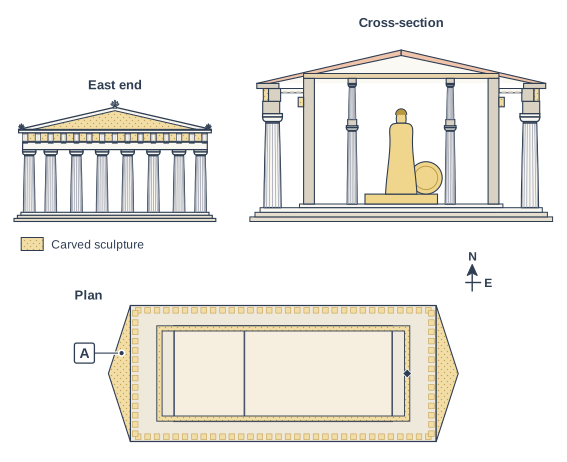
Figure 1 shows where the sculpture was on the Parthenon in Athens. The plan at the bottom shows the two pediments folded out flat at each end. The pediment at the west end, labelled A, showed a contest between two gods to decide which of them would be the patron of Athens.

Name the two gods in the contest, and state the gift that the winner gave to the Athenians.

Two views of a Greek temple. Two views of a Greek temple; a key under the left view says that dotted areas are carved sculpture. Left, headed "East end": the front of the temple, with 8 columns on three steps, a band of dotted square panels alternating with grooved blocks above the columns, and a dotted triangular gable with an ornament on the top and each corner. Right, headed "Cross-section": a section across the building. From the outside in on each side: an outer column, with the beams above it cut through and a dotted block on their outside face; a covered walkway with a panelled ceiling; an inner wall with a dotted band high up on its outside face, just under the walkway ceiling; then, inside, a stack of two small columns, and in the middle a tall figure on a wide base with a round shield beside it. A pitched roof covers everything. Below is a plan of the building labelled "Plan" (a compass shows north up and east on the right): a row of small squares runs round the outer edge, a dotted band runs round the inner building, a black diamond sits in the middle of the east end of the dotted band, and a dotted triangle is folded out flat at each end. Label A points to the triangle folded out at the west (left) end of the plan.

Model answer

The contest was between Athena and Poseidon. Athena won, and her gift to the Athenians was the olive tree.

Explanation

In the myth, Poseidon struck the rock of the Acropolis with his trident and produced a salt-water spring, while Athena made an olive tree grow; her gift was judged better and she became the city's patron. Herodotus (8.55) says the olive and the salt spring could still be seen on the Acropolis. The east pediment showed the birth of Athena.

Mark scheme
  1. 1 mark

    Athena

    Accept Athene. Either order for the two gods.

  2. 1 mark

    Poseidon

  3. 1 mark

    The olive tree (Athena's gift)

    Accept olive / olive tree / olive branch. Do not accept the salt-water spring or a horse (Poseidon's gift - he lost).

Question 4

8 marks

Source A: fragments of Xenophanes of Colophon, a poet and thinker of the late 6th century BC, quoted by later writers.

'But mortals suppose that gods are born, and that they have clothes and a voice and a body like their own.'
'The Ethiopians say their gods are snub-nosed and black; the Thracians say theirs have pale blue eyes and red hair.'
'But if cattle and horses or lions had hands, and could draw and make works of art as men do, horses would draw the shapes of gods like horses, and cattle like cattle, and they would make the gods' bodies just like their own.'
'Homer and Hesiod have given the gods everything that brings shame and blame among men: stealing, adultery and deceiving one another.'

To what extent did the Greeks imagine their gods as being like human beings? Use Source A as a starting point and your own knowledge.

Model answer

Source A shows that most Greeks did imagine their gods as like human beings. Xenophanes complains that 'mortals suppose that gods are born' and have 'clothes and a voice and a body like their own', and that each people pictures gods like themselves. His last fragment shows that the gods were thought to behave like humans too: Homer and Hesiod give them 'stealing, adultery and deceiving'.

My own knowledge supports this. In art the gods have human bodies: the Artemision bronze is a bearded, muscular man, and on the Parthenon frieze the gods sit chatting and relaxing like Athenian citizens. In myth they have human families and feelings: Hera is jealous of Zeus' affairs and persecutes Heracles, Hephaistos is lame and is made a laughing-stock when he catches his wife Aphrodite with Ares, and Ares whines to Zeus when Diomedes wounds him.

However, the gods were not simply human. They were immortal and had ichor instead of blood, and they could change shape: Zeus became a cuckoo to win Hera, and Dionysos turned into a lion. Their power over nature - Zeus' thunderbolt, Poseidon's earthquakes - is far beyond any human. Artists showed this by idealising them and making them huge: Pheidias' gold and ivory Zeus at Olympia was so large that it seemed he would break through the roof if he stood up. Some gods were even honoured in non-human forms, such as Hestia in the hearth fire and Hermes in the herms.

Overall, the Greeks imagined their gods to a great extent as human in form and personality, which made them easier to understand and pray to. But they were idealised, immortal and far more powerful humans, so Xenophanes' criticism is only partly fair: the Greeks believed the gods were like humans, but greater in every way.

Explanation

Xenophanes is a useful starting point because he criticises the very anthropomorphism that was normal in Greek religion. Top answers balance the human features of the gods (bodies, families, emotions, failings) against what made them divine (immortality, power, size, shape-changing) and reach a clear judgement. Simply listing human-like myths without weighing them keeps an answer in Level 2.

Mark scheme
  1. 8 marks

    Levels of response (8 marks). AO1 (4) and AO2 (4) are equally weighted.
    Level 4 (7-8 marks): consistently accurate and detailed knowledge of how the Greeks imagined and represented their gods, using both Source A and own wider knowledge of myths, literature and art; very good understanding of the religious context and of possible interpretations; a well-argued response with a clear, substantiated judgement on how far the gods were imagined as human, supported by a range of well-selected evidence, including critical analysis.
    Level 3 (5-6 marks): accurate knowledge, using both the source and own knowledge; a focused response with relevant analysis of the ways the gods were and were not like humans, and a judgement.
    Level 2 (3-4 marks): sound, mostly accurate knowledge; engages with the general topic of the gods' appearance and behaviour; limited range of evidence; some analysis.
    Level 1 (1-2 marks): limited knowledge, may only use the source given; isolated analysis.
    0 marks: no response or no response worthy of credit.
    A mainly descriptive answer with little analysis or judgement cannot go above Level 2.

    Indicative content (not a checklist; credit other valid points): AO1: Source A - Xenophanes says mortals think gods are born and have clothes, voices and bodies like theirs; each people imagines gods that look like themselves (Ethiopians, Thracians); animals would draw gods like animals; Homer and Hesiod show gods stealing, committing adultery and deceiving. Own knowledge - gods shown in art with human bodies (Artemision bronze, Athena Parthenos, Hermes of Praxiteles, the seated gods of the Parthenon east frieze); human family life (Zeus and Hera's quarrelsome marriage, Kronos swallowing his children); human emotions and failings (Hera's jealousy and persecution of Heracles, Ares whining in Iliad 5, Hephaistos' lameness and his net trapping Ares and Aphrodite, Hermes stealing Apollo's cattle); gods feast, sleep, fall in love. Differences - immortal and ageless; ichor not blood, nectar and ambrosia; vast size (the seated Zeus at Olympia filled his temple; gods on the Parthenon frieze are larger than the mortals); shape-changing (Zeus as a cuckoo, swan or bull, Dionysos as a lion); power over nature (thunderbolt, earthquakes); some gods honoured in non-human forms (herms, Hestia as the hearth fire). AO2: for - the gods were consistently shown and described in human form with human personalities, which let worshippers relate to them and pray to them as powerful patrons; Xenophanes' attack shows how widespread this view was. Against - artists idealised the gods (perfect bodies, calm faces, gold and ivory), so they were superhuman rather than simply human; attributes, size and setting set them apart; their power, immortality and shape-changing are not human at all. Xenophanes was an unusual critic and his view was not typical, but it shows some Greeks questioned it. Judgement, e.g.: the gods were imagined in human form and with human emotions, but as immortal, idealised and far more powerful beings - 'like humans, but more so'.

Ready to try the rest? Every answer you write is marked against the mark scheme, so you can see exactly where the marks are.

AI Tutor Hints first, answers after you try

Hi! Stuck? Ask me for a hint and I’ll help you work it out. Once you’ve checked your answer I can explain exactly where the marks are.