Level:
Correct: 0
Incorrect: 0
Marks: 0/0
Exam Practice
Subject:
Topics:
OCR GCSE Classical Civilisation (Myth and Religion) Smart practice A mixed round aimed at your weak spots
Unit 1
Greece
Unit 2
Rome
Unit 3
Greece and Rome
Avg
score:
–
Topics
done:
0/22

Comparing Greek and Roman temples, priests and sacrifice

Practise 24 exam-style questions on Comparing Greek and Roman temples, priests and sacrifice for OCR GCSE Classical Civilisation (Myth and Religion). Write your answer as you would in the exam and get it marked in seconds against the mark scheme, point by point, with an AI tutor on hand if you get stuck.

  • 24 questions
  • 2–15 marks each
  • Instant marking
  • No sign-up needed
20 questions, marked as you go

Sample questions with model answers

Here are 4 of the questions in this topic, each with a model answer, an explanation of why it earns the marks and the mark scheme an examiner would use.

Question 1

2 marks

Give two differences between Greek priests and priestesses and Roman priests such as the pontiffs and augurs.

Model answer

Greek priests and priestesses usually served a particular god at one sanctuary, often for a limited time or chosen by lot, whereas Roman priests belonged to colleges such as the pontiffs and augurs and usually held office for life. Roman priests were also usually leading politicians, headed by the Pontifex Maximus, while Greece had no central religious authority.

Explanation

Greek religion had many local priesthoods but no hierarchy; Roman priests formed state colleges, were drawn from the political elite and were led by the Pontifex Maximus (an office held by Julius Caesar and, from 12 BC, by Augustus). Answers must state both sides of each difference.

Mark scheme
  1. 2 marks

    Any two differences, 1 mark each: Greek priests usually served one god at one sanctuary, while Roman priests belonged to colleges serving the state religion as a whole; many Greek priesthoods were held for a year or chosen by lot (or inherited within a family), while Roman priests were usually co-opted or elected for life; Roman priests were usually leading politicians / senators who also held public office, while Greek priests generally had less political power; Rome had a head of religion (the Pontifex Maximus) while Greece had no central religious authority; priestesses served many Greek goddesses, while Rome's only state priestesses were the Vestal Virgins (and the wives of flamines); Roman priests advised the Senate on sacred law and could affect public business (e.g. augurs and the auspices).

    Two from; max 2. Each answer must make the contrast clear. Credit other accurate differences.

Question 2

6 marks

Source A: Pausanias, Description of Greece 5.10.3-4 (the Temple of Zeus at Olympia)

'The temple is in the Doric style, and a colonnade runs all round it. It is built of local stone. Its height up to the pediment is sixty-eight feet, its width ninety-five feet and its length two hundred and thirty feet. Its architect was Libon, a local man. The roof tiles are not of baked clay but of Pentelic marble, cut to look like tiles ... A gilded cauldron stands on each end of the roof, and a Victory, also gilded, stands in about the middle of the pediment.'

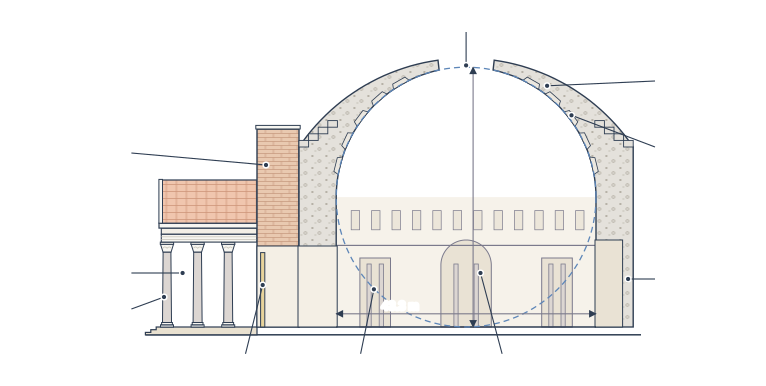
Source B is a cross-section of the Pantheon in Rome, as rebuilt by the emperor Hadrian in about AD 118-125 (Figure 1).

Explain how both sources show that temples were built to impress.

Cross-section of the Pantheon in Rome. The section is cut through the middle from front (left) to back (right), with steps up to the portico (porch), whose tall granite Corinthian columns carry the entablature and roof; behind it the tall intermediate block, with the bronze doors in the passage through it. Then the rotunda: its thick walls rise to the height of the radius (about 21.7 m) and carry the concrete dome, thick at the base (with step rings outside) and thinner at the top, where the oculus, about 9 m across, is open to the sky. Five rings of coffers (recessed panels) line the inside of the dome. The far wall shows a semicircular niche (exedra) screened by two columns, with rectangular niches either side, and the apse opposite the entrance. Dimension arrows show that the inside is 43.3 m across and 43.3 m high from the floor to the oculus; a dashed circle shows that a sphere 43.3 m across would fit exactly inside, touching the floor and the dome. The label "Oculus (open to the sky)" points to the gap at the very top of the dome; the label "Concrete dome" points to the thick curved shell over the round hall; the label "Coffers" points to the row of small recessed panels on the inside of the curved shell; the label "Rotunda (drum)" points to the thick round wall on the right supporting the dome; the label "Niche (exedra)" points to the arched recess with two columns in the far wall of the hall; the label "Portico (porch)" points to the columned porch on the left; the label "Granite Corinthian column" points to one of the tall columns of the porch; the label "Intermediate block" points to the tall solid block between the porch and the round hall; the label "Bronze doors" points to the tall doors in the passage through the solid block; the label "A sphere fits inside" points to the dashed circle touching the floor and the inside of the dome.

Model answer

Source A shows that the Temple of Zeus was designed to impress through its size and costly materials. Pausanias gives its great dimensions - sixty-eight feet high and two hundred and thirty feet long - so it dominated the sanctuary at Olympia and expressed the greatness of Zeus. Its roof tiles were of expensive Pentelic marble brought from Attica, and gilded cauldrons and a gilded Victory stood on the roof, glittering in the sun so that visitors arriving for the games would see them from far away. This display also showed off the wealth and piety of the Eleans who built it.

Source B shows the Pantheon impressing in a different way. Its concrete dome is 43.3 m across and exactly as high, so a whole sphere would fit inside; such a huge unsupported dome was an engineering marvel that displayed Roman skill and imperial power. The oculus, open to the sky, floods the interior with light and seems to link the temple with the heavens. Costly features such as the granite Corinthian columns and bronze doors added to the effect. While the Greek temple impressed mainly from outside, the Pantheon was designed to amaze people as they stepped inside.

Explanation

Both temples were built to impress worshippers and visitors, but the Temple of Zeus does so with size, marble and gold seen from outside, while the Pantheon uses Roman concrete technology to create an awe-inspiring interior. Full marks need explanation for both sources, not just a list of features.

Mark scheme
  1. 2 marks

    AO1 (2 marks): a relevant detail selected from each source - 1 mark for Source A, 1 mark for Source B.

    Source A, e.g.: its great size (68 feet high, 95 wide, 230 long); a colonnade all round; roof tiles of Pentelic marble; gilded cauldrons on the roof; a gilded Victory on the pediment. Source B, e.g.: the dome is 43.3 m across and 43.3 m high (a sphere fits inside); the concrete dome; the oculus open to the sky; coffers; granite Corinthian columns in the portico; bronze doors.

  2. 4 marks

    AO2 (4 marks): explanation of how the selected details show that temples were built to impress - 1 mark for each valid explanatory point or development. Both sources must be discussed for full marks: if only one source is used, maximum 3 marks for AO2.

    Indicative content (not a checklist; credit other valid points): Source A - the huge size made the temple the dominant building in the sanctuary and expressed the greatness of Zeus; marble tiles brought from Attica and gilded decoration show great expense and devotion, and the wealth of Elis (built from war spoils); gilded cauldrons and Victory on the roof glittered in the sun and could be seen from far away by visitors to the games; the decoration was on the outside, where worshippers gathered at the altar. Source B - the vast unsupported concrete dome was an engineering marvel, showing Roman skill and imperial power; the perfect geometry (height equals diameter, a sphere fits inside) gives harmony and suggests the heavens / the cosmos; the oculus floods the interior with light and links the temple to the sky; costly imported granite columns and bronze doors display the wealth of the empire; unlike a Greek temple, it impresses mainly from inside, as a great space for people. An answer cannot gain two AO2 marks for listing features; each mark needs an explanation.

Question 3

6 marks

Source A: Plutarch, Life of Numa 10 (the Vestal Virgins)

'The king laid down a period of thirty years for the Vestals: in the first ten they learn their duties, in the next ten they perform what they have learned, and in the remaining ten they teach others. After that, any who wish are free to marry ... He gave them great privileges: they may make a will while their father is still alive, and manage their own affairs without a guardian. When they go out, a lictor goes before them; and if they happen to meet a criminal being led to execution, his life is spared ... But a Vestal who has broken her vow of chastity is buried alive near the Colline Gate.'

Source B: the central scene of the marble frieze over the east entrance of the Parthenon (about 442-438 BC). A man and a child hold a folded cloth between them - probably the new robe (peplos) for Athena's ancient statue. Beside them a woman, probably the priestess of Athena, turns to take a stool carried on the head of one of two girls. On either side sit the gods, and beyond them processions of young women carry jugs, bowls and incense burners.

Explain how both sources show that women could hold important roles in religion.

Model answer

Source A shows that the Vestal Virgins held a unique and honoured position in Rome. Their thirty years of service - ten learning, ten performing and ten teaching - shows that theirs was an expert and demanding role. They had privileges no other Roman women had: they could make a will while their father was alive and manage their own affairs without a guardian, and a lictor walked in front of them, an honour normally given to magistrates. They even had the sacred power to save a condemned criminal's life. The terrible punishment of being buried alive for breaking their vow shows that their purity was believed to be bound up with the safety of Rome itself.

Source B shows the priestess of Athena at the very centre of the Parthenon's east frieze, beside the peplos, the sacred robe presented to the goddess at the climax of the Panathenaic festival. This suggests that she had a key role in Athens' greatest festival and was shown close to the gods themselves. The girls carrying stools and the young women carrying jugs, bowls and incense burners show that women and girls of citizen families took an active part in public worship, one of the few public roles open to them. Both sources show women in honoured religious roles linked with the welfare of the city.

Explanation

The Vestals were the only state priestesses of Rome, with extraordinary privileges and responsibilities; on the Parthenon frieze the priestess of Athena Polias and the maidens of the procession show women at the heart of Athenian civic religion. Strong answers explain what each detail reveals about women's status in religion.

Mark scheme
  1. 2 marks

    AO1 (2 marks): a relevant detail selected from each source - 1 mark for Source A, 1 mark for Source B.

    Source A, e.g.: thirty years of service (learning, performing, teaching); they may make a will while their father is alive; they manage their affairs without a guardian; a lictor goes before them; a condemned criminal they meet is spared; buried alive if unchaste. Source B, e.g.: the priestess of Athena in the central scene; she takes a stool from a girl; girls carry stools on their heads; young women carry jugs, bowls and incense burners in procession; next to the gods.

  2. 4 marks

    AO2 (4 marks): explanation of how the selected details show women's important religious roles - 1 mark for each valid explanatory point or development. Both sources must be discussed for full marks: if only one source is used, maximum 3 marks for AO2.

    Indicative content (not a checklist; credit other valid points): Source A - the Vestals were Rome's only state priestesses, and their thirty-year training shows a demanding, expert role; the legal privileges (wills, no guardian) set them apart from all other Roman women, showing their unique status; the lictor was an honour usually given to magistrates, so they were treated almost like officials of the state; the power to save a condemned man shows sacred authority; the terrible punishment shows that their chastity was believed to be bound up with the safety of Rome (they guarded the sacred flame). Source B - the priestess appears in the central scene of the frieze, at the climax of the Panathenaic procession, beside the peplos, so she had a key role in Athens' greatest festival; she is shown close to the gods; girls and young women carry the sacred vessels, showing that women of citizen families took part in public worship; religious roles were among the few public roles open to Athenian women. Comparison - both show women in honoured religious roles linked with the welfare of the city. An answer cannot gain two AO2 marks for listing details; each mark needs an explanation.

Question 4

15 marks

'Women played a more important part in religion in Greece than in Rome.'

How far do you agree with this statement? Use a range of Greek and Roman evidence to support your answer.

Model answer

There is good evidence that women played a large part in Greek religion. Many goddesses were served by priestesses: in Athens the priestess of Athena Polias came from the ancient Eteoboutadai family, and the priestess of Athena Nike was chosen by lot from all Athenian women. At the greatest Athenian festival, the Panathenaia, girls helped to weave the new peplos for Athena's ancient statue, unmarried girls of good family carried the sacred baskets in the procession, and on the Parthenon's east frieze the priestess of Athena stands in the central scene beside the peplos, with maidens carrying jugs and incense burners. Women also had a ritual voice at sacrifice: in the Odyssey, Nestor's wife and daughters raise the sacred cry as the heifer is struck. Festivals such as the Thesmophoria were for women only. Above all, at Delphi, the most important oracle in the Greek world, Apollo spoke through a woman, the Pythia.

In Rome, by contrast, the main state priesthoods - the pontiffs, augurs and most flamines - were held by men, usually leading politicians. Women's roles were fewer. The wife of the priest of Jupiter, the flaminica Dialis, had duties of her own, matrons took part in public prayers in times of crisis, and the rites of the Bona Dea were reserved for women. But these were limited compared with the many Greek priestesses.

However, Rome had one female priesthood of enormous importance: the Vestal Virgins. Plutarch says that they served for thirty years, learning, performing and teaching their duties, and that they had privileges no other Roman women enjoyed: they could make a will while their father was alive, managed their own affairs, were preceded by a lictor like a magistrate and could save a condemned criminal they met by chance. They tended the sacred fire of Vesta, which symbolised the life of the state, made the mola salsa used in sacrifices and guarded sacred objects and important documents. The punishment of being buried alive for breaking their vow, as Pliny describes in the case of the Vestal Cornelia, shows that Rome's safety was believed to depend on their purity. No single Greek priestess had quite such a central role in the welfare of the state.

In both cultures women's religious roles were bound up with ideas of purity and with the family. Greek basket-bearers and Roman Vestals had to be virgins, and in both societies religion offered women a public role that politics denied them, but men controlled the main structures - Greek magistrates organised festivals, and the Roman Pontifex Maximus supervised the Vestals.

In conclusion, I largely agree. Greek women had more numerous and varied religious roles, from the many priestesses and festival duties to the Pythia at Delphi, while in Rome the official priesthoods were overwhelmingly male. Yet the statement needs qualifying: the Vestal Virgins held a position of unique importance at the heart of the Roman state, so Roman women's role, though narrower, was in one respect just as vital.

Explanation

Strong answers compare the breadth of Greek women's roles (priestesses, the Pythia, the Panathenaia, the Thesmophoria) with the narrower but crucial Roman roles (the Vestals above all, the flaminica, Bona Dea), using specific evidence, and reach a qualified judgement. Answers that discuss only the Vestals and the Parthenon frieze will lack range.

Mark scheme
  1. 15 marks

    Levels of response (15 marks). AO1 (5) knowledge and understanding; AO2 (10) analysis, evaluation and argument.
    Level 5 (13-15 marks): very good, detailed and accurate knowledge of a wide range of Greek AND Roman evidence for women's religious roles and their contexts; very good analysis of well-selected evidence; a coherent argument with a clear line of reasoning, successful evaluation, and a convincing, substantiated conclusion.
    Level 4 (10-12 marks): good, accurate knowledge of both cultures; good analysis of a wide range of evidence; consistently well-structured argument and sound conclusion.
    Level 3 (7-9 marks): reasonable, mostly accurate knowledge; reasonable analysis of a range of evidence, perhaps unbalanced between Greece and Rome; relevant conclusion.
    Level 2 (4-6 marks): basic knowledge; some relevant evidence; some structure and a credible conclusion.
    Level 1 (1-3 marks): limited knowledge, little relevant evidence, weak conclusion.
    0 marks: no response or no response worthy of credit.
    An answer that is mostly description, or that discusses only Greece or only Rome, cannot go above Level 3.

    Indicative content (not a checklist; credit other valid points): AO1: Greece - priestesses served many goddesses (the priestess of Athena Polias from the Eteoboutadai family; the priestess of Athena Nike chosen by lot from all Athenian women; priestesses of Demeter); the Pythia at Delphi, Apollo's voice; the Panathenaia - girls helped weave the peplos, unmarried girls of good family were basket-bearers (kanephoroi), maidens with sacred vessels on the Parthenon frieze, the priestess in the central scene; women's cry (ololyge) at sacrifice (Odyssey 3); women-only festivals such as the Thesmophoria; the Arkteia for Artemis at Brauron; Dionysiac worship. Rome - the Vestal Virgins: six, chosen young, thirty years, tending the sacred flame, making mola salsa, guarding sacred objects and wills, with privileges (lictor, independence) and the punishment of burial alive (Plutarch; Pliny's letter on the Vestal Cornelia); the flaminica Dialis, wife of the priest of Jupiter, whose role was essential to his; women-only rites of the Bona Dea; matrons in public supplications; household worship. AO2: Agree - Greek women held more priesthoods, including major civic ones, and the Pythia's role at the most important oracle had no Roman parallel; many festivals gave women public roles. Disagree - the Vestals' role was arguably more central to the state than any Greek priestess, since Rome's safety was believed to depend on them; their legal status was unique; women's religious roles in both cultures were limited compared with men's (Roman colleges and Greek magistrates); both cultures controlled women's sexuality in religion (virginity, punishment). Judgement: e.g. Greek women had more numerous and varied roles; Roman women fewer but, in the Vestals, one of extraordinary importance.

Ready to try the rest? Every answer you write is marked against the mark scheme, so you can see exactly where the marks are.

AI Tutor Hints first, answers after you try

Hi! Stuck? Ask me for a hint and I’ll help you work it out. Once you’ve checked your answer I can explain exactly where the marks are.