
Level:
Correct: 0
Incorrect: 0
Marks: 0/0
Exam Practice
Course:
Topics:
OCR GCSE Computer Science (Paper 1) Smart practice A mixed round aimed at your weak spots
Unit 1
Systems architecture
Unit 2
Memory and storage
Unit 3
Computer networks, connections and protocols
Unit 4
Network security
Unit 5
Systems software
Unit 6
Ethical, legal, cultural and environmental impacts of digital technology
Avg
score:
–
Topics
done:
0/34

The concept of layers

Practise 21 exam-style questions on The concept of layers for OCR GCSE Computer Science (Paper 1). Write your answer as you would in the exam and get it marked in seconds against the mark scheme, point by point, with the Study Helper on hand if you get stuck.

  • 21 questions
  • 1–6 marks each
  • Instant marking
  • No sign-up needed
20 questions, marked as you go

Sample questions with model answers

Here are 4 of the questions in this topic, each with a model answer, an explanation of why it earns the marks and the mark scheme an examiner would use.

Question 1

1 mark

What is the main reason for dividing network communication into layers?

Choose your answer.

  • To make data travel across the network faster
  • To break a complex task into smaller, more manageable parts
  • To give each device on the network a unique address
  • To reduce the number of protocols that are needed

Model answer

To break a complex task into smaller, more manageable parts

Explanation

Sending data between devices involves many different jobs, so it is split into layers, each with a smaller, simpler job. This makes the whole system easier to design, understand, change and fix. Layers do not make data travel faster, addresses are given by IP addressing, and a layered system uses many protocols, not fewer.

Mark scheme
  1. 1 mark

    To break a complex task into smaller, more manageable parts

    If more than one option is given, 0 marks. Accept a clear identification of this option.
Question 2

2 marks

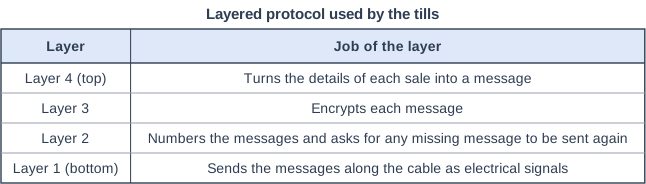
The self-service tills in a supermarket send the details of each sale to a central server, using a layered protocol. The table shows the job of each layer.

Messages are sometimes lost on the cable because of interference, and the system is designed to cope with this. However, the manager has found that when a message is lost, that sale is never recorded on the server.

Identify the layer that is not doing its job properly. Explain your answer.

Layered protocol used by the tills. Table with columns "Layer", "Job of the layer". Layer: Layer 4 (top); Job of the layer: Turns the details of each sale into a message | Layer: Layer 3; Job of the layer: Encrypts each message | Layer: Layer 2; Job of the layer: Numbers the messages and asks for any missing message to be sent again | Layer: Layer 1 (bottom); Job of the layer: Sends the messages along the cable as electrical signals.

Model answer

Layer 2. Its job is to number the messages and ask for any missing message to be sent again. Messages being lost on the cable is expected, so the fault is that Layer 2 is not noticing the missing messages or not asking for them to be re-sent - otherwise the lost sale would be sent again and recorded.

Explanation

Because each layer has a specific job, a fault can be traced by asking which layer's job is not being done. Losing a message on the cable is expected; recovering it is Layer 2's job, so Layer 2 is the one at fault. This is one way layers make it easier to find and fix problems.

Mark scheme
  1. 1 mark

    Layer 2

    Do not accept Layer 1: messages being lost on the cable is expected, and the system is designed to cope with it.

  2. 1 mark

    ...because its job is to (number the messages and) ask for missing messages to be sent again, but the lost sales are not being re-sent

    Accept 'losing messages on the cable is expected, so Layer 2 should notice the missing message and ask for it again'.

Question 3

3 marks

Zainab is writing a new messaging app. The app will send messages over Wi-Fi, mobile data or a wired connection, but Zainab does not need to write any code to deal with how the data is actually transmitted.

Explain how the use of layers makes this possible.

Model answer

Zainab's app works only in the top layer. When it sends a message, it just passes the data down to the layer below, which provides the service of getting it to the other phone. The lower layers do the work of splitting the data into packets, addressing them and sending them over Wi-Fi, mobile data or a cable, and how they do this is hidden from her app. So the type of connection can change without Zainab changing her app.

Explanation

Each layer provides services to the layer above and hides the detail of how it does its job. This means an app developer can concentrate on their own layer and rely on the layers below to deliver the data, whichever type of connection is used. It is also why developers can specialise in one layer.

Mark scheme
  1. 1 mark

    Her app is only in / she only writes the protocol for the top layer (one layer)

  2. 1 mark

    The lower layers deal with transmitting the data (e.g. splitting it into packets, addressing it, sending it over Wi-Fi, mobile data or cable)

  3. 1 mark

    Her app just passes the data to the layer below, which provides this as a service // each layer uses the services of the layer below

  4. 1 mark

    The details of how the lower layers work are hidden from her app (abstraction)

    Do not award MS3 and MS4 for the same statement. A repeat of the question ('she does not need to write code for transmitting the data') is not enough for MS4.

  5. 1 mark

    The lower layer used can be different (Wi-Fi, mobile data, wired) without her app having to change

    max 3.

Question 4

4 marks

Engineers at a company are designing the protocols for a new network system. One engineer suggests writing a single, large protocol that does every job, from preparing the data to sending the signals. Another engineer suggests splitting the protocols into layers.

Explain why splitting the protocols into layers is the better choice.

Model answer

A single protocol doing every job would be very large and complex, so it would be hard to design and understand; layers break the task into smaller, manageable parts. With one protocol, any change would mean rewriting and retesting the whole thing, but with layers one layer can be changed or replaced without affecting the others. If something goes wrong, a fault is hard to find in one huge protocol, whereas each layer can be tested separately. Layers also let different teams specialise in different layers and work at the same time, and each layer can have its own standards, so hardware and software from different companies can work together.

Explanation

Comparing the two designs is a good way to show why layers are used. Every benefit of layers is a weakness of one big protocol: complexity, difficulty of change, difficulty of finding faults, and one company having to build everything. Make each point specific - say what is easier and why.

Mark scheme
  1. 1 mark

    A single protocol would be very large/complex and hard to design and understand // layers break the task into smaller, more manageable parts

  2. 1 mark

    With a single protocol, any change means the whole protocol must be rewritten/re-tested // with layers, one layer can be changed or replaced without affecting the others

  3. 1 mark

    Faults are harder to locate in one large protocol // with layers, each layer can be tested separately to find the fault

  4. 1 mark

    With layers, different teams/developers can work on / specialise in different layers (at the same time)

  5. 1 mark

    With layers, each layer can have its own standards, so hardware/software from different companies can be used together // with a single protocol, one company would have to make everything

  6. 1 mark

    With layers, the lower layers can be reused by many different protocols/apps in the layer above

    max 4. Points can be made about either approach (e.g. 'a single protocol would be hard to change'). The same idea made about both approaches scores once. 'Layers are easier' on its own is not enough.

Ready to try the rest? Every answer you write is marked against the mark scheme, so you can see exactly where the marks are.

Study Helper Hints first, answers after you try

Stuck on this one? Ask for a hint and I’ll point you in the right direction, without giving the answer away. Once you’ve checked your answer, I’ll show you how the marks are awarded.