Denial of service, data interception and SQL injection
Practise 29 exam-style questions on Denial of service, data interception and SQL injection for OCR GCSE Computer Science (Paper 1). Write your answer as you would in the exam and get it marked in seconds against the mark scheme, point by point, with the Study Helper on hand if you get stuck.
29 questions
1–8 marks each
Instant marking
No sign-up needed
20 questions, marked as you go
Sample questions with model answers
Here are 4 of the questions in this topic, each with a model answer, an explanation of why it earns the marks and the mark scheme an examiner would use.
Question 1
1 mark
Which one of these is most at risk of having its data intercepted?
Choose your answer.
Logging in to a website that uses HTTP, not HTTPS, on a cafe's open Wi-Fi
Logging in to a website that uses HTTPS over a wired home connection
Saving a file on an encrypted USB drive
Typing a document on a laptop that is not connected to any network
Model answer
Logging in to a website that uses HTTP, not HTTPS, on a cafe's open Wi-Fi
Explanation
Data interception happens while data travels across a network. On open Wi-Fi, anyone within range can capture the radio signals, and HTTP sends the login details unencrypted, so they can be read. HTTPS encrypts the data and a wired connection needs physical access, while the last two options do not send data across a network at all.
Mark scheme
1 mark
Logging in to a website that uses HTTP, not HTTPS, on a cafe's open Wi-Fi
If more than one option is given, 0 marks. Accept a clear identification of this option, e.g. 'the first one' or 'HTTP on open Wi-Fi'.
Question 2
2 marks
Data can be stolen without being intercepted as it travels across a network.
Give two other ways that data could be stolen from a company.
Model answer
A thief could steal a laptop that has customer files stored on it. An employee could copy confidential files onto a USB drive and take them home.
Explanation
Data theft includes physically taking the hardware or storage that holds the data, and people inside the organisation copying data they can access. These risks are why physical security and user access levels matter as much as network security. Each answer must be a different way, not two examples of the same one.
Mark scheme
1 mark
Stealing a device that holds the data // e.g. a laptop, phone, tablet, USB drive, external hard drive or backup
1 mark
An employee/insider copying files (e.g. to a USB drive) or emailing them to themselves
1 mark
Taking or photographing printed documents or screens
1 mark
Using a computer that has been left logged in / unlocked
1 mark
Getting into the server room / office and taking or copying storage
1 mark
Recovering data from old devices that were thrown away/sold without being wiped
max 2. Also accept other attacks that steal stored data, e.g. spyware/malware sending files to the criminal, SQL injection, using a password obtained by phishing. Two examples of stealing a device (e.g. a laptop and a USB drive) count as one way.
Question 3
3 marks
The exams officer at a sixth-form college has her laptop stolen from her bag on a train. The laptop holds a spreadsheet of students' names, dates of birth, home addresses and exam results. The laptop has no password and its files are not encrypted.
Explain the threats posed by the theft of this laptop.
Model answer
Because the laptop has no password and the files are not encrypted, the thief can simply open the spreadsheet and read everything in it. The students' names, dates of birth and addresses could be used for identity theft or sold to other criminals, and the thief knows where the students live. The college could also be fined for failing to protect the students' personal data, and its reputation would be damaged.
Explanation
Data theft does not need a network: stealing a device steals the data on it. The threats are to the people the data is about (identity theft, privacy, safety) and to the organisation (fines under data protection law, reputation, losing the data). Encryption and a strong password would mean the thief had the hardware but could not read the data.
Mark scheme
1 mark
Anyone who has the laptop can open and read the files (no password, not encrypted)
1 mark
The students' personal data could be used for identity theft / fraud // could be sold to other criminals
1 mark
The students' privacy is breached // their data could be published / used to harass or blackmail them // the thief knows where they live
1 mark
The college could be fined / face legal action for failing to protect personal data (Data Protection Act)
1 mark
Damage to the college's reputation // students and parents lose trust in the college
1 mark
The data on the laptop may be lost to the college if there is no backup
max 3. 'The data could be stolen' is not enough - it has already been stolen; the answer must say what could happen as a result. Do not award MS2 and MS3 for the same statement, e.g. 'the thief could misuse their personal data' earns one mark.
Question 4
4 marks
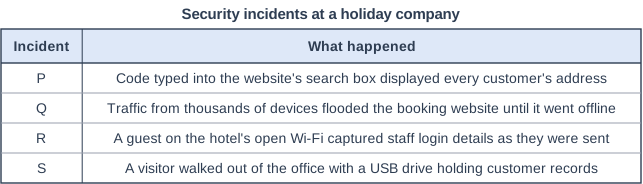
A holiday company's security log records the four incidents shown in the table.
For each incident P, Q, R and S, state which form of attack has taken place.
Model answer
P: SQL injection Q: distributed denial of service (DDoS) R: data interception (packet sniffing) S: data theft (physical theft of a storage device)
Explanation
P is SQL injection because code typed into an input box made the database reveal data. Q is a DDoS attack because traffic from thousands of devices made the website unavailable. R is data interception because the details were captured while they travelled over Wi-Fi, and S is theft because the data was physically taken away on a storage device.
Mark scheme
1 mark
P: SQL injection
1 mark
Q: distributed denial of service // DDoS
Accept denial of service / DoS.
1 mark
R: data interception // packet sniffing
Do not accept 'theft' on its own for R.
1 mark
S: (data) theft // physical theft (of a storage device)
Do not accept 'interception' for S. Each answer must be clearly matched to its letter.
Ready to try the rest? Every answer you write is marked against the mark scheme, so you can see exactly where the marks are.
Ctrl + Enter to check
Study HelperHints first, answers after you try
Stuck on this one? Ask for a hint and I’ll point you in the right direction, without giving the answer away. Once you’ve checked your answer, I’ll show you how the marks are awarded.