Level:
Correct: 0
Incorrect: 0
Marks: 0/0
Exam Practice
Course:
Topics:
OCR GCSE Computer Science (Paper 1) Smart practice A mixed round aimed at your weak spots
Unit 1
Systems architecture
Unit 2
Memory and storage
Unit 3
Computer networks, connections and protocols
Unit 4
Network security
Unit 5
Systems software
Unit 6
Ethical, legal, cultural and environmental impacts of digital technology
Avg
score:
–
Topics
done:
0/34

CPU performance

Practise 31 exam-style questions on CPU performance for OCR GCSE Computer Science (Paper 1). Write your answer as you would in the exam and get it marked in seconds against the mark scheme, point by point, with the Study Helper on hand if you get stuck.

  • 31 questions
  • 1–8 marks each
  • Instant marking
  • No sign-up needed
20 questions, marked as you go

Sample questions with model answers

Here are 4 of the questions in this topic, each with a model answer, an explanation of why it earns the marks and the mark scheme an examiner would use.

Question 1

1 mark

Imogen often has a web browser, a music player and a word processor open at the same time.

Which one of these changes to her computer is most likely to help these programs run at the same time without slowing down?

Choose your answer.

  • A CPU with more cores
  • A hard disk drive with a larger capacity
  • A CPU with a smaller cache
  • A larger monitor

Model answer

A CPU with more cores

Explanation

Each core can fetch, decode and execute instructions independently, so with more cores the different programs can be processed at the same time on different cores. A larger hard disk drive stores more files but does not make processing faster, a smaller cache would make the CPU slower, and the size of the monitor has no effect on processing. A common misconception is that more storage capacity makes a computer faster.

Mark scheme
  1. 1 mark

    A CPU with more cores

    If more than one option is given, 0 marks.

Question 2

2 marks

In the mid-1990s, a typical home computer's CPU had a clock speed of 66 MHz. A core in a modern CPU has a clock speed of 3.3 GHz.

Calculate how many times more clock cycles per second the modern core carries out.

Show your working.

Model answer

3.3 GHz = 3,300 MHz.
3,300 ÷ 66 = 50, so the modern core carries out 50 times as many clock cycles per second.

Explanation

The two clock speeds must be in the same unit before you divide: 1 GHz = 1,000 MHz, so 3.3 GHz = 3,300 MHz. Then 3,300 ÷ 66 = 50. Converting both to hertz (3,300,000,000 ÷ 66,000,000) gives the same answer. A common mistake is dividing 3.3 by 66 straight away, which mixes gigahertz and megahertz.

Mark scheme
  1. 1 mark

    Converts to the same unit: 3.3 GHz = 3,300 MHz // 66 MHz = 0.066 GHz // 3,300,000,000 Hz and 66,000,000 Hz

    Correct answer with no working scores full marks. Accept any correct route.

  2. 1 mark

    50 (times)

    Dividing 3.3 by 66 without converting the units (0.05) scores 0. Do not accept 0.02 (division the wrong way round).

Question 3

3 marks

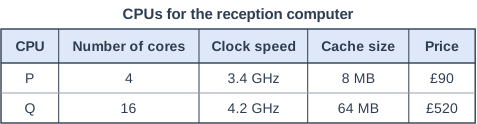
A dental surgery is buying a new computer for its reception desk. The receptionist uses it to book appointments, send emails and print letters, usually with one or two programs open at a time. The table shows two CPUs the surgery could choose.

Explain why CPU P is suitable for the reception computer, even though CPU Q would give higher performance.

CPUs for the reception computer. Table with columns "CPU", "Number of cores", "Clock speed", "Cache size", "Price". CPU: P; Number of cores: 4; Clock speed: 3.4 GHz; Cache size: 8 MB; Price: £90 | CPU: Q; Number of cores: 16; Clock speed: 4.2 GHz; Cache size: 64 MB; Price: £520.

Model answer

The receptionist only books appointments, sends emails and prints letters, which need very little processing. P's four cores are plenty for one or two programs at a time, and its 3.4 GHz clock speed is fast enough that she would not notice any delay - most of Q's 16 cores would never be used. P also costs 430 pounds less, so the surgery saves money without losing any performance it needs.

Explanation

The 'best' CPU is the one that matches the tasks, not the most powerful one. Office tasks like these use little processing, so extra cores, clock speed and cache would make no noticeable difference but would cost much more. Good answers use the figures in the table and link them to what the receptionist actually does.

Mark scheme
  1. 1 mark

    The receptionist's tasks (booking appointments, emails, letters) need little processing // are simple tasks

  2. 1 mark

    P's four cores are enough for one or two programs at a time // most of Q's 16 cores would hardly ever be used

  3. 1 mark

    P's clock speed (3.4 GHz) is high enough for these programs to run without noticeable delay // the receptionist would not notice Q's extra speed

    Do not award the first and third marks for one statement such as 'P is fast enough for these tasks' (third mark only).

  4. 1 mark

    P is much cheaper (430 pounds less), so the surgery saves money // Q's extra cost is not worth it for these tasks

  5. 1 mark

    Q (with more cores and a higher clock speed) is likely to use more power / produce more heat

    max 3. For 3 marks the answer must refer to the receptionist's tasks or the figures in the table, not just general facts.

Question 4

5 marks

Rhys's computer has a dual-core CPU with a clock speed of 3.0 GHz. He can afford one of these upgrades:

Upgrade 1: a dual-core CPU with a clock speed of 4.0 GHz
Upgrade 2: a six-core CPU with a clock speed of 3.0 GHz

Both new CPUs have the same cache size as his current CPU. Rhys mainly uses his computer to play an older game that can only use one core. Now and then he converts long videos into a different file format, and the converter shares its work between all of the CPU's cores.

Explain how each upgrade would affect the performance of these two tasks, and recommend which upgrade Rhys should choose.

Model answer

Upgrade 1 raises the clock speed from 3.0 to 4.0 GHz, so each core carries out 4 billion cycles per second instead of 3 billion. The game uses only one core, so it would run faster. Video conversion would also be a little faster, because both cores are faster (8 billion cycles per second in total instead of 6 billion).

Upgrade 2 keeps the clock speed at 3.0 GHz, so the game would not run any faster - it can only use one of the six cores. However, the converter could share its work between six cores instead of two, up to 18 billion cycles per second in total, so long videos would convert much faster than with either Upgrade 1 or his current CPU.

I recommend Upgrade 1, because Rhys mainly plays the game, and only a higher clock speed will make a one-core program faster. Video conversion is only occasional, and it would still be a little quicker.

Explanation

This question tests the effect of changing one characteristic at a time. A higher clock speed helps every task, including one-core programs; more cores only help software that splits its work, but then they can help a lot. Because the game is Rhys's main use, Upgrade 1 suits him better, although Upgrade 2 can be justified if video conversion matters more. Remember that six cores do not really give three times the speed, because not all work can be split.

Mark scheme
  1. 1 mark

    Upgrade 1: the higher clock speed means each core carries out more fetch-execute cycles per second (4 billion instead of 3 billion)

  2. 1 mark

    So the game (which uses one core) runs faster with Upgrade 1

  3. 1 mark

    Upgrade 2 would not make the game any faster, because the game uses only one core and the clock speed is unchanged

  4. 1 mark

    With Upgrade 2 the converter can share its work between six cores instead of two, so videos convert faster (than with Upgrade 1) // up to 18 billion cycles per second in total, compared with 8 billion for Upgrade 1

  5. 1 mark

    Upgrade 1 also makes video conversion a little faster, because both cores are faster // 8 billion compared with 6 billion cycles per second in total

  6. 1 mark

    A recommendation justified by Rhys's use, e.g. Upgrade 1 because his main use is the game, which only uses one core (and conversion is only occasional) // Upgrade 2 if justified, e.g. because converting long videos is what takes him the longest

    max 5. For 5 marks a justified recommendation must be given. A recommendation with no reason scores 0 for this point.

Ready to try the rest? Every answer you write is marked against the mark scheme, so you can see exactly where the marks are.

Study Helper Hints first, answers after you try

Stuck on this one? Ask for a hint and I’ll point you in the right direction, without giving the answer away. Once you’ve checked your answer, I’ll show you how the marks are awarded.