
Level:
Correct: 0
Incorrect: 0
Marks: 0/0
Exam Practice
Course:
Topics:
OCR GCSE Computer Science (Paper 1) Smart practice A mixed round aimed at your weak spots
Unit 1
Systems architecture
Unit 2
Memory and storage
Unit 3
Computer networks, connections and protocols
Unit 4
Network security
Unit 5
Systems software
Unit 6
Ethical, legal, cultural and environmental impacts of digital technology
Avg
score:
–
Topics
done:
0/34

Standards and common protocols

Practise 33 exam-style questions on Standards and common protocols for OCR GCSE Computer Science (Paper 1). Write your answer as you would in the exam and get it marked in seconds against the mark scheme, point by point, with the Study Helper on hand if you get stuck.

  • 33 questions
  • 1–8 marks each
  • Instant marking
  • No sign-up needed
20 questions, marked as you go

Sample questions with model answers

Here are 4 of the questions in this topic, each with a model answer, an explanation of why it earns the marks and the mark scheme an examiner would use.

Question 1

1 mark

Which one of these is the main difference between HTTPS and HTTP?

Choose your answer.

  • HTTPS sends web pages faster
  • HTTPS encrypts the data sent between the browser and the web server
  • HTTPS stops data from being intercepted
  • HTTPS is used to send emails rather than web pages

Model answer

HTTPS encrypts the data sent between the browser and the web server

Explanation

HTTPS is HTTP with encryption: the data sent between the browser and the web server is encrypted, so if it is intercepted it cannot be understood without the key. HTTPS does not stop interception - it makes intercepted data useless. It is not faster, and both protocols are for web pages, not email.

Mark scheme
  1. 1 mark

    HTTPS encrypts the data sent between the browser and the web server

    If more than one option is given, 0 marks. Accept a clear identification of this option, e.g. 'HTTPS encrypts the data'.
Question 2

2 marks

A school's weather station sends temperature readings to a computer in the science lab. The weather station and the computer were made by different companies.

Explain why the weather station and the computer must both use the same protocol.

Model answer

A protocol is a set of rules for transferring data, such as the format of each reading and how errors are checked. If both devices follow the same rules, the computer knows how to interpret the data the weather station sends; if they used different protocols, the computer could not understand the readings.

Explanation

Communication only works if the sender and receiver agree on the rules - like two people needing to speak the same language. Because the protocol is agreed, devices made by different companies can still communicate.

Mark scheme
  1. 1 mark

    A protocol sets the rules for how the data is sent and received (e.g. its format, addressing, error checking)

  2. 1 mark

    If they used different rules/protocols, the computer would not be able to understand/interpret the readings (correctly) // using the same rules means the computer can understand the data sent by the weather station

    'So they can communicate' or 'so they can connect' on its own is not enough for MS2 - it must say that the computer can understand/interpret the data, or what would go wrong.

Question 3

3 marks

Freya says: 'My bank's website uses HTTPS, so hackers cannot intercept my data.'

Explain why Freya is wrong, and describe how HTTPS does protect her data.

Model answer

Freya is wrong because HTTPS does not stop data being intercepted - a hacker can still capture the data as it travels across the network. What HTTPS does is encrypt the data sent between her browser and the bank's web server, so if it is intercepted it cannot be understood without the key, and her bank details stay private.

Explanation

This is a very common misconception: encryption does not prevent interception, it makes intercepted data useless. HTTPS is HTTP with encryption added, so the protection comes from the data being scrambled, not from it being hidden.

Mark scheme
  1. 1 mark

    HTTPS does not stop data being intercepted // her data can still be intercepted/captured

  2. 1 mark

    HTTPS encrypts the data (sent between her browser and the bank's web server)

  3. 1 mark

    So if her data is intercepted, it cannot be understood/read (without the key) // it is meaningless to the hacker

    MS3 can be awarded without MS2 if the idea that intercepted data cannot be understood is clear.

Question 4

4 marks

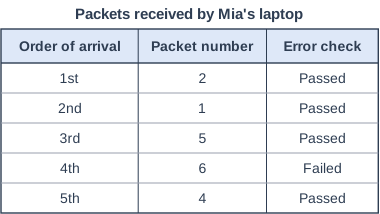
Mia downloads a file from her school's website. The file was split into six packets, numbered 1 to 6. The table shows the packets that reached Mia's laptop, in the order they arrived, and whether each one passed its error check.

Explain how TCP makes sure that Mia's laptop ends up with the complete and correct file.

Packets received by Mia's laptop. Table with columns "Order of arrival", "Packet number", "Error check". Order of arrival: 1st; Packet number: 2; Error check: Passed | Order of arrival: 2nd; Packet number: 1; Error check: Passed | Order of arrival: 3rd; Packet number: 5; Error check: Passed | Order of arrival: 4th; Packet number: 6; Error check: Failed | Order of arrival: 5th; Packet number: 4; Error check: Passed.

Model answer

TCP uses the packet numbers to see that six packets were sent but packet 3 has not arrived. Packet 6 has arrived but failed its error check, so it is damaged. TCP requests that packets 3 and 6 are sent again. When all six packets have arrived undamaged, TCP puts them back together in the order 1, 2, 3, 4, 5, 6 using their numbers, so Mia's laptop has the complete, correct file.

Explanation

Packets can arrive out of order because they can take different routes across the Internet, and some can be lost or damaged on the way. TCP numbers the packets so the receiver can tell which are missing and what order they belong in, and it uses error checks to find damaged ones and request them again. Good answers use the table: packet 3 is missing, packet 6 is damaged, and the rest arrived out of order.

Mark scheme
  1. 1 mark

    Packet 3 is missing - TCP can tell from the packet numbers (six packets were sent but number 3 has not arrived)

    Accept for MS1 that TCP waits for packet 3 and treats it as missing if it does not arrive.

  2. 1 mark

    Packet 6 is damaged/corrupted (it failed its error check), so it cannot be used

    MS1 and MS2 need the packets identified (packet 3, packet 6) or clearly described ('the missing packet', 'the packet that failed its check').

  3. 1 mark

    TCP requests that the missing/damaged packets (3 and 6) are sent again // the sender re-sends packets 3 and 6

    Accept the idea that the laptop acknowledges the packets it receives correctly and the sender re-sends any that are not acknowledged. Do not award MS3 for 'all the packets are sent again'.

  4. 1 mark

    TCP puts/reassembles the packets in the correct order (1 to 6) using the packet numbers

    Generic answers that do not use the table can score MS3 and MS4 only.

Ready to try the rest? Every answer you write is marked against the mark scheme, so you can see exactly where the marks are.

Study Helper Hints first, answers after you try

Stuck on this one? Ask for a hint and I’ll point you in the right direction, without giving the answer away. Once you’ve checked your answer, I’ll show you how the marks are awarded.