
Level:
Correct: 0
Incorrect: 0
Marks: 0/0
Exam Practice
Course:
Topics:
OCR GCSE Computer Science (Paper 1) Smart practice A mixed round aimed at your weak spots
Unit 1
Systems architecture
Unit 2
Memory and storage
Unit 3
Computer networks, connections and protocols
Unit 4
Network security
Unit 5
Systems software
Unit 6
Ethical, legal, cultural and environmental impacts of digital technology
Avg
score:
–
Topics
done:
0/34

Identifying and preventing vulnerabilities

Practise 37 exam-style questions on Identifying and preventing vulnerabilities for OCR GCSE Computer Science (Paper 1). Write your answer as you would in the exam and get it marked in seconds against the mark scheme, point by point, with the Study Helper on hand if you get stuck.

  • 37 questions
  • 1–8 marks each
  • Instant marking
  • No sign-up needed
20 questions, marked as you go

Sample questions with model answers

Here are 4 of the questions in this topic, each with a model answer, an explanation of why it earns the marks and the mark scheme an examiner would use.

Question 1

1 mark

Which one of these threats do user access levels most directly limit?

Choose your answer.

  • Staff viewing files they do not need
  • A denial of service attack
  • Data intercepted on Wi-Fi
  • A virus in an email attachment

Model answer

Staff viewing files they do not need

Explanation

User access levels give each user permission to read, change or delete only the files and data they need for their role, so staff cannot open files they have no reason to see. A denial of service attack is limited by a firewall, intercepted data is protected by encryption, and a virus in an attachment is caught by anti-malware software.

Mark scheme
  1. 1 mark

    Staff viewing files they do not need

    If more than one option is given, 0 marks.
Question 2

2 marks

Explain why an organisation should carry out penetration testing regularly, rather than only once.

Model answer

New vulnerabilities and new methods of attack are discovered all the time, so a system that passed a test last year may be vulnerable now. The organisation's own system also changes as new software, devices and staff are added, and each change could introduce a new weakness.

Explanation

A penetration test is a snapshot: it finds the weaknesses that exist on the day of the test. Because both the threats and the system keep changing, testing has to be repeated, and a repeat test also confirms that the earlier weaknesses really were fixed.

Mark scheme
  1. 1 mark

    New vulnerabilities are discovered / new types of attack are developed all the time

  2. 1 mark

    The system changes: new software, updates, devices or staff can introduce new weaknesses

  3. 1 mark

    A test only shows the weaknesses that exist at the time of the test // a later test checks that the weaknesses found earlier have been fixed

    max 2.

Question 3

3 marks

Smile Dental Practice backs up its patient records every night onto a portable hard drive. The practice manager takes the drive home each evening so that a copy is kept away from the building.

Explain why the backup drive should be encrypted.

Model answer

The drive is small and is carried out of the building every day, so it could easily be lost or stolen, for example from the manager's car or house. Without encryption, anyone who found it could read all the patients' records. If the drive is encrypted, the data cannot be understood without the key, so the confidential medical data stays protected, and the practice meets its legal duty to keep personal data secure.

Explanation

Encryption protects stored data as well as data being sent. It is especially important on portable devices such as laptops, USB drives and backup drives, which are easily lost or stolen. Encryption does not prevent the theft - physical security helps with that - but it makes the stolen data useless.

Mark scheme
  1. 1 mark

    The drive is small/portable and leaves the building, so it could be lost or stolen (e.g. on the way home or from the manager's house)

  2. 1 mark

    Without encryption, anyone who has the drive could read or copy the patient records

  3. 1 mark

    If it is encrypted, the data cannot be understood without the key/password

  4. 1 mark

    Patient records are confidential/personal medical data // the practice has a legal duty to protect personal data (and could be fined)

    max 3. Do not credit 'encryption stops the drive being stolen'.

Question 4

4 marks

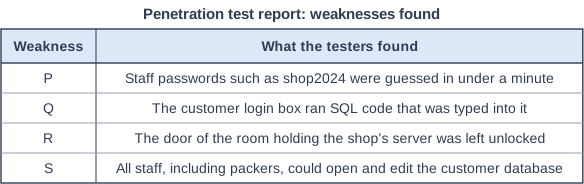
An online shop paid for penetration testing. The table shows four weaknesses that the testers found.

For each weakness P, Q, R and S, state a prevention method that would remove it.

Penetration test report: weaknesses found. Table with columns "Weakness", "What the testers found". Weakness: P; What the testers found: Staff passwords such as shop2024 were guessed in under a minute | Weakness: Q; What the testers found: The customer login box ran SQL code that was typed into it | Weakness: R; What the testers found: The door of the room holding the shop's server was left unlocked | Weakness: S; What the testers found: All staff, including packers, could open and edit the customer database.

Model answer

P: enforce strong passwords (at least 12 characters with a mix of character types) and lock accounts after a few wrong attempts.
Q: validate and sanitise everything typed into the login box, so SQL code is rejected.
R: physical security - fit a keycard lock to the server room door and keep it locked.
S: user access levels - give packers read-only access to delivery details only, and let only the staff who need to edit the database do so.

Explanation

Penetration testing only finds weaknesses; the organisation then removes each one with the right method. Weak passwords need password rules or lockout, SQL injection needs input validation, an unlocked door needs physical security, and too much access needs user access levels. A firewall would not fix any of these, because each weakness is inside the shop or in how its website handles input.

Mark scheme
  1. 1 mark

    P: stronger password rules (long, mixed character types, not words) // lock accounts after a few wrong attempts // two-factor authentication

  2. 1 mark

    Q: validate/sanitise all input (e.g. reject or remove SQL code) // use parameterised queries

    Do not accept a firewall or anti-malware software.

  3. 1 mark

    R: physical security - keep the door locked // fit a keycard or biometric lock // add CCTV or an alarm

    'Physical security' on its own is enough.

  4. 1 mark

    S: user access levels - give packers access only to the delivery details they need (read-only) // only staff who need to edit the database can do so

    'User access levels' on its own is enough.

Ready to try the rest? Every answer you write is marked against the mark scheme, so you can see exactly where the marks are.

Study Helper Hints first, answers after you try

Stuck on this one? Ask for a hint and I’ll point you in the right direction, without giving the answer away. Once you’ve checked your answer, I’ll show you how the marks are awarded.