
Level:
Correct: 0
Incorrect: 0
Marks: 0/0
Exam Practice
Course:
Topics:
OCR GCSE Computer Science (Paper 1) Smart practice A mixed round aimed at your weak spots
Unit 1
Systems architecture
Unit 2
Memory and storage
Unit 3
Computer networks, connections and protocols
Unit 4
Network security
Unit 5
Systems software
Unit 6
Ethical, legal, cultural and environmental impacts of digital technology
Avg
score:
–
Topics
done:
0/34

LANs, WANs and network performance

Practise 30 exam-style questions on LANs, WANs and network performance for OCR GCSE Computer Science (Paper 1). Write your answer as you would in the exam and get it marked in seconds against the mark scheme, point by point, with the Study Helper on hand if you get stuck.

  • 30 questions
  • 1–8 marks each
  • Instant marking
  • No sign-up needed
20 questions, marked as you go

Sample questions with model answers

Here are 4 of the questions in this topic, each with a model answer, an explanation of why it earns the marks and the mark scheme an examiner would use.

Question 1

1 mark

A secondary school's network has 300 computers.

Which one of these is most likely to reduce the performance of the school's network?

Choose your answer.

  • Replacing copper cables with fibre-optic cables
  • Thirty students streaming high-definition videos at the same time
  • Upgrading the Internet connection to a higher bandwidth
  • Switching off computers that are not being used

Model answer

Thirty students streaming high-definition videos at the same time

Explanation

Streaming high-definition video needs a lot of data every second, so thirty streams at once create heavy traffic that uses up much of the bandwidth and leaves less for everyone else (congestion). Fibre-optic cables and a higher-bandwidth connection would improve performance, and switching off unused computers would not slow the network down.

Mark scheme
  1. 1 mark

    Thirty students streaming high-definition videos at the same time

    If more than one option is given, 0 marks. Accept a clear identification of this option, e.g. 'the streaming one'.
Question 2

2 marks

Owen downloads a 50 MB file. His connection has a bandwidth of 100 Mbps.

Calculate how long the download will take, in seconds. Assume the full bandwidth is available for the whole download. Show your working.

(1 Mbps = 1,000,000 bits per second)

Model answer

50 MB × 8 = 400 megabits = 400,000,000 bits
400,000,000 ÷ 100,000,000 = 4 seconds

Explanation

Transfer time = file size in bits ÷ bandwidth in bits per second. The file size is in megabytes but the bandwidth is in megabits per second, so multiply by 8 first (1 byte = 8 bits). Forgetting this step gives 0.5 seconds, which is 8 times too small.

Mark scheme
  1. 1 mark

    Converts the file size to bits: 50 × 8 = 400 megabits // 400,000,000 bits

    Accept 419,430,400 bits (using 1 MB = 1,048,576 bytes).

  2. 1 mark

    4 (seconds)

    Accept 4.19 or 4.2 seconds from the 1,024 method. Correct answer with no working scores full marks. 0.5 seconds (bytes not converted to bits) scores 0.

Question 3

3 marks

A film-editing company needs to send a 300 MB video clip to a TV studio in no more than 20 seconds.

Calculate the minimum bandwidth, in Mbps, that the company's connection needs. Show your working.

(1 Mbps = 1,000,000 bits per second)

Model answer

300 MB × 8 = 2,400 megabits
Bandwidth needed = 2,400 ÷ 20 = 120 Mbps

Explanation

Rearrange the transfer-time formula: bandwidth = file size in bits ÷ time in seconds. Convert megabytes to megabits by multiplying by 8, then divide by 20 seconds to get megabits per second. In practice the company would choose a connection with more than 120 Mbps, because the full bandwidth is rarely available.

Mark scheme
  1. 1 mark

    Converts the file size to bits: 300 × 8 = 2,400 megabits // 2,400,000,000 bits

    Accept 2,516,582,400 bits (using 1 MB = 1,048,576 bytes).

  2. 1 mark

    Divides the file size by the time: e.g. 2,400 ÷ 20

    Follow through from their file size.

  3. 1 mark

    120 (Mbps)

    Accept 125.8 or 126 Mbps from the 1,024 method. 15 Mbps (bytes not converted to bits) scores the second mark only. Correct answer with no working scores full marks.

Question 4

4 marks

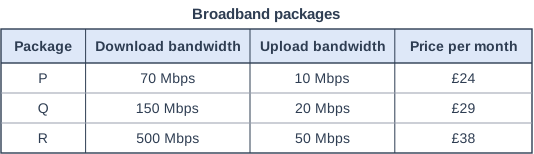
Ellie makes videos for her online channel. Each week she uploads one 3 GB video. She wants each upload to take no more than 30 minutes. The table shows three broadband packages.

Calculate the upload time for each package, and identify the cheapest package that meets Ellie's needs. Show your working.

(1 Mbps = 1,000,000 bits per second)

Broadband packages. Table with columns "Package", "Download bandwidth", "Upload bandwidth", "Price per month". Package: P; Download bandwidth: 70 Mbps; Upload bandwidth: 10 Mbps; Price per month: £24 | Package: Q; Download bandwidth: 150 Mbps; Upload bandwidth: 20 Mbps; Price per month: £29 | Package: R; Download bandwidth: 500 Mbps; Upload bandwidth: 50 Mbps; Price per month: £38.

Model answer

3 GB = 3,000 MB = 3,000 × 8 = 24,000 megabits
P: 24,000 ÷ 10 = 2,400 seconds = 40 minutes
Q: 24,000 ÷ 20 = 1,200 seconds = 20 minutes
R: 24,000 ÷ 50 = 480 seconds = 8 minutes
P takes longer than 30 minutes, so it does not meet Ellie's needs. Q and R both do, and Q is cheaper (£29 a month), so Ellie should choose package Q.

Explanation

Ellie is uploading, so the upload bandwidth is the one that matters - many home broadband packages have a much lower upload bandwidth than download bandwidth. Using the download figures would make package P look fast enough (about 5.7 minutes), which is the trap in this question. Once each time is known, rule out P (40 minutes) and choose the cheaper of the packages that remain.

Mark scheme
  1. 1 mark

    Converts the video size to bits: 3 GB = 3,000 MB = 24,000 megabits // 24,000,000,000 bits

    Accept 25,769,803,776 bits (1,024 used all the way to bytes) or 24,576 megabits (1 GB = 1,024 MB).

  2. 1 mark

    Uses the upload bandwidth for P: 24,000 ÷ 10 = 2,400 seconds = 40 minutes

    Accept 2,577 seconds / 43 minutes (1,024 to bytes) or 2,457.6 seconds / 41 minutes (1 GB = 1,024 MB). Follow through from their size in bits.

  3. 1 mark

    Q: 24,000 ÷ 20 = 1,200 seconds = 20 minutes AND R: 24,000 ÷ 50 = 480 seconds = 8 minutes

    Both needed. Accept 1,288 s / 21.5 min and 515 s / 8.6 min (1,024 to bytes), or 1,228.8 s / 20.5 min and 491.5 s / 8.2 min (1 GB = 1,024 MB). Follow through from their size in bits. Times calculated with the download bandwidths (e.g. 5.7 minutes for P) score 0 for this mark and the previous one.

  4. 1 mark

    Package Q, because it is the cheapest package with an upload time under 30 minutes (P takes 40 minutes, which is too long)

    Follow through from their own upload times, but not from times based on download bandwidth. Correct times with no working score full marks.

Ready to try the rest? Every answer you write is marked against the mark scheme, so you can see exactly where the marks are.

Study Helper Hints first, answers after you try

Stuck on this one? Ask for a hint and I’ll point you in the right direction, without giving the answer away. Once you’ve checked your answer, I’ll show you how the marks are awarded.