
Level:
Correct: 0
Incorrect: 0
Marks: 0/0
Exam Practice
Course:
Topics:
OCR GCSE Biology (Paper 2) Smart practice A mixed round aimed at your weak spots
Avg
score:
–
Topics
done:
0/28

Single gene inheritance and genetic crosses

Practise 22 exam-style questions on Single gene inheritance and genetic crosses for OCR GCSE Biology (Paper 2). Write your answer as you would in the exam and get it marked in seconds against the mark scheme, point by point, with the Study Helper on hand if you get stuck.

  • 22 questions
  • 1–6 marks each
  • Instant marking
  • No sign-up needed
20 questions, marked as you go

Sample questions with model answers

Here are 4 of the questions in this topic, each with a model answer, an explanation of why it earns the marks and the mark scheme an examiner would use.

Question 1

1 mark

In pepper plants, the allele for red fruit (R) is dominant to the allele for yellow fruit (r).

A grower crosses two pepper plants that are both heterozygous (Rr). She grows 200 plants from the seeds.

How many of the 200 plants are expected to have yellow fruit?

Choose your answer.

  • A 150
  • B 100
  • C 67
  • D 50

Model answer

D

Explanation

A cross between two heterozygous plants gives a 3 : 1 ratio of the dominant to the recessive phenotype, so 1 in 4 plants are expected to be rr with yellow fruit: 200 ÷ 4 = 50. A common slip is to divide by 3, because the ratio contains a 3, but a 3 : 1 ratio means 1 out of every 4 plants. 150 is the number expected to have red fruit.

Mark scheme
  1. 1 mark

    D / 50

    The only correct answer is D: Rr × Rr gives the offspring RR, Rr, Rr and rr, so 1 in 4 (25%) are expected to be rr with yellow fruit, and 200 ÷ 4 = 50. A is not correct because 150 is the number expected to have red fruit (3 in 4); B is not correct because 100 would be half of the plants, as expected from Rr × rr; C is not correct because 67 comes from 200 ÷ 3, which wrongly treats the 3 : 1 ratio as 1 in 3. ALLOW the letter or the option. If more than one option is given, do not award the mark.
Question 2

2 marks

Some goats have wattles: small flaps of skin that hang from the neck. The allele for wattles (W) is dominant to the allele for no wattles (w).

A farmer has a goat with wattles. The farmer says: 'My goat has wattles, so its genotype must be WW.'

Explain why the farmer could be wrong.

Model answer

The goat could be heterozygous (Ww). W is dominant, so one copy of W gives wattles: WW goats and Ww goats both have wattles, so the farmer cannot tell the genotype just by looking at the goat.

Explanation

A dominant characteristic shows whether the organism has one or two dominant alleles, so a goat with wattles could be WW or Ww. Only the recessive phenotype tells you the genotype for certain: a goat with no wattles must be ww. The farmer could find out by breeding the goat with a goat that has no wattles: any kid without wattles would show that the goat carries w.

Mark scheme
  1. 1 mark

    the goat could be heterozygous / Ww

    ALLOW the goat could have one W allele and one w allele. DO NOT ALLOW the goat could be ww.

  2. 1 mark

    W is dominant, so one copy of W is enough to give wattles (so WW and Ww goats both have wattles)

    ALLOW the allele for no wattles is recessive, so it does not show when W is present. ALLOW you cannot tell the genotype from the phenotype because WW and Ww goats look the same. IGNORE the goat could be WW.

Question 3

2 marks

In gerbils, the allele for golden-brown fur (A) is dominant to the allele for black fur (a).

Two gerbils that are both heterozygous (Aa) have three young. All three young have golden-brown fur.

The owner says: 'A cross between two Aa gerbils gives 1 in 4 young with black fur. None of the first three young is black, so the next young gerbil these parents have must have black fur.'

Explain why the owner is wrong.

Model answer

Each young gerbil has the same 1 in 4 (25%) chance of being aa with black fur, whatever colour the earlier young were, because which sperm cell fertilises which egg cell is down to chance each time. So the next young gerbil is still more likely to have golden-brown fur (a 3 in 4, or 75%, chance) than black fur.

Explanation

The Punnett square for Aa × Aa gives AA, Aa, Aa and aa, so each fertilisation has a 1 in 4 chance of giving black fur and a 3 in 4 chance of giving golden-brown fur. The earlier young do not change the alleles in the next egg cell and sperm cell, so the chance is the same every time. A probability of 1 in 4 does not mean that exactly one young in every four will be black.

Mark scheme
  1. 1 mark

    each young gerbil has the same chance (1 in 4 / 25%) of being aa / having black fur, whatever the fur colour of the earlier young

    ALLOW the earlier young do not change the chance for the next young. ALLOW the 1 in 4 is a probability for each young, not a rule that exactly one in every four young will be black. ALLOW fertilisation is random / due to chance each time, so the earlier young do not affect the next one. DO NOT ALLOW the next young cannot be black.

  2. 1 mark

    the next young is more likely to have golden-brown fur than black fur (a 3 in 4 / 75% chance)

    ALLOW 3/4 / 0.75 / 3 : 1 for golden-brown. ALLOW the next young could be AA or Aa and have golden-brown fur. DO NOT ALLOW the next young will definitely have golden-brown fur.

Question 4

3 marks

Mendel crossed pea plants that bred true for round seeds with pea plants that bred true for wrinkled seeds. All of the offspring had round seeds. He grew 253 of these offspring plants and let each one pollinate itself.

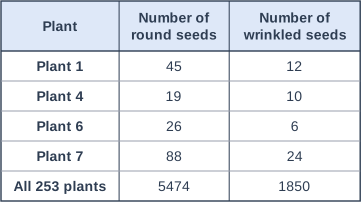
The table shows the numbers of round and wrinkled seeds made by four of the 253 plants, and by all 253 plants together.

Mendel concluded that the seeds are produced in a ratio of 3 round : 1 wrinkled.

Explain why Mendel needed the results from many plants to reach this conclusion. Use data from the table.

Table with columns "Plant", "Number of round seeds", "Number of wrinkled seeds". Plant: Plant 1; Number of round seeds: 45; Number of wrinkled seeds: 12 | Plant: Plant 4; Number of round seeds: 19; Number of wrinkled seeds: 10 | Plant: Plant 6; Number of round seeds: 26; Number of wrinkled seeds: 6 | Plant: Plant 7; Number of round seeds: 88; Number of wrinkled seeds: 24 | Plant: All 253 plants; Number of round seeds: 5474; Number of wrinkled seeds: 1850.

Model answer

The ratios for single plants are very different from each other: plant 4 made 19 round to 10 wrinkled (about 1.9 : 1) but plant 6 made 26 round to 6 wrinkled (about 4.3 : 1). This happens because which pollen and egg cells join at fertilisation is a matter of chance, so a few seeds can give a ratio far from 3 : 1. When all 253 plants are added together, 5474 : 1850 is about 2.96 : 1, very close to 3 : 1. Large numbers reduce the effect of chance, so the real pattern can be seen.

Explanation

Work out the ratio for each plant by dividing the number of round seeds by the number of wrinkled seeds. Individual plants give scattered ratios because fertilisation is random, just as tossing a coin ten times often does not give exactly five heads. Mendel's use of very large numbers, and of mathematics to find ratios, was unusual in biology at the time, and it let him see a pattern that small samples hide.

Mark scheme
  1. 1 mark

    the ratio for a single plant can be very different from 3 : 1 / varies a lot between plants, for example plant 4 is about 1.9 : 1 and plant 6 is about 4.3 : 1

    Max 2 if no data from the table are used. ALLOW any correct ratio for one plant that is not close to 3 : 1 (plant 1 = 3.75 : 1, plant 4 = 1.9 : 1, plant 6 = 4.3 : 1, plant 7 = 3.7 : 1). ALLOW a correct comparison without a ratio, for example plant 4 made more than half as many wrinkled seeds as round seeds.

  2. 1 mark

    (this is because) which gametes join at fertilisation is random / due to chance, so a small number of seeds can give a ratio far from 3 : 1

    ALLOW the results for one plant are affected by chance. ALLOW a small sample / few seeds per plant gives unreliable ratios. IGNORE errors in counting.

  3. 1 mark

    the total for all 253 plants (5474 : 1850 / 7324 seeds) is about 2.96 : 1 / very close to 3 : 1, so using large numbers reduces the effect of chance / shows the real pattern

    ALLOW 3.0 : 1 / almost exactly 3 : 1 / 74.7% round. ALLOW large numbers make the conclusion more valid / more reliable / the differences between plants cancel out.

Ready to try the rest? Every answer you write is marked against the mark scheme, so you can see exactly where the marks are.

Study Helper Hints first, answers after you try

Stuck on this one? Ask for a hint and I’ll point you in the right direction, without giving the answer away. Once you’ve checked your answer, I’ll show you how the marks are awarded.