
Level:
Correct: 0
Incorrect: 0
Marks: 0/0
Exam Practice
Course:
Topics:
OCR GCSE Biology (Paper 2) Smart practice A mixed round aimed at your weak spots
Avg
score:
–
Topics
done:
0/28

Genetic engineering and gene technology in agriculture

Practise 13 exam-style questions on Genetic engineering and gene technology in agriculture for OCR GCSE Biology (Paper 2). Write your answer as you would in the exam and get it marked in seconds against the mark scheme, point by point, with the Study Helper on hand if you get stuck.

  • 13 questions
  • 1–6 marks each
  • Instant marking
  • No sign-up needed
13 questions, marked as you go

Sample questions with model answers

Here are 4 of the questions in this topic, each with a model answer, an explanation of why it earns the marks and the mark scheme an examiner would use.

Question 1

1 mark

Wild sea beet grows on UK coasts. It is closely related to sugar beet, and the two plants can cross-pollinate.

A genetically modified (GM) variety of sugar beet carries a gene that stops it being harmed by a weedkiller (herbicide). Some people are worried that pollen from this GM sugar beet could fertilise wild sea beet plants.

What is the most likely result if this happened?

Choose your answer.

  • A All the wild sea beet plants would die out.
  • B Some wild sea beet plants would be resistant to the herbicide.
  • C The GM sugar beet would lose its own resistance to the herbicide.
  • D The herbicide would start to kill the GM sugar beet.

Model answer

B

Explanation

A gene added by genetic engineering is passed on in pollen like any other gene. If GM pollen fertilises a closely related wild plant, the offspring can inherit the gene, so herbicide-resistant wild plants could spread and become hard to control. This spread of genes to wild relatives is one of the main environmental risks of growing GM crops.

Mark scheme
  1. 1 mark

    B / some wild sea beet plants would be resistant to the herbicide

    The only correct answer is B: the pollen carries the gene for herbicide resistance, so seeds formed on the wild plants could inherit it and grow into plants that are not killed by the herbicide (weeds that are hard to control). A is not correct because the gene does not harm the wild plants, so they would not die out; C is not correct because the GM sugar beet keeps its own genes when its pollen fertilises other plants; D is not correct because the GM sugar beet still has the gene, so the herbicide still does not harm it. ALLOW the letter or the option. If more than one option is given, do not award the mark.
Question 2

1 mark

A shopper says: 'I only buy tomatoes that are not genetically modified, because I do not want to eat genes.'

Explain why the shopper's reason is not correct.

Model answer

All tomatoes contain genes, because every tomato cell contains DNA. A non-GM tomato contains genes too, so the shopper eats genes whichever tomatoes she buys.

Explanation

Every living cell contains DNA, and genes are sections of that DNA, so all fruit, vegetables and meat contain genes. A GM tomato differs from a non-GM tomato only because its genome has been modified, for example by adding a gene. People may have other reasons for avoiding GM food, but 'not eating genes' is not one that makes sense.

Mark scheme
  1. 1 mark

    all tomatoes (GM or not) contain genes / DNA in their cells, so the shopper eats genes whichever tomatoes she buys

    ALLOW all living things / all foods from plants or animals contain genes or DNA. ALLOW non-GM tomatoes also contain genes. IGNORE GM tomatoes are safe to eat. DO NOT ALLOW only GM foods contain genes.

Question 3

2 marks

A seed company says that its new genetically modified (GM) soya variety gives 15 % more beans than other soya varieties.

Suggest two things scientists would want to check before they accept the company's claim.

Model answer

They would check that the GM soya and the other varieties were grown in the same conditions, such as the same soil and the same amount of fertiliser. They would also want the trial repeated by independent scientists who do not work for the company, to see if they get similar results.

Explanation

A claim is only trustworthy if the test was fair, repeated and large enough, and if it has been checked by other scientists. The company makes money from the seed, so independent testing and peer review help to rule out bias. These checks apply to any claim about a new crop, GM or not.

Mark scheme
  1. 1 mark

    the trial has been repeated (in different places or years) and gives similar results

    1 mark for each of points 1 to 5, max 2. If more than two answers are given, a wrong one cancels a right one. ALLOW the results are repeatable / reproducible.

  2. 1 mark

    the GM and non-GM soya were grown in the same conditions (a fair test)

    ALLOW a named condition kept the same, such as soil, fertiliser, water, weather or field.

  3. 1 mark

    a large number of plants or fields was used

    ALLOW the sample was large enough.

  4. 1 mark

    the results have been checked by other scientists who do not work for the company (independent / peer reviewed)

    ALLOW the company could be biased, so the trial should be done by independent scientists. ALLOW the results have been published and peer reviewed.

  5. 1 mark

    the increase is bigger than the normal variation in yield between fields or years

    ALLOW the difference is not just due to chance.

Question 4

4 marks

Late blight is a disease of potato plants caused by a pathogen. Farmers usually spray potato crops with a fungicide many times each summer to control late blight.

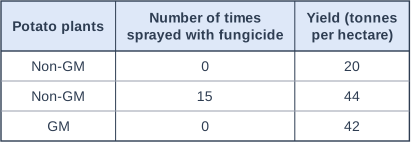
Scientists added a gene from a wild potato plant to the genome of a potato variety. They grew GM and non-GM plants of this variety in a field trial where late blight was present. The table shows the results.

Calculate the percentage increase in yield of the GM potatoes compared with the non-GM potatoes when neither type was sprayed.

Suggest two benefits of growing the GM potatoes instead of spraying non-GM potatoes with fungicide.

Table with columns "Potato plants", "Number of times sprayed with fungicide", "Yield (tonnes per hectare)". Potato plants: Non-GM; Number of times sprayed with fungicide: 0; Yield (tonnes per hectare): 20 | Potato plants: Non-GM; Number of times sprayed with fungicide: 15; Yield (tonnes per hectare): 44 | Potato plants: GM; Number of times sprayed with fungicide: 0; Yield (tonnes per hectare): 42.

Model answer

Increase = 42 − 20 = 22 tonnes per hectare
Percentage increase = 22 ÷ 20 × 100 = 110 %
Benefits: the GM potatoes gave almost the same yield (42 tonnes per hectare) as non-GM potatoes sprayed 15 times (44 tonnes per hectare), so the farmer saves the cost of the fungicide and of spraying. Less fungicide gets into the environment, so there is less harm to other organisms.

Explanation

Percentage increase = increase ÷ original value × 100, and the original value here is the unsprayed non-GM yield of 20 tonnes per hectare: 22 ÷ 20 × 100 = 110 %. Dividing by 42 (52 %) or writing 42 ÷ 20 × 100 (210 %) are the usual slips. The table shows that the added gene protected the crop almost as well as 15 fungicide sprays, which is a benefit for the farmer's costs and for the environment.

Mark scheme
  1. 1 mark

    (42 − 20) ÷ 20 × 100 / 22 ÷ 20 × 100; or a correct final answer of 110 % with no working

    An answer of 110 % with no working scores marking points 1 and 2 only. ALLOW 22 (tonnes per hectare) seen as the increase for this mark. An answer of 52 % (22 ÷ 42 × 100, dividing by the GM yield) scores point 1 only. An answer of 210 % (42 ÷ 20 × 100) scores 0 for the calculation.

  2. 1 mark

    evaluation: 110 (%)

    IGNORE units.

  3. 1 mark

    almost the same yield as sprayed non-GM potatoes without using any fungicide

    1 mark for each of points 3 to 7, max 2. If more than two answers are given, a wrong one cancels a right one. ALLOW use of data: 42 compared with 44 tonnes per hectare, with no sprays instead of 15.

  4. 1 mark

    saves the cost of buying the fungicide and spraying it

    ALLOW saves money.

  5. 1 mark

    saves the farmer time, labour or fuel used for spraying

    This must be a different benefit from point 4: DO NOT give point 5 for a second statement about money.

  6. 1 mark

    less fungicide gets into the environment, so less harm to other organisms

    ALLOW less pollution of soil or rivers by fungicide. ALLOW less harm to useful organisms such as soil organisms or animals in rivers.

  7. 1 mark

    less risk to farm workers from handling or breathing in fungicide

    ALLOW less fungicide left on the potatoes that people eat.

Ready to try the rest? Every answer you write is marked against the mark scheme, so you can see exactly where the marks are.

Study Helper Hints first, answers after you try

Stuck on this one? Ask for a hint and I’ll point you in the right direction, without giving the answer away. Once you’ve checked your answer, I’ll show you how the marks are awarded.