
Level:
Correct: 0
Incorrect: 0
Marks: 0/0
Exam Practice
Course:
Topics:
OCR GCSE Biology (Paper 2) Smart practice A mixed round aimed at your weak spots
Avg
score:
–
Topics
done:
0/28

Genetic terms and the genome

Practise 15 exam-style questions on Genetic terms and the genome for OCR GCSE Biology (Paper 2). Write your answer as you would in the exam and get it marked in seconds against the mark scheme, point by point, with the Study Helper on hand if you get stuck.

  • 15 questions
  • 1–6 marks each
  • Instant marking
  • No sign-up needed
15 questions, marked as you go

Sample questions with model answers

Here are 4 of the questions in this topic, each with a model answer, an explanation of why it earns the marks and the mark scheme an examiner would use.

Question 1

1 mark

In sweetcorn plants, the allele for purple kernels (P) is dominant to the allele for yellow kernels (p).

A sweetcorn plant has the genotype Pp, so its kernels are purple.

What happens to the p allele in the cells of this plant?

Choose your answer.

  • A It changes into a P allele as the plant grows.
  • B It is destroyed by the P allele in every cell.
  • C It is removed from the cells before they divide.
  • D It is still present and can be passed on in gametes.

Model answer

D - It is still present and can be passed on in gametes.

Explanation

Dominant and recessive describe which allele shows in the phenotype, not what happens to the alleles. A Pp plant has purple kernels because P is dominant, but the p allele is still in every cell and can be passed on, so a purple plant can have offspring with yellow kernels. A common misconception is that the dominant allele 'beats' or removes the recessive allele.

Mark scheme
  1. 1 mark

    D / it is still present and can be passed on in gametes

    The only correct answer is D: a heterozygous plant keeps both alleles in its cells; the recessive allele p does not show in the phenotype because P is dominant, but it is still there and half of the gametes the plant makes carry p. A is not correct because a dominant allele does not change a recessive allele into a copy of itself; B is not correct because the dominant allele does not destroy the recessive allele, it only shows in the phenotype; C is not correct because both alleles stay in the cells and are copied when the cells divide. ALLOW the letter or the option. If more than one option is given, do not award the mark.
Question 2

1 mark

In a species of beetle, the allele for green wing cases (G) is dominant to the allele for brown wing cases (g).

A beetle has brown wing cases.

Give the genotype of this beetle.

Model answer

gg

Explanation

Brown is the recessive phenotype. A recessive allele shows in the phenotype only when there is no dominant allele, so a brown beetle must have two copies of g: its genotype is gg (homozygous recessive). Gg would give green wing cases, because G is dominant.

Mark scheme
  1. 1 mark

    gg

    The answer must use the letters given in the question. DO NOT ALLOW GG / Gg / g on its own. DO NOT ALLOW other letters (for example bb). IGNORE homozygous recessive written as well as gg, but homozygous recessive on its own does not score because the question asks for the genotype in letters.

Question 3

2 marks

Four sentences about genetic terms each have a gap.

Choose a word from the list for each gap, 1 to 4, and write it down.

alleles   chromosomes   gametes   gene   genome   genotype   phenotype   zygotes

Egg cells and sperm cells are sex cells called (1) .......... .

In the nucleus, DNA is found in long structures called (2) .......... .

A short section of DNA that codes for a protein is a (3) .......... .

The characteristics that an organism shows, such as the colour of its eyes, are its (4) .......... .

Model answer

(1) gametes (2) chromosomes (3) gene (4) phenotype

Explanation

Gametes are the sex cells (egg and sperm). Chromosomes are long DNA molecules in the nucleus, and a gene is a short section of a chromosome's DNA that codes for a protein. The phenotype is the characteristics shown, while the genotype is the alleles; zygotes are fertilised egg cells, not gametes.

Mark scheme
  1. 2 marks

    (1) gametes (2) chromosomes (3) gene (4) phenotype

    All four correct = 2 marks. Two or three correct = 1 mark. One or none correct = 0 marks. ALLOW the singular or plural of a word (for example gamete for gametes). If two words are written for one gap, that gap is not credited.

Question 4

4 marks

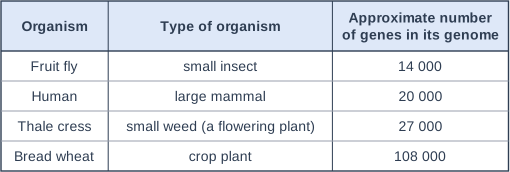
The table shows the approximate number of genes that code for proteins in the genomes of four organisms. The numbers are rounded figures from genome databases (2025).

Calculate how many more genes there are in the genome of bread wheat than in the genome of thale cress.

Give the organism in the table that has the fewest genes in its genome.

Thale cress is a small weed. Humans are large animals with many different types of specialised cell. What do the data suggest about the link between the number of genes in a genome and how complex an organism is? Use data from the table.

Table with columns "Organism", "Type of organism", "Approximate number of genes in its genome". Organism: Fruit fly; Type of organism: small insect; Approximate number of genes in its genome: 14 000 | Organism: Human; Type of organism: large mammal; Approximate number of genes in its genome: 20 000 | Organism: Thale cress; Type of organism: small weed (a flowering plant); Approximate number of genes in its genome: 27 000 | Organism: Bread wheat; Type of organism: crop plant; Approximate number of genes in its genome: 108 000.

Model answer

108 000 − 27 000 = 81 000 more genes.
The fruit fly has the fewest genes.
The data suggest that there is no clear link between the number of genes and how complex an organism is. Thale cress, a small weed, has about 27 000 genes and bread wheat has about 108 000, but humans, which are large and have many types of specialised cell, have only about 20 000.

Explanation

Subtract to find how many more: 108 000 − 27 000 = 81 000 (dividing gives 4, which is how many times as many). The genome is all of the genetic material of an organism, and the number of genes in it varies a lot between species. Two plants in the table have more genes than humans, so the number of genes does not show how complex an organism is.

Mark scheme
  1. 1 mark

    81 000 (108 000 − 27 000)

    An answer of 81 000 with no working scores marking point 1 only. DO NOT ALLOW 4 (108 000 ÷ 27 000), which is how many times as many, not how many more.

  2. 1 mark

    fruit fly

    DO NOT ALLOW human (humans have more genes than the fruit fly).

  3. 1 mark

    use of data: a plant (thale cress or bread wheat) has more genes than humans

    A comparison using data from the table is needed: thale cress about 27 000 or bread wheat about 108 000, compared with about 20 000 for humans. ALLOW thale cress, a small weed, has more genes than humans, with or without the numbers.

  4. 1 mark

    (so) the number of genes in a genome does not show how complex an organism is / there is no clear link between the number of genes and how complex an organism is

    ALLOW a simple organism can have more genes than a complex one. ALLOW the fruit fly fits a link, but the plants do not, so there is no clear link. DO NOT ALLOW more complex organisms have more genes.

Ready to try the rest? Every answer you write is marked against the mark scheme, so you can see exactly where the marks are.

Study Helper Hints first, answers after you try

Stuck on this one? Ask for a hint and I’ll point you in the right direction, without giving the answer away. Once you’ve checked your answer, I’ll show you how the marks are awarded.