
Level:
Correct: 0
Incorrect: 0
Marks: 0/0
Exam Practice
Course:
Topics:
OCR GCSE Biology (Paper 2) Smart practice A mixed round aimed at your weak spots
Avg
score:
–
Topics
done:
0/28

Evolution by natural selection and its evidence

Practise 22 exam-style questions on Evolution by natural selection and its evidence for OCR GCSE Biology (Paper 2). Write your answer as you would in the exam and get it marked in seconds against the mark scheme, point by point, with the Study Helper on hand if you get stuck.

  • 22 questions
  • 1–6 marks each
  • Instant marking
  • No sign-up needed
20 questions, marked as you go

Sample questions with model answers

Here are 4 of the questions in this topic, each with a model answer, an explanation of why it earns the marks and the mark scheme an examiner would use.

Question 1

1 mark

Some head lice have an allele that makes them resistant to an insecticide used in head lice lotions.

How did this allele first arise?

Choose your answer.

  • A A mutation happened by chance in a louse's DNA.
  • B The insecticide changed the DNA of the lice to protect them.
  • C The lice changed their own DNA because they needed to survive.
  • D The lice learned to avoid the insecticide in the lotion.

Model answer

A

Explanation

New alleles arise by mutation, which happens by chance. The insecticide does not cause the mutation: it kills the lice without the resistance allele, so the resistant lice survive and breed. Saying that organisms change their DNA because they need to is a wrong idea about how evolution works.

Mark scheme
  1. 1 mark

    A / a mutation happened by chance in a louse's DNA

    The only correct answer is A: all new alleles (variants) arise by mutation, a random change in DNA that happens whether or not the insecticide is present. B is not correct because the insecticide does not cause the mutations that make lice resistant; it only kills the lice that are not resistant; C is not correct because organisms cannot change their DNA because they need to; D is not correct because learned behaviour is not an allele and is not inherited. ALLOW the letter or the option. If more than one option is given, do not award the mark.
Question 2

2 marks

Ash dieback is a disease of ash trees caused by a fungus. It was first found in woods in the UK in 2012, and it has killed many ash trees.

A few ash trees are tolerant of the disease: they are damaged less and survive. Tolerance is partly inherited.

Scientists at Forest Research, the UK's forestry research agency, expect tolerance to ash dieback to evolve in UK ash trees by natural selection, but over a long time.

Explain why tolerance is expected to evolve, and suggest why this will take a long time.

Model answer

The trees that are tolerant are more likely to survive the disease and reproduce, so they pass on the alleles for tolerance to their seeds, and each generation has more tolerant trees. This will take a long time because ash trees grow for many years before they are old enough to produce seeds, so each generation takes a long time.

Explanation

Natural selection favours the tolerant trees because they survive and reproduce, so the alleles for tolerance become more common. Evolution needs many generations, and a tree takes many years to reach an age when it makes seeds, whereas bacteria can produce a new generation in less than an hour. That is why resistance in bacteria can be seen within a few years, but tolerance in ash trees will take decades or more.

Mark scheme
  1. 1 mark

    tolerant trees are more likely to survive (the disease) and reproduce, so they pass on the alleles for tolerance (and tolerant trees become more common in each generation)

    ALLOW gene(s) for allele(s). ALLOW trees without tolerance die, so fewer of their alleles are passed on. ORA (allow the reverse argument). IGNORE the trees become immune. DO NOT ALLOW the trees become tolerant because they need to.

  2. 1 mark

    ash trees take many years to grow old enough to reproduce / each generation of ash trees takes a long time

    ALLOW trees grow slowly / live for a long time, so there are few generations in a person's lifetime / natural selection needs many generations. IGNORE mutations are rare, unless linked to the time taken.

Question 3

2 marks

Fish live in water. Amphibians, reptiles, mammals and birds are vertebrates that mainly live on land.

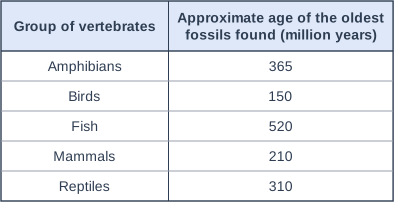
The table shows the approximate age of the oldest fossils found of each group.

Calculate how many million years passed between the oldest fish fossils and the oldest amphibian fossils.

Explain how the fossils support the idea that land vertebrates evolved from fish.

Table with columns "Group of vertebrates", "Approximate age of the oldest fossils found (million years)". Group of vertebrates: Amphibians; Approximate age of the oldest fossils found (million years): 365 | Group of vertebrates: Birds; Approximate age of the oldest fossils found (million years): 150 | Group of vertebrates: Fish; Approximate age of the oldest fossils found (million years): 520 | Group of vertebrates: Mammals; Approximate age of the oldest fossils found (million years): 210 | Group of vertebrates: Reptiles; Approximate age of the oldest fossils found (million years): 310.

Model answer

520 − 365 = 155 million years.

The oldest fish fossils, at 520 million years, are older than the oldest fossils of any land vertebrate group. So fish existed first and amphibians, reptiles, mammals and birds appeared later, which fits the idea that land vertebrates evolved from fish ancestors.

Explanation

Subtract the ages: 520 − 365 = 155 million years. Fossils can be put in order of age, and the order in which groups first appear in the fossil record matches the order in which scientists think they evolved. If land vertebrates had appeared before fish, the idea would not be supported.

Mark scheme
  1. 1 mark

    155 (million years)

    An answer of 155 million years with no working scores marking point 1 only. ALLOW 520 − 365. DO NOT ALLOW 885 (the two ages added).

  2. 1 mark

    the oldest fish fossils are older than the oldest fossils of every group of land vertebrates, so fish existed first and land vertebrates appeared later (from fish ancestors)

    ALLOW fish appear first in the fossil record and the land groups appear later / one after another. IGNORE fish are simpler than land animals unless linked to the ages of the fossils.

Question 4

3 marks

Kew's Millennium Seed Bank in West Sussex is a seedbank for wild plants from around the world. In March 2023, Kew reported that it held more than 2.4 billion seeds, from 40 020 species.

1 billion = 1 000 000 000

Use 2.4 billion seeds to calculate the mean number of seeds stored for each species. Give your answer to 1 significant figure.

Suggest one reason why seedbanks store seeds, rather than growing whole plants of each species.

Model answer

2 400 000 000 ÷ 40 020 = 59 970
Mean = 60 000 seeds for each species (to 1 significant figure)

Seeds are small, so huge numbers of seeds of thousands of species can be stored in a small space.

Explanation

Write 2.4 billion in full (2 400 000 000) before dividing by the number of species, then round to 1 significant figure. Seeds make a good store of biodiversity because they are small and, once dried and frozen, many stay alive for decades, while living plants would need land, light, water and care and could be lost to disease.

Mark scheme
  1. 1 mark

    method: 2 400 000 000 ÷ 40 020 (= 59 970); or a correct final answer of 60 000 with no working

    An answer of 60 000 with no working scores marking points 1 and 2 only. ALLOW 2.4 × 10⁹ ÷ 40 020. ALLOW 59 970 (or 59 970.0) for 1 mark (not rounded to 1 significant figure). ALLOW 60 for 1 mark (2.4 billion taken as 2.4 million). 40 020 ÷ 2 400 000 000 (the division the wrong way round) scores 0 for this point.

  2. 1 mark

    evaluation: 60 000 (seeds)

    ALLOW 6 × 10⁴. Rounding mark: ALLOW ECF for a wrong answer correctly rounded to 1 significant figure.

  3. 1 mark

    seeds are small, so very large numbers of seeds / seeds of many species can be stored in a small space

    1 mark for any one of points 3 to 6, max 1. If more than one answer is given, a wrong one cancels a right one. ALLOW seeds take up less room than plants.

  4. 1 mark

    (dried, cold) seeds stay alive for many years / decades without needing water, light or soil / without being looked after

    ALLOW seeds can be stored for a long time / are dormant. IGNORE seeds last longer unless the idea of staying alive or being stored for a long time is clear.

  5. 1 mark

    growing whole plants of every species would need a lot of land / space / greenhouses / care

    ALLOW it would cost much more to grow and look after the plants.

  6. 1 mark

    living plants could die from disease / pests / old age / bad weather, so the collection could be lost

    ALLOW many plants would have to be grown again from seed every year or so.

Ready to try the rest? Every answer you write is marked against the mark scheme, so you can see exactly where the marks are.

Study Helper Hints first, answers after you try

Stuck on this one? Ask for a hint and I’ll point you in the right direction, without giving the answer away. Once you’ve checked your answer, I’ll show you how the marks are awarded.