Level:
Correct: 0
Incorrect: 0
Marks: 0/0
Exam Practice
Course:
Topics:
OCR GCSE Biology (Paper 2) Smart practice A mixed round aimed at your weak spots
Avg
score:
–
Topics
done:
0/28

Physical and chemical plant defences

Practise 10 exam-style questions on Physical and chemical plant defences for OCR GCSE Biology (Paper 2). Write your answer as you would in the exam and get it marked in seconds against the mark scheme, point by point, with the Study Helper on hand if you get stuck.

  • 10 questions
  • 1–4 marks each
  • Instant marking
  • No sign-up needed
10 questions, marked as you go

Sample questions with model answers

Here are 4 of the questions in this topic, each with a model answer, an explanation of why it earns the marks and the mark scheme an examiner would use.

Question 1

1 mark

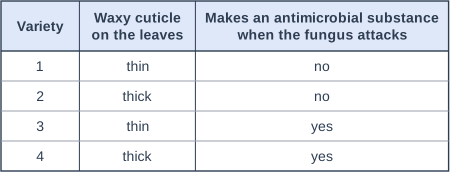
A plant breeder compared four varieties of barley. The table shows information about their defences against the fungus that causes powdery mildew.

Which variety is least likely to be infected by the fungus?

Choose your answer.

  • A variety 1
  • B variety 2
  • C variety 3
  • D variety 4
Table with columns "Variety", "Waxy cuticle on the leaves", "Makes an antimicrobial substance when the fungus attacks". Variety: 1; Waxy cuticle on the leaves: thin; Makes an antimicrobial substance when the fungus attacks: no | Variety: 2; Waxy cuticle on the leaves: thick; Makes an antimicrobial substance when the fungus attacks: no | Variety: 3; Waxy cuticle on the leaves: thin; Makes an antimicrobial substance when the fungus attacks: yes | Variety: 4; Waxy cuticle on the leaves: thick; Makes an antimicrobial substance when the fungus attacks: yes.

Model answer

D

Explanation

A thick waxy cuticle is a physical defence: it makes it harder for the fungus to get into the leaf. An antimicrobial substance is a chemical defence: it kills the fungus or stops it growing if it does get in. Variety 4 is the only variety with both defences, so it is the least likely to be infected.

Mark scheme
  1. 1 mark

    D / variety 4

    The only correct answer is D: variety 4 has a thick waxy cuticle (a physical barrier that the fungus must get through) and it also makes an antimicrobial substance (a chemical defence) that can kill the fungus if it gets in. A is not correct because variety 1 has a thin cuticle and makes no antimicrobial substance, so it has the weakest defences. B is not correct because variety 2 has a thick cuticle but no chemical defence if the fungus gets through. C is not correct because variety 3 makes an antimicrobial substance but has only a thin cuticle, so the fungus gets in more easily. ALLOW the letter or the option. If more than one option is given, do not award the mark.
Question 2

1 mark

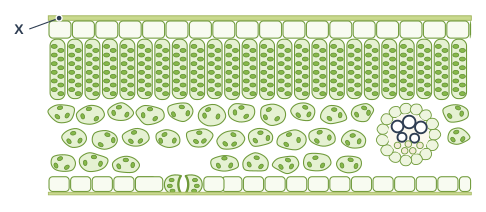
The diagram shows a section through part of a leaf.

The layer labelled X covers the upper surface of the leaf. It is one of the leaf's physical defences against pathogens.

Name the layer labelled X.

Diagram of a cross-section through a leaf (upper surface at the top). Layers of cells. From the top: a thin outer layer covering the surface; a single row of flat clear cells; a layer of tall closely packed cells full of green discs; a layer of rounded cells with fewer green discs and spaces between them; another row of flat clear cells; and another thin outer layer. In the layer of rounded cells, on the right, is a round bundle with large hollow cells in its upper part and smaller cells in its lower part. In the bottom row a small pore lies between two bean-shaped cells, which contain green discs, with a space above it. Label X points to the thin outer layer covering the top surface.

Model answer

The waxy cuticle.

Explanation

X is the waxy cuticle, a layer of wax on the outside of the upper epidermis. It is a physical barrier that most pathogens cannot get through, and it is also waterproof. The cells of the upper epidermis lie just underneath it, so do not confuse the cuticle with the epidermis.

Mark scheme
  1. 1 mark

    (waxy) cuticle

    ALLOW wax layer / waxy layer. DO NOT ALLOW epidermis / upper epidermis / cell wall / cell membrane / bark.

Question 3

2 marks

A gardener says: 'My rose bushes have a thick waxy cuticle on their leaves and strong cell walls, so they do not need chemical defences against pathogens.'

Explain why the gardener is wrong.

Model answer

Pathogens can still get into the leaves without going through the cuticle, for example through the open stomata or through a wound made by an insect or by pruning. Once they are inside, only chemical defences such as antimicrobial substances can kill them or stop them growing, so the roses still need chemical defences.

Explanation

Physical barriers such as the waxy cuticle and cell walls keep most pathogens out, but they have gaps: stomata are openings, and any damage breaks the barriers. Antimicrobial substances are chemical defences that work after a pathogen has got in. Plants need both kinds of defence, just as the human body has barriers and an immune system.

Mark scheme
  1. 1 mark

    pathogens can still get past the physical barriers / into the plant, for example through the stomata or through wounds / damage (made by insects, cutting or weather)

    ALLOW pathogens can get in through cuts / broken leaves / holes made by insects / open stomata. ALLOW the cuticle and cell walls do not stop every pathogen. IGNORE pathogens get in through the roots, unless damage to the roots is described.

  2. 1 mark

    chemical defences / antimicrobial substances kill pathogens / stop pathogens growing once they are inside the plant / after they have got past the physical barriers

    ALLOW chemical defences are a second line of defence that works inside the plant. DO NOT ALLOW antibodies / white blood cells kill the pathogens.

Question 4

3 marks

Holly is a shrub with tough leaves. Each holly leaf usually stays on the plant for more than one year. Holly leaves have a very thick waxy cuticle.

In 2021, scientists in Spain reported that the cuticle on the upper surface of young holly leaves is about 30 μm thick.

A textbook shows a photograph of a section through a young holly leaf, taken with a light microscope. The magnification of the photograph is × 250.

Use the equation: image size = real size × magnification

1 mm = 1000 μm

Calculate the thickness of the cuticle in the photograph, in mm.

Suggest one reason why a thick cuticle is useful to holly leaves, which stay on the plant for more than one year.

Model answer

thickness in the photograph = 30 × 250 = 7500 μm
7500 ÷ 1000 = 7.5 mm
The leaves stay on the plant for more than a year, so they are exposed to fungal spores and other pathogens for a long time. A thick cuticle is a strong barrier that is hard for pathogens to get through, so it protects the leaves for all that time.

Explanation

Multiply the real size by the magnification: 30 × 250 = 7500 μm, then divide by 1000 to change micrometres to millimetres: 7.5 mm. Do not divide by the magnification: the image in a photograph taken through a microscope is bigger than the real object, so the answer must be more than 30 μm (0.03 mm). A thick cuticle is a physical defence that helps a long-lived leaf resist pathogens, and it also reduces water loss.

Mark scheme
  1. 1 mark

    30 × 250 = 7500 (μm) / 0.030 (mm) × 250; or a correct final answer of 7.5 mm with no working

    An answer of 7.5 mm with no working scores marking points 1 and 2 only. ALLOW 7500 μm (μm not converted to mm) for 1 mark. DO NOT ALLOW 0.12 (dividing by the magnification instead of multiplying).

  2. 1 mark

    7.5 (mm)

    IGNORE units unless they are wrong (DO NOT ALLOW 7.5 μm).

  3. 1 mark

    the leaves are exposed to pathogens / spores for a long time (in every season), so a thick cuticle is a stronger barrier / is harder for pathogens to get through, so it protects the leaves for longer

    1 mark for any one of points 3 and 4, max 1. If more than one answer is given, a wrong one cancels a right one. ALLOW a thick cuticle makes it less likely that a pathogen gets into the leaf during the time it is on the plant.

  4. 1 mark

    a thick cuticle reduces water loss (from the leaves) in winter or dry weather, when water is hard to take up

    ALLOW a thick cuticle reduces transpiration / evaporation of water from the leaves.

Ready to try the rest? Every answer you write is marked against the mark scheme, so you can see exactly where the marks are.

Study Helper Hints first, answers after you try

Stuck on this one? Ask for a hint and I’ll point you in the right direction, without giving the answer away. Once you’ve checked your answer, I’ll show you how the marks are awarded.