
Level:
Correct: 0
Incorrect: 0
Marks: 0/0
Exam Practice
Course:
Topics:
OCR GCSE Biology (Paper 2) Smart practice A mixed round aimed at your weak spots
Avg
score:
–
Topics
done:
0/28

Selective breeding

Practise 14 exam-style questions on Selective breeding for OCR GCSE Biology (Paper 2). Write your answer as you would in the exam and get it marked in seconds against the mark scheme, point by point, with the Study Helper on hand if you get stuck.

  • 14 questions
  • 1–6 marks each
  • Instant marking
  • No sign-up needed
14 questions, marked as you go

Sample questions with model answers

Here are 4 of the questions in this topic, each with a model answer, an explanation of why it earns the marks and the mark scheme an examiner would use.

Question 1

1 mark

A plant breeder has used selective breeding to produce onions with larger bulbs.

- The mean mass of the bulbs at the start was 150 g.
- After several generations, the mean mass of the bulbs was 210 g.

What is the percentage increase in the mean mass of the bulbs?

Choose your answer.

  • A 140 %
  • B 60 %
  • C 40 %
  • D 29 %

Model answer

C
Increase = 210 − 150 = 60 g
Percentage increase = 60 ÷ 150 × 100 = 40 %

Explanation

Percentage increase = increase ÷ starting value × 100. Here the increase is 60 g, and dividing by the starting mass of 150 g gives 40 %. Dividing by the final mass (giving 29 %) or quoting the new mass as a percentage of the old one (140 %) are the usual slips.

Mark scheme
  1. 1 mark

    C / 40 %

    The only correct answer is C: the increase is 210 − 150 = 60 g, and 60 ÷ 150 × 100 = 40 %. A is not correct because 140 % is the new mean mass as a percentage of the starting mass (210 ÷ 150 × 100), not the increase; B is not correct because 60 is the increase in grams, not a percentage; D is not correct because 29 % comes from dividing the increase by the new mass (60 ÷ 210 × 100) instead of by the starting mass. ALLOW the letter or the option. If more than one option is given, do not award the mark.
Question 2

2 marks

Most breeds of sheep must have their wool cut off (sheared) once a year. A farmer pays skilled workers to shear the sheep.

Some breeds of sheep kept for meat have been selectively bred so that their wool falls off naturally in spring.

Suggest two benefits of keeping sheep that lose their wool naturally.

Model answer

The farmer does not have to pay workers to shear the sheep, so this saves money. The sheep are not caught and handled for shearing, so they are less stressed and cannot be cut by the shears.

Explanation

Breeders chose sheep that lost their wool most completely in spring and bred from them over many generations. The impacts are mostly on cost and welfare: no shearing bill, less work and less handling of the animals. Answers about selling more wool do not score, because the wool from these sheep is no longer collected.

Mark scheme
  1. 1 mark

    the farmer does not have to pay for shearing / saves the cost of shearing

    1 mark for each of points 1 to 6, max 2. If more than two answers are given, a wrong one cancels a right one. ALLOW saves money (on shearing / on paying workers). IGNORE cheaper on its own.

  2. 1 mark

    saves the farmer time or work (gathering and handling the sheep for shearing)

    ALLOW less labour needed. This must be a different benefit from point 1: DO NOT give point 2 for a second statement about the cost of the shearers.

  3. 1 mark

    less stress for the sheep (from being caught and handled for shearing)

    ALLOW the sheep are not frightened by being caught / turned over.

  4. 1 mark

    no risk of the sheep being cut or injured during shearing

    ALLOW fewer injuries to the sheep.

  5. 1 mark

    less risk of flies laying eggs in dirty wool / less risk of maggots (flystrike)

    ALLOW less wool to get dirty, so less chance of infection by flies or maggots.

  6. 1 mark

    the sheep do not overheat in hot weather (if shearing is late)

    ALLOW the sheep stay cool in summer. IGNORE the sheep are more comfortable unqualified. DO NOT ALLOW the sheep produce more wool to sell.

Question 3

2 marks

Broccoli contains a substance called glucoraphanin, which some scientists think may be good for human health. Plant breeders in the UK wanted to produce broccoli with more glucoraphanin.

- All the broccoli plants that the breeders tested had low amounts of glucoraphanin.
- A wild broccoli plant from Sicily has much more glucoraphanin.
- The breeders crossed the wild plant with broccoli, then selectively bred from the offspring for many generations.
- In 2013, scientists reported that the new variety had about 2.5 to 3 times as much glucoraphanin as standard broccoli.

Explain why the breeders crossed broccoli with the wild plant, instead of only breeding broccoli plants together.

Model answer

All the broccoli plants had low amounts of glucoraphanin, so there was not enough variation: there were no high-glucoraphanin plants for the breeders to choose. The wild plant had the alleles for high glucoraphanin, so crossing it with broccoli let some offspring inherit these alleles, and the breeders could then select and breed these offspring.

Explanation

Selective breeding can only select from variation that already exists. When every plant of a crop has low levels of a substance, breeders can bring in the alleles they need by crossing the crop with a wild relative that has them, then selecting the best offspring. This is still selective breeding: no gene is moved in a laboratory, which is the difference from genetic engineering.

Mark scheme
  1. 1 mark

    there was no / little variation in glucoraphanin in the broccoli plants, so there were no high-glucoraphanin plants to choose and breed from

    ALLOW none of the broccoli plants had the alleles / genes for high glucoraphanin. ALLOW breeding broccoli plants together could not increase the glucoraphanin (much). IGNORE broccoli has low glucoraphanin unless linked to having nothing to select from.

  2. 1 mark

    the wild plant had the alleles / genes for high glucoraphanin, so some of the offspring could inherit them (and be selected)

    ALLOW the offspring could get the high-glucoraphanin characteristic from the wild parent. DO NOT ALLOW answers describing genetic engineering, such as taking the gene out of the wild plant and putting it into broccoli.

Question 4

4 marks

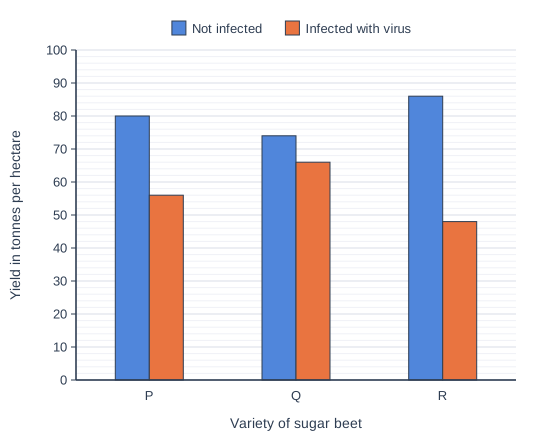
Virus yellows is a disease of sugar beet. It is caused by viruses that are spread by aphids (small insects). Infected plants have yellow leaves and give a lower yield.

A plant breeder grew three varieties of sugar beet, P, Q and R. Half of the plants of each variety were infected with the virus and half were not infected. All other conditions were kept the same.

The bar chart shows the breeder's results.

Calculate the percentage decrease in the yield of variety P caused by the virus.

The breeder wants to use one of these varieties as a parent to selectively breed new sugar beet for farms where virus yellows is common. Which variety should she choose? Use data from the bar chart to explain your answer.

Dual bar chart of yield in tonnes per hectare for each variety of sugar beet, comparing Not infected and Infected with virus (a key above the chart shows which bar is which). P: Not infected 80, Infected with virus 56; Q: Not infected 74, Infected with virus 66; R: Not infected 86, Infected with virus 48.

Model answer

Decrease in yield of P = 80 − 56 = 24 tonnes per hectare
Percentage decrease = 24 ÷ 80 × 100 = 30 %
She should choose variety Q. When infected, its yield fell by only 8 tonnes per hectare (from 74 to 66), about 11 %, compared with 30 % for P and 44 % for R. Q also had the highest yield of the three varieties when infected (66 tonnes per hectare).

Explanation

Percentage decrease = decrease ÷ original value × 100, so use the yield without the virus (80) as the original value: 24 ÷ 80 × 100 = 30 %. To breed beet for farms with the disease, the parent should be the variety whose yield is least affected by the virus, so its offspring can inherit this. Variety R has the highest yield without the virus but loses the most when infected, so it is a poor choice where virus yellows is common.

Mark scheme
  1. 1 mark

    (80 − 56) ÷ 80 × 100 / 24 ÷ 80 × 100; or a correct final answer of 30 % with no working

    An answer of 30 % with no working scores marking points 1 and 2 only. ALLOW 24 (tonnes per hectare) seen as the decrease for this mark. An answer of 43 % (24 ÷ 56 × 100, dividing by the infected yield) scores point 1 only. An answer of 70 % (56 ÷ 80 × 100, the percentage of the yield that is left) scores 0 for the calculation.

  2. 1 mark

    evaluation: 30 (%)

    IGNORE units. ALLOW a minus sign (−30 %).

  3. 1 mark

    (variety) Q

    Points 4 and 5 can only be awarded if Q is chosen.

  4. 1 mark

    use of data: the yield of Q decreased the least when infected

    1 mark for point 4 or point 5, max 1. The answer must use data (a value read from the bar chart or a calculated value): Q fell by 8 tonnes per hectare, about 11 %. ALLOW a comparison such as Q fell by 8 but P fell by 24 and R by 38 (tonnes per hectare), or Q fell by 11 % but P by 30 % and R by 44 %. IGNORE Q is resistant / tolerant with no data.

  5. 1 mark

    use of data: Q had the highest yield when infected

    Award only if Q is chosen (point 3). The answer must use data: 66 tonnes per hectare, compared with 56 for P and 48 for R. DO NOT ALLOW choosing R because it has the highest yield without the virus (86 tonnes per hectare): on farms where the disease is common, its yield falls the most.

Ready to try the rest? Every answer you write is marked against the mark scheme, so you can see exactly where the marks are.

Study Helper Hints first, answers after you try

Stuck on this one? Ask for a hint and I’ll point you in the right direction, without giving the answer away. Once you’ve checked your answer, I’ll show you how the marks are awarded.