
Level:
Correct: 0
Incorrect: 0
Marks: 0/0
Exam Practice
Course:
Topics:
OCR GCSE Biology (Paper 2) Smart practice A mixed round aimed at your weak spots
Avg
score:
–
Topics
done:
0/28

Cycling of materials and the role of microorganisms

Practise 19 exam-style questions on Cycling of materials and the role of microorganisms for OCR GCSE Biology (Paper 2). Write your answer as you would in the exam and get it marked in seconds against the mark scheme, point by point, with the Study Helper on hand if you get stuck.

  • 19 questions
  • 1–6 marks each
  • Instant marking
  • No sign-up needed
19 questions, marked as you go

Sample questions with model answers

Here are 4 of the questions in this topic, each with a model answer, an explanation of why it earns the marks and the mark scheme an examiner would use.

Question 1

1 mark

Water cycles through living organisms as well as through the air, soil, rivers and sea.

A badger drinks water from a stream. The badger also releases water vapour into the air in its breath. Some of this water was made by a chemical reaction in the badger's cells.

Which process in the badger's cells makes water?

Choose your answer.

  • A digestion
  • B photosynthesis
  • C respiration
  • D transpiration

Model answer

C - respiration

Explanation

The word equation for aerobic respiration is glucose + oxygen → carbon dioxide + water, so every respiring cell makes some water. Animals return water to the air and soil in their breath, sweat, urine and faeces, so water passes through the biotic part of an ecosystem as well as the abiotic part. Transpiration is the plant version of losing water vapour, so it cannot happen in a badger.

Mark scheme
  1. 1 mark

    C / respiration

    The only correct answer is C: aerobic respiration (glucose + oxygen → carbon dioxide + water) makes water in the badger's cells, and some of it leaves in the breath as water vapour. A is not correct because digestion breaks down large food molecules using water, it does not make water; B is not correct because animal cells cannot photosynthesise, and photosynthesis uses water rather than making it; D is not correct because transpiration is the loss of water vapour from the leaves of plants. ALLOW the letter or the option. If more than one option is given, do not award the mark.
Question 2

2 marks

Oxygen is one of the materials that cycle between living organisms and the air.

About 21% of the air is oxygen. This percentage hardly changes from one year to the next, even though animals, plants and microorganisms use oxygen all the time.

Explain why the percentage of oxygen in the air stays almost the same.

Model answer

Animals, plants and microorganisms take oxygen from the air for aerobic respiration, and burning fuels also uses oxygen. But plants and algae release oxygen into the air when they photosynthesise. Photosynthesis releases oxygen at about the same rate as respiration uses it, so the percentage of oxygen in the air stays almost the same.

Explanation

Oxygen cycles between living things and the air: photosynthesis by producers releases it, and respiration by all organisms uses it. Because the two processes roughly balance across the whole Earth, the percentage of oxygen in the air hardly changes. Remember that plants respire as well as photosynthesise: they use oxygen all the time, but in the light they release more than they use.

Mark scheme
  1. 1 mark

    organisms use oxygen (take it from the air) in (aerobic) respiration

    1 mark for each of points 1 and 2. The process (respiration) must be named for this mark. ALLOW burning fuels (combustion) also uses oxygen. IGNORE animals breathe in oxygen (on its own, without respiration).

  2. 1 mark

    plants (and algae) release oxygen into the air in photosynthesis, so the oxygen used is replaced (at about the same rate as it is used)

    The idea that photosynthesis releases (replaces) the oxygen is needed. ALLOW producers / green plants / algae / phytoplankton. ALLOW plants take in carbon dioxide and give out oxygen when they photosynthesise. DO NOT ALLOW plants make oxygen by respiration.

Question 3

2 marks

A gardener spreads 40 kg of garden compost on a vegetable bed. Nitrogen makes up 1.2% of the mass of the compost.

Calculate the mass of nitrogen in the compost that the gardener spreads.

Model answer

mass of nitrogen = 1.2 ÷ 100 × 40
= 0.48 kg

Explanation

To find a percentage of a mass, divide the percentage by 100 and multiply by the whole mass: 1.2 ÷ 100 × 40 = 0.48 kg. A quick check: 1% of 40 kg is 0.4 kg, so 1.2% must be a little more than 0.4 kg. Forgetting to divide by 100 gives 48 kg, which is more than the mass of the compost itself.

Mark scheme
  1. 1 mark

    1.2 ÷ 100 × 40 / 0.012 × 40 / 40 × 1.2 ÷ 100; or a correct final answer of 0.48 kg (or 480 g) with no working

    An answer of 0.48 kg (or 480 g) with no working scores 2 marks. ALLOW the working in any order. 48 kg (40 × 1.2, not divided by 100) scores 0. 33 kg or 33.3 kg (40 ÷ 1.2) scores 0.

  2. 1 mark

    evaluation: 0.48 (kg) / 480 g

    IGNORE units unless the answer is given in grams, when it must be 480 g. ALLOW 0.480 (kg).

Question 4

3 marks

A water company measures the rainfall and the volume of water stored in a reservoir in the Pennines.

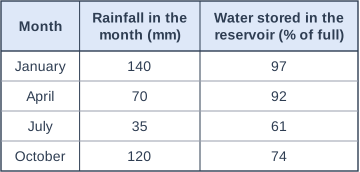
The table shows some of the data for one year.

Describe how the volume of water stored in the reservoir changed between April and July, and use ideas about the water cycle to explain this change.

Use data from the table in your answer.

Table with columns "Month", "Rainfall in the month (mm)", "Water stored in the reservoir (% of full)". Month: January; Rainfall in the month (mm): 140; Water stored in the reservoir (% of full): 97 | Month: April; Rainfall in the month (mm): 70; Water stored in the reservoir (% of full): 92 | Month: July; Rainfall in the month (mm): 35; Water stored in the reservoir (% of full): 61 | Month: October; Rainfall in the month (mm): 120; Water stored in the reservoir (% of full): 74.

Model answer

Between April and July the volume of water stored fell from 92% to 61% of full. There was less rain in July (35 mm) than in April (70 mm), so less water ran off the land into the reservoir. It is also warmer in summer, so more water evaporated from the surface of the reservoir.

Explanation

A good answer first describes the change using the numbers in the table, then explains it with stages of the water cycle. The reservoir gains water from precipitation that runs into it and loses water by evaporation, which is faster in warm, sunny weather. Reservoirs store the fresh water that the water cycle provides for people and for wildlife.

Mark scheme
  1. 1 mark

    the volume of water stored fell / the reservoir became less full (from 92% to 61% of full)

    Max 2 if the change in the volume stored is not described or no data from the table are used. Any three from points 1 to 4, max 3. ALLOW the water level dropped (by 31 percentage points / by about a third). The data may be given in this point or in point 2.

  2. 1 mark

    there was less rain / precipitation (70 mm in April, 35 mm in July), so less water ran off the land / flowed into the reservoir

    ALLOW less rain, so less water entered the reservoir (from streams / rivers / the ground). IGNORE less rain on its own (without the idea of less water flowing in).

  3. 1 mark

    in summer it is warmer, so more water evaporated from the (surface of the) reservoir

    ALLOW more evaporation (from the reservoir) in the summer / in warmer or sunnier weather. DO NOT ALLOW more condensation.

  4. 1 mark

    plants (on the land around the reservoir) take up more water and transpire more in summer, so less water flows into the reservoir

    ALLOW more transpiration in summer so less water reaches the reservoir. IGNORE people use more water / more water is taken out for drinking (this is not part of the water cycle).

Ready to try the rest? Every answer you write is marked against the mark scheme, so you can see exactly where the marks are.

Study Helper Hints first, answers after you try

Stuck on this one? Ask for a hint and I’ll point you in the right direction, without giving the answer away. Once you’ve checked your answer, I’ll show you how the marks are awarded.