Level:
Correct: 0
Incorrect: 0
Marks: 0/0
Exam Practice
Course:
Topics:
OCR GCSE Biology (Paper 2) Smart practice A mixed round aimed at your weak spots
Avg
score:
–
Topics
done:
0/28

Health and types of disease

Practise 14 exam-style questions on Health and types of disease for OCR GCSE Biology (Paper 2). Write your answer as you would in the exam and get it marked in seconds against the mark scheme, point by point, with the Study Helper on hand if you get stuck.

  • 14 questions
  • 1–6 marks each
  • Instant marking
  • No sign-up needed
14 questions, marked as you go

Sample questions with model answers

Here are 4 of the questions in this topic, each with a model answer, an explanation of why it earns the marks and the mark scheme an examiner would use.

Question 1

1 mark

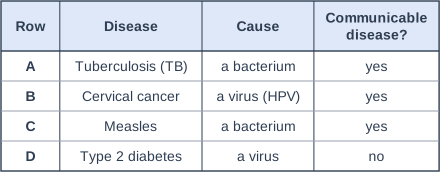
The table shows information about four diseases.

Which row of the table is correct?

Choose your answer.

  • A Row A
  • B Row B
  • C Row C
  • D Row D
Table with columns "Row", "Disease", "Cause", "Communicable disease?". Row: A; Disease: Tuberculosis (TB); Cause: a bacterium; Communicable disease?: yes | Row: B; Disease: Cervical cancer; Cause: a virus (HPV); Communicable disease?: yes | Row: C; Disease: Measles; Cause: a bacterium; Communicable disease?: yes | Row: D; Disease: Type 2 diabetes; Cause: a virus; Communicable disease?: no.

Model answer

A

Explanation

Check every cell of each row. TB is a bacterial disease spread in droplets, so row A is right. Cervical cancer is linked to a virus, but the cancer is non-communicable: the infection can be passed on, the cancer cannot. Measles is caused by a virus, and type 2 diabetes is not caused by any pathogen.

Mark scheme
  1. 1 mark

    A / tuberculosis, a bacterium, yes

    The only correct answer is A: tuberculosis (TB) is caused by a bacterium and can be passed from person to person (in droplets when an infected person coughs or sneezes), so it is a communicable disease. B is not correct because cervical cancer is not communicable: the virus (HPV) can be passed on, but the cancer itself cannot; C is not correct because measles is caused by a virus, not a bacterium; D is not correct because type 2 diabetes is not caused by a pathogen such as a virus (it is linked to factors such as diet, body mass and genes). ALLOW the letter or the option. If more than one option is given, do not award the mark.
Question 2

2 marks

In 2016, scientists combined the results of many studies of adults. They found that people with poor social relationships (people who were lonely or had little contact with others) had about a 29 % higher risk of developing coronary heart disease than other people.

Describe one way that health and disease are linked, using this example.

The scientists said that their results do not prove that poor social relationships cause coronary heart disease. Suggest why.

Model answer

Poor health, such as poor social or mental well-being, can make a person more likely to develop a disease such as coronary heart disease.
The results only show a correlation. Another factor could cause both, for example lonely people may exercise less or smoke more, and this could be what increases the risk of heart disease.

Explanation

Health means physical and mental well-being, not just having no disease, and poor health can raise the risk of disease. A link (correlation) between two things does not show that one causes the other, because a third factor, such as smoking or lack of exercise, might affect both. Saying the study was too small does not work here, because it combined many studies.

Mark scheme
  1. 1 mark

    poor (social or mental) health can make a person more likely to develop a disease, such as coronary heart disease

    Point 1 is for the link. Points 2 and 3 are for why the results are not proof: 1 mark for point 2 or point 3, max 1. If more than one answer is given, a wrong one cancels a right one. ALLOW being lonely / poor well-being increases the risk of a (non-communicable) disease. IGNORE lonely people are unhealthy, unqualified.

  2. 1 mark

    the results show only a link / correlation, and a correlation does not prove that one thing causes the other

    ALLOW it is only an association.

  3. 1 mark

    another factor could be the cause (for example lonely people may smoke more, exercise less or eat less healthily)

    ALLOW a named lifestyle factor that could explain the link. IGNORE they did not study enough people (the study combined many studies).

Question 3

2 marks

Asthma is a non-communicable disease. In a person with asthma, the airways can become narrow and inflamed (swollen), making it hard to breathe.

Flu (influenza) is a communicable disease. The flu virus infects the cells lining the airways and makes the airways inflamed.

People with asthma are more likely to need hospital treatment when they catch flu than people without asthma.

Suggest why.

Model answer

Both asthma and flu make the airways inflamed and narrow. When a person with asthma catches flu, their airways become even narrower, so even less air reaches the alveoli and less oxygen gets into the blood. They may need help in hospital to get enough oxygen.

Explanation

This is an interaction between a non-communicable disease (asthma) and a communicable disease (flu): having asthma makes the effects of flu more serious. Both diseases narrow the airways, so together they can stop enough air reaching the alveoli, where oxygen diffuses into the blood. This is why people with asthma are among the groups most at risk from flu.

Mark scheme
  1. 1 mark

    both diseases make the airways inflamed / narrow, so with flu the airways of a person with asthma become even narrower

    ALLOW flu makes the asthma worse / can trigger an asthma attack. IGNORE asthma makes them more likely to catch flu, unless the answer says flu affects them more seriously.

  2. 1 mark

    so (even) less air reaches the lungs / alveoli, and less oxygen gets into the blood

    ALLOW they cannot breathe in enough air / oxygen, so they may need help to breathe. IGNORE it is harder to breathe on its own (given in the question).

Question 4

4 marks

HIV is a virus that infects and destroys one type of white blood cell. Without treatment, the number of these white blood cells in the blood falls over several years.

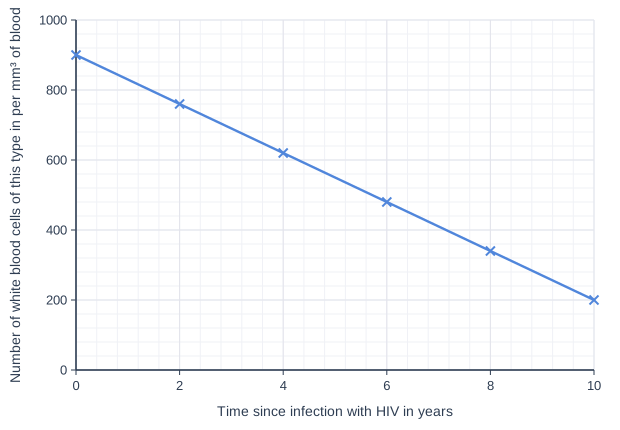
The graph shows how the number of these white blood cells typically changes in a person with HIV who is not treated.

Use the graph to find the number of these white blood cells 5 years after infection.

Describe how the number of these white blood cells changes over the 10 years. Use data from the graph.

Explain why the person becomes more likely to develop tuberculosis (TB) as the number of these white blood cells falls.

Line graph of number of white blood cells of this type in per mm³ of blood (y-axis, 0 to 1000) against Time since infection with HIV in years (x-axis, 0 to 10). The line joins the points (0, 900), (2, 760), (4, 620), (6, 480), (8, 340), (10, 200).

Model answer

After 5 years the number is about 550 per mm³ of blood.
The number decreases steadily, from 900 per mm³ at the start to 200 per mm³ after 10 years, a fall of about 70 per mm³ each year.
White blood cells destroy pathogens such as TB bacteria. As HIV destroys these white blood cells, there are fewer to fight the TB bacteria, so the bacteria are not destroyed and can multiply and cause TB.

Explanation

To read a value between two plotted points, go up from 5 years to the line and across to the y-axis: the line passes halfway between 620 and 480, at about 550. When describing a trend, give the direction and quote the start and end values. HIV does not cause TB; it destroys white blood cells, so a person infected with TB bacteria is much less able to fight them.

Mark scheme
  1. 1 mark

    550 (per mm³ of blood)

    ALLOW any value from 540 to 560. IGNORE units.

  2. 1 mark

    the number decreases (steadily) from 900 to 200 (per mm³) over the 10 years

    The answer must use data from the graph. ALLOW it falls by 700 / by about 70 each year. IGNORE decreases, with no data.

  3. 1 mark

    white blood cells (help to) destroy pathogens such as TB bacteria

    ALLOW white blood cells engulf pathogens / make antibodies against pathogens.

  4. 1 mark

    with fewer white blood cells, the TB bacteria are not destroyed, so they can multiply and cause TB

    ALLOW the immune system is too weak to fight off TB bacteria. DO NOT ALLOW HIV causes TB / HIV turns into TB.

Ready to try the rest? Every answer you write is marked against the mark scheme, so you can see exactly where the marks are.

Study Helper Hints first, answers after you try

Stuck on this one? Ask for a hint and I’ll point you in the right direction, without giving the answer away. Once you’ve checked your answer, I’ll show you how the marks are awarded.