
Level:
Correct: 0
Incorrect: 0
Marks: 0/0
Exam Practice
Course:
Topics:
OCR GCSE Biology (Paper 2) Smart practice A mixed round aimed at your weak spots
Avg
score:
–
Topics
done:
0/28

Factors affecting the rate of decomposition

Practise 12 exam-style questions on Factors affecting the rate of decomposition for OCR GCSE Biology (Paper 2). Write your answer as you would in the exam and get it marked in seconds against the mark scheme, point by point, with the Study Helper on hand if you get stuck.

  • 12 questions
  • 1–4 marks each
  • Instant marking
  • No sign-up needed
12 questions, marked as you go

Sample questions with model answers

Here are 4 of the questions in this topic, each with a model answer, an explanation of why it earns the marks and the mark scheme an examiner would use.

Question 1

1 mark

Museums keep collections of pressed, dried plants called herbaria. Some of the dried plants in UK herbaria were collected more than 200 years ago, but they have not decomposed.

Which statement explains why the dried plants have not decomposed?

Choose your answer.

  • A Drying removes all the oxygen from the cells of the plants.
  • B Pressing makes the plants too hard for any enzyme to digest.
  • C The plants were already dead, so they cannot be decomposed.
  • D Without water, decomposers cannot grow or digest the plants.

Model answer

D

Explanation

Water content is one of the factors that affects the rate of decomposition. Decomposers need water to grow, and their enzymes need water to digest dead material, so drying stops decomposition almost completely. Option C is a common misunderstanding: decomposers only ever feed on dead material.

Mark scheme
  1. 1 mark

    D / Without water, decomposers cannot grow or digest the plants.

    The only correct answer is D: bacteria and fungi need water to grow and reproduce, and their enzymes need water to digest dead material, so dry plant material is not decomposed. A is not correct because drying removes water, not oxygen, and the dried plants are surrounded by air; B is not correct because pressing flattens the plants but does not stop enzymes digesting them: pressed plants that become damp can still go mouldy; C is not correct because decomposers feed on dead material, so being dead does not protect the plants. ALLOW the letter or the option. If more than one option is given, do not award the mark.
Question 2

2 marks

A gardener's compost heap is in a cold, shady corner of the garden. The material in the heap is very dry. After six months, it has hardly decomposed.

Use the information to suggest two changes the gardener could make so that the material in the heap decomposes faster.

Model answer

1. Move the heap to a sunny, warmer place, or cover it with a lid, so that it is warmer and the decomposers' enzymes work faster.
2. Add water to make the material damp, because decomposers need water to grow and to digest the material.

Explanation

Use the clues in the question: the heap is cold and dry. Decomposers work faster when it is warm, because their enzymes work faster, and they need water to grow and to digest dead material. Turning the heap to add air also helps decomposition, but it does not deal with the problems described.

Mark scheme
  1. 1 mark

    make the heap warmer (for example by moving it to a sunny place or covering it with a lid or insulation)

    1 mark for each of points 1 and 2, max 2. If more than two answers are given, a wrong one cancels a right one. ALLOW put the heap in a greenhouse / somewhere it is not shaded. IGNORE changes that do not deal with the cold or the dryness, such as turning the heap or chopping up the material.

  2. 1 mark

    add water / make the material moist (damp)

    ALLOW water the heap (regularly) / add wet material such as fresh grass cuttings or vegetable waste. DO NOT ALLOW soak the heap until it is waterlogged / full of water.

Question 3

2 marks

Many councils collect food waste and garden waste and decompose it in large, closed containers called in-vessel composters.

In one container, the mass of the waste decreased by 0.84 tonnes in 6 days.

1 tonne = 1000 kg

Calculate the mean rate of decomposition in kg per day.

Model answer

0.84 tonnes = 0.84 × 1000 = 840 kg
rate = 840 ÷ 6 = 140 kg per day

Explanation

Rate of decomposition = mass lost ÷ time taken. Convert the mass to kilograms first (multiply by 1000), then divide by the number of days. An answer of 0.14 is the rate in tonnes per day: the method is right, but the unit asked for is kg per day.

Mark scheme
  1. 1 mark

    0.84 tonnes = 840 kg / 840 ÷ 6; or a correct final answer of 140 kg per day with no working

    An answer of 140 kg per day with no working scores 2 marks. ALLOW 0.14 (tonnes per day: the mass not converted to kg) for 1 mark. 5.04 or 5040 (multiplying by the time instead of dividing) scores 0.

  2. 1 mark

    140 (kg per day)

    IGNORE units.

Question 4

3 marks

A student investigated the effect of temperature on the decomposition of vegetable peelings.
• She mixed 100 g of chopped vegetable peelings with a handful of garden soil in each of nine plastic tubs.
• Each tub had a lid with small air holes.
• She kept three tubs at 10 °C, three at 20 °C and three at 30 °C.
• After 3 weeks she found the mass lost from each tub.

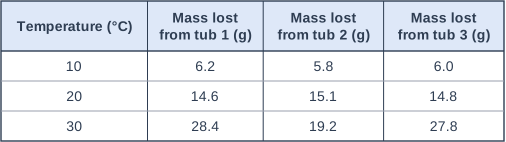
The table shows her results.

Identify the anomalous result. Calculate the mean mass lost at 30 °C, leaving out the anomalous result.

The student concluded: '30 °C is the best temperature for decomposing vegetable peelings.'

Give one reason why her results do not support this conclusion.

Table with columns "Temperature (°C)", "Mass lost from tub 1 (g)", "Mass lost from tub 2 (g)", "Mass lost from tub 3 (g)". Temperature (°C): 10; Mass lost from tub 1 (g): 6.2; Mass lost from tub 2 (g): 5.8; Mass lost from tub 3 (g): 6.0 | Temperature (°C): 20; Mass lost from tub 1 (g): 14.6; Mass lost from tub 2 (g): 15.1; Mass lost from tub 3 (g): 14.8 | Temperature (°C): 30; Mass lost from tub 1 (g): 28.4; Mass lost from tub 2 (g): 19.2; Mass lost from tub 3 (g): 27.8.

Model answer

The anomalous result is 19.2 g (tub 2 at 30 °C).
Mean at 30 °C = (28.4 + 27.8) ÷ 2 = 28.1 g
She did not test any temperature above 30 °C, so decomposition might be even faster at a higher temperature such as 35 °C or 40 °C. 30 °C is only the best of the three temperatures she tested.

Explanation

An anomalous result does not fit the pattern of the repeats: 19.2 g is far from 28.4 g and 27.8 g, so leave it out and find the mean of the other two. A conclusion can only cover the range that was tested: to find the best temperature, she would need to test temperatures above 30 °C to see where the mass lost stops increasing.

Mark scheme
  1. 1 mark

    anomalous result: 19.2 (g) (tub 2 at 30 °C)

    An answer of 28.1 g for the mean with no working scores marking point 2 only. ALLOW marking point 1 if the working shows the anomalous result left out, for example (28.4 + 27.8) ÷ 2. For marking point 3 (one reason): If more than one answer is given, a wrong one cancels a right one.

  2. 1 mark

    mean = (28.4 + 27.8) ÷ 2 = 28.1 (g); or a correct final answer of 28.1 g with no working

    25.1 (25.13, the mean including the anomalous result) scores 0. IGNORE units.

  3. 1 mark

    she did not test any temperature above 30 °C, so decomposition might be even faster at a higher temperature / the best temperature might be above 30 °C

    If more than one reason is given, a wrong one cancels a right one. ALLOW she only tested three temperatures, so she cannot find the best temperature / the gaps between her temperatures are too large. ALLOW 30 °C is only the best of the temperatures she tested. DO NOT ALLOW she should repeat the investigation (she used three tubs at each temperature). IGNORE she should use other types of vegetable peelings / soil.

Ready to try the rest? Every answer you write is marked against the mark scheme, so you can see exactly where the marks are.

Study Helper Hints first, answers after you try

Stuck on this one? Ask for a hint and I’ll point you in the right direction, without giving the answer away. Once you’ve checked your answer, I’ll show you how the marks are awarded.