Level:
Correct: 0
Incorrect: 0
Marks: 0/0
Exam Practice
Course:
Topics:
OCR GCSE Biology (Paper 2) Smart practice A mixed round aimed at your weak spots
Avg
score:
–
Topics
done:
0/28

Levels of organisation, abiotic and biotic factors

Practise 17 exam-style questions on Levels of organisation, abiotic and biotic factors for OCR GCSE Biology (Paper 2). Write your answer as you would in the exam and get it marked in seconds against the mark scheme, point by point, with the Study Helper on hand if you get stuck.

  • 17 questions
  • 1–6 marks each
  • Instant marking
  • No sign-up needed
17 questions, marked as you go

Sample questions with model answers

Here are 4 of the questions in this topic, each with a model answer, an explanation of why it earns the marks and the mark scheme an examiner would use.

Question 1

1 mark

The pH of the soil affects which plants can grow in a community.

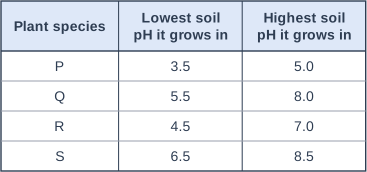
The table shows the range of soil pH in which four species of plant, P, Q, R and S, can grow.

A gardener has two flower beds. The soil in one bed has a pH of 5.0. The soil in the other bed has a pH of 6.5.

Which plant species could grow in BOTH beds?

Choose your answer.

  • A species P
  • B species Q
  • C species R
  • D species S
Table with columns "Plant species", "Lowest soil pH it grows in", "Highest soil pH it grows in". Plant species: P; Lowest soil pH it grows in: 3.5; Highest soil pH it grows in: 5.0 | Plant species: Q; Lowest soil pH it grows in: 5.5; Highest soil pH it grows in: 8.0 | Plant species: R; Lowest soil pH it grows in: 4.5; Highest soil pH it grows in: 7.0 | Plant species: S; Lowest soil pH it grows in: 6.5; Highest soil pH it grows in: 8.5.

Model answer

C - species R

Explanation

Check each species against BOTH pH values: the lowest pH it grows in must be 5.0 or less, and the highest must be 6.5 or more. Only species R (pH 4.5 to 7.0) passes both checks. This is why the plant community on acid soil can be very different from the community on neutral or alkaline soil.

Mark scheme
  1. 1 mark

    C / species R

    The only correct answer is C: species R grows from pH 4.5 to pH 7.0, which includes both pH 5.0 and pH 6.5. A is not correct because species P grows only up to pH 5.0, so it could not grow at pH 6.5; B is not correct because species Q needs a pH of at least 5.5, so it could not grow at pH 5.0; D is not correct because species S needs a pH of at least 6.5, so it could not grow at pH 5.0. ALLOW the letter or the option. If more than one option is given, do not award the mark.
Question 2

2 marks

A student wrote this sentence:

'All the oak trees in Sherwood Forest are a community.'

Explain why the student is wrong.

Model answer

All the oak trees are one species, so they are a population, not a community. A community is all the populations of the different species living in the forest, such as the oak trees, birch trees, deer, birds, insects and fungi.

Explanation

A population is all the individuals of ONE species in an area; a community is all the populations of ALL the species living there. Adding the abiotic factors, such as soil, water and temperature, gives the ecosystem. Confusing population and community is one of the most common errors with these terms.

Mark scheme
  1. 1 mark

    the oak trees are a population: all the organisms of one species (in the area)

    ALLOW they are one species so they are a population. The idea of one species must be given for this mark. IGNORE they are a group of trees (on its own).

  2. 1 mark

    a community is all the populations of different species (plants, animals and microorganisms) living in the area

    ALLOW a community includes the other organisms in the forest as well, such as birds, insects and fungi. DO NOT ALLOW a community includes the abiotic / non-living factors (this describes an ecosystem).

Question 3

2 marks

A gardener finds many slugs eating her lettuces on damp evenings, but very few slugs on dry, sunny afternoons.

Slugs have a soft, moist skin with no waterproof covering.

Suggest why slugs come out to feed when conditions are damp.

Model answer

Slugs lose water easily by evaporation through their moist skin, because it has no waterproof covering. In damp conditions less water evaporates from them, so they can feed without drying out. On dry, sunny afternoons they would lose so much water that they could dry out and die.

Explanation

Moisture level is an abiotic factor that affects where and when animals can be active. Animals with moist skin, such as slugs, worms and frogs, lose water quickly in dry air. They are active when it is damp and shelter in moist places when it is dry.

Mark scheme
  1. 1 mark

    slugs lose water easily (by evaporation) through their (moist) skin

    ALLOW water evaporates from their skin / they have no waterproof layer to stop water loss. IGNORE slugs need water (on its own).

  2. 1 mark

    in damp (or cool) conditions less water evaporates from them, so they do not dry out / dehydrate and die

    ORA (allow the reverse argument): in dry, sunny conditions they would dry out (and die). ALLOW the high moisture level / humidity reduces water loss. IGNORE slugs like the damp.

Question 4

3 marks

Arctic charr are fish that live in deep, cold lakes in the Lake District, Wales and Scotland. They need water that contains a lot of dissolved oxygen.

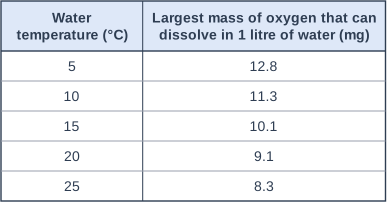
The table shows the largest mass of oxygen that can dissolve in 1 litre of fresh water at different temperatures. The values are rounded.

Describe the relationship shown in the table.

Use ideas about respiration to suggest why a rise in the temperature of the water in these lakes could reduce the number of Arctic charr.

Table with columns "Water temperature (°C)", "Largest mass of oxygen that can dissolve in 1 litre of water (mg)". Water temperature (°C): 5; Largest mass of oxygen that can dissolve in 1 litre of water (mg): 12.8 | Water temperature (°C): 10; Largest mass of oxygen that can dissolve in 1 litre of water (mg): 11.3 | Water temperature (°C): 15; Largest mass of oxygen that can dissolve in 1 litre of water (mg): 10.1 | Water temperature (°C): 20; Largest mass of oxygen that can dissolve in 1 litre of water (mg): 9.1 | Water temperature (°C): 25; Largest mass of oxygen that can dissolve in 1 litre of water (mg): 8.3.

Model answer

As the water temperature increases, less oxygen can dissolve in the water: 12.8 mg in 1 litre at 5 °C but only 8.3 mg at 25 °C.
The charr need oxygen for aerobic respiration in their cells, which releases the energy they need. If the lakes get warmer, the water holds less oxygen, so the charr cannot respire enough to release the energy they need to swim, grow and breed. Fewer charr survive and breed, so their number falls.

Explanation

Temperature is an abiotic factor, and it also changes another abiotic factor: the amount of dissolved oxygen. Fish take in dissolved oxygen through their gills and use it in aerobic respiration, which releases energy. Species such as Arctic charr that need cold water with a lot of oxygen are among the first to suffer when lakes become warmer.

Mark scheme
  1. 1 mark

    as the temperature increases, the mass of oxygen that can dissolve decreases

    1 mark for each of points 1 to 3. ALLOW negative correlation / warmer water holds less oxygen. ALLOW use of data (for example 12.8 mg at 5 °C and 8.3 mg at 25 °C). ORA (allow the reverse argument).

  2. 1 mark

    the charr need oxygen for (aerobic) respiration (in their cells) to release energy

    ALLOW the charr use oxygen to respire. IGNORE the charr need oxygen to breathe (on its own, without respiration). DO NOT ALLOW respiration makes energy.

  3. 1 mark

    warmer water contains less oxygen, so the charr cannot respire (aerobically) enough / cannot release enough energy (to swim, grow or breed), so fewer survive or breed

    The idea of less oxygen leading to less respiration (or less energy released) is needed. ALLOW so some charr die / move away / have fewer young.

Ready to try the rest? Every answer you write is marked against the mark scheme, so you can see exactly where the marks are.

Study Helper Hints first, answers after you try

Stuck on this one? Ask for a hint and I’ll point you in the right direction, without giving the answer away. Once you’ve checked your answer, I’ll show you how the marks are awarded.